Get Full Government Meeting Transcripts, Videos, & Alerts Forever!
Get email alerts on the Housing And Community Development topic
No spam. Unsubscribe anytime.
Miami holds public hearing on FY2025 annual action plan as HUD allocations decline
Summary
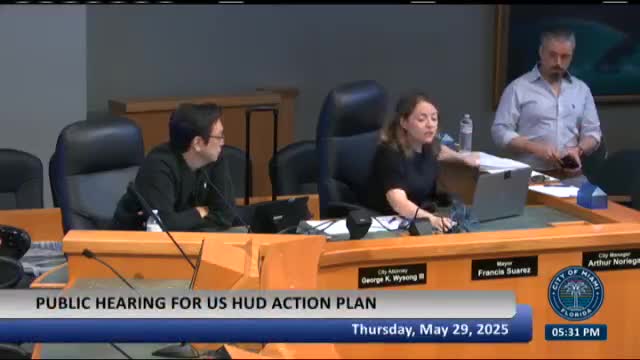
City of Miami staff held a public hearing on May 29 to solicit resident input on the fiscal year 2025 annual action plan, the document the city submits to HUD that directs federal CDBG, HOME, HOPWA and ESG funding for 10/01/2025–09/30/2026.
City of Miami staff held a public hearing on May 29 to solicit resident input on the fiscal year 2025 annual action plan, the document the city submits to the U.S. Department of Housing and Urban Development that directs federal CDBG, HOME, HOPWA and ESG funding for 10/01/2025–09/30/2026.
Roberto Tassoy, assistant director of the Department of Housing and Community Development, told attendees the draft plan will be submitted to HUD in mid‑August and repeated the invitation for public feedback: "This plan determines how we'll be using next year's federal funding to support housing, community development, and public services." He framed the plan as both the city's strategic roadmap and its formal application for federal formula grants.
The department briefed residents on program allocations and constraints. The City of Miami's HUD formula allocations announced for FY2025 in the presentation were: Community Development Block Grant (CDBG) $5,026,283 (about $64,000 less than the prior year); HOME Investment Partnerships Program (HOME) $2,919,009.51 (down $68,002.26); Housing Opportunities for Persons with AIDS (HOPWA) $13,889,565 (down about $383,000); and Emergency Solutions Grant (ESG) $447,390 (down $22,647). Staff noted CDBG has a federal cap limiting public service uses to no more than 15% of the allocation.
Department staff also described how the city supplements federal dollars with a local Social Service Gap general fund account. For the current period the department said the city allocated $487,000 from that account to support social service providers that serve elderly residents and other vulnerable groups.
Presentations summarized recent accomplishments funded in whole or in part with HUD and local funds: staff displayed an investment total of approximately $7,000,000 tied to projects projected to create roughly 3,600 affordable housing units; childcare/youth services reaching about 762 people; elderly meal services to 247 individuals; assistance to six people with disabilities for work‑related supports; 13 households helped through a Down Payment Assistance program; nine rehabilitated single‑family units; HOPWA housing assistance reaching 736 households; another program described in the meeting as a "section a program" assisting 377 households (name as stated in the meeting); and an ESG‑funded rapid rehousing program that helped 93 families.
Staff explained HOME funding strategies, including the statutory 15% set‑aside for community housing development organizations (CHDOs). They also described an open pipeline RFP for nonprofit housing developers; attendees were directed to miami.gov/communitydevelopment and given the contact name Alberto Castellon for RFP questions.
Public commenters raised operational and service priorities. Luizana Salazar Martinez, who identified herself as representing Assistance to the Elderly, urged the city to streamline compliance for projects that combine county and city funds, saying the multiple, duplicative paperwork requirements cause delays and higher costs: "It's cumbersome. It's extremely complicated."
Miriam (representing Aldepeda Community Action, Inc.) warned of rising demand among low‑income seniors and expressed concern about the long‑term decline in CDBG funding, urging continued city matching and support for social services.
Dr. Haines, executive director of Haines Harbor Group, asked what programs the city can use to support youth who age out of foster care and become homeless. Staff replied that the city's direct homeless prevention resources are primarily ESG rapid rehousing and that people experiencing homelessness should seek services through the Continuum of Care; staff encouraged nonprofit developers to apply to the HOME pipeline RFP for housing development funds.
CEO Financial Literacy Academy Executive Director Brandon Williams suggested prioritizing financial education, workforce readiness and reentry programs as complements to housing investments.
No formal votes or ordinance actions occurred at the hearing. Staff said the draft action plan will be released for a 30‑day public comment period consistent with the citizen participation plan and that another public hearing will be held on Tuesday, June 3 at 5:30 p.m. at Charles Hadley Park Black Box Theatre, 1350 NW 50th Street, with online comment available at www.miamigov.com/hcdvph.
The public hearing is part of the consolidated planning process governed by 24 CFR part 91 that determines how HUD formula funds will be allocated and administered in the coming program year.