Get Full Government Meeting Transcripts, Videos, & Alerts Forever!
Get email alerts on the Budget topic
No spam. Unsubscribe anytime.
Carmel-by-the-Sea adopts $34.9M budget and $45M appropriations limit, sets capital priorities
Summary
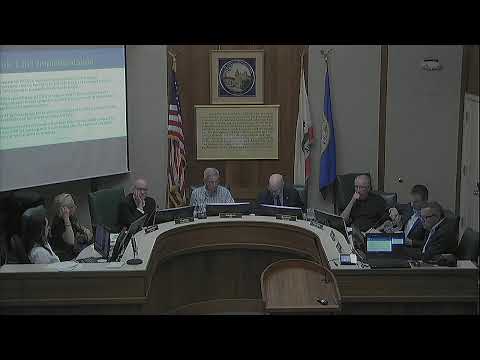
The City Council on June 3 approved the fiscal year 2025–26 operating and capital budget and adopted the annual appropriations (Gann) limit. Council discussed a long list of capital projects, directed tighter quarterly reporting and additional project management resources, and approved the budget 5-0.
CARMEL-BY-THE-SEA, Calif. — The Carmel-by-the-Sea City Council on June 3 adopted a $34.9 million budget for fiscal year 2025–26 and a $45,000,081,158 appropriations limit, approving new capital spending while directing staff to tighten oversight and report back regularly.
The council adopted the annual appropriations limit (the “Gann limit”) first and then approved the operating and capital budget in a separate vote. The budget passed on a 5-0 roll call; all council members present voted yes.
City staff said the adopted budget relies on $4.9 million of fund balance to cover proposed capital projects and uses projected revenues of $34.9 million. Operating expenditures total about $31.9 million (roughly 91.6% of projected revenue), while capital projects in year 1 total $7.8 million; combined with an estimated $3.9 million in carryovers, the city could spend as much as $11.4 million on capital this year.
Finance staff summarized the revenue mix that underpins the plan: sales tax, property tax and transient-occupancy tax together supply about 82% of general-fund revenue. Salaries and benefits are the single-largest operating expense (about 38% of the budget), while outside services — dominated by fire and ambulance contracts — account for another 27%.
Council members and staff spent the bulk of their discussion on capital spending and delivery capacity. Staff presented a prioritized capital-improvement program (CIP) and a separate “menu” of projects that could be deferred. The year’s largest single capital allocations on the adopted list include forest and beach work (roughly $2.4 million this year), city facilities (about $1.7 million) and streets (budgeted at $1.1 million this year but with carryovers making it the largest multi‑year item at about $3.8 million).
During debate, council asked staff to: provide quarterly budget-to-actual reports, accelerate hiring of a second project manager (or use consultants where needed), and produce a clearer dashboard showing project status, spend-to-date and carryovers. Staff told the council they will return in midyear with refined delivery forecasts and, if necessary, contract awards for projects that exceed staff signing authority.
Council members emphasized the tradeoffs between deferring work and higher future costs. Several members said they preferred to leave many projects in the adopted CIP while improving project management and reporting rather than cutting items immediately. Staff said the most likely near-term funding pressure would be if multi-year infrastructure needs (estimated in a broad range of $33–$60 million across all facilities) are pushed into the near term.
Votes at a glance - Resolution 2025-05-53: Adopt fiscal year 2025–26 appropriations limit (Gann limit) of $45,000,081,158. Motion made from the dais; roll-call vote: Barron—Yes, Bueter—Yes, Delves—Yes, Jermoff—Yes, Byrne—Yes. Outcome: Approved. - Resolution 2025-05-52: Adopt fiscal year 2025–26 operating and capital budget. Motion and second recorded on the floor; roll-call vote: Barron—Yes, Bueter—Yes, Delves—Yes, Jermoff—Yes, Byrne—Yes. Outcome: Approved.
Context and next steps Council directed staff to: tighten monthly monitoring, present a midyear review with realistic carryover assumptions, accelerate procurement where feasible and return with a clearer five‑year CIP schedule. Staff also committed to producing a public-facing dashboard that tracks each capital project’s phase, expenditures and remaining scope.
While the council adopted the budget as proposed, members reiterated that the city must find recurring revenue or reduce operating costs to sustain multi-year capital needs without rapidly drawing down the city’s reserves.