Get Full Government Meeting Transcripts, Videos, & Alerts Forever!
Get email alerts on the School Discipline Attendance topic
No spam. Unsubscribe anytime.
Highlands County schools report fewer office discipline referrals, steady gains on chronic absenteeism
Summary
District staff reported progress on behavior supports and attendance at the May school board meeting, citing new MTSS behavioral tiers, tools for schools and an attendance "nudge" system. Board heard data showing lower office-discipline referrals in elementary schools and higher shares of students attending at least 90% of enrolled days.
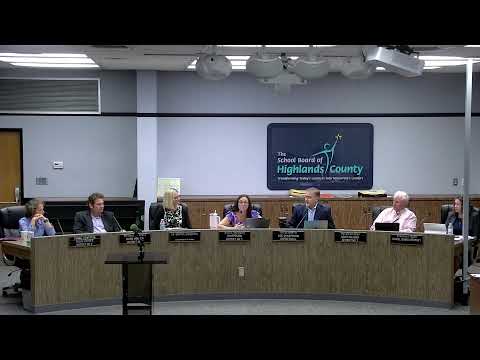
Miss Blackman, the district goal lead for "Goal 2: Whole Child," presented the Highlands County School District's third-nine-weeks review on May 20, outlining behavioral-support strategies and steps to reduce chronic absenteeism.
Blackman told the School Board that the district has implemented a tiered approach within a multi-tiered system of supports (MTSS) for behavior: schoolwide (tier 1), targeted interventions such as check-in/check-out and skill streaming (tier 2), and intensive functional behavior assessment-based plans (tier 3). She said staff built a Power BI dashboard to help schools monitor discipline and attendance data and that district school psychologists and, when necessary, behavior analysts provide support.
The presentation included specific benchmarks the district uses for a "healthy core": roughly 80% of students responding to classroom rules, 5% to 15% needing more support and 1% to 5% requiring intensive services. Blackman said those percentages are drawn from national PBIS guidance and are being used locally to evaluate schoolwide discipline systems.
The district reported measurable changes in elementary discipline: office-discipline referrals per 100 students declined from 49 at the end of the 2023-24 school year to 28 per 100 at the end of the third nine weeks this year, Blackman said. In secondary schools, she said the number of students receiving referrals and referrals per 100 declined as well; she noted that cellphone-related referrals remain the single largest offense category in secondary buildings.
Blackman also reviewed chronic absenteeism, defined in district materials as missing more than 10% of enrolled days. Using the metric of students attending at least 90% of enrolled days, she said the district's share rose overall to 73% at the end of the third nine weeks, up from earlier years (65% in 2021-22 and 70% in 2022-23). She reported that elementary schools reached 77% of students attending at least 90% of enrolled days in March, while secondary campuses were at about 69% in March.
Blackman described the district's attendance work as a mix of prevention and problem solving. Early interventions include automated reminders to families and a "nudge" campaign District MIS pushes on Sunday evenings to remind parents about attendance and how small absences accumulate. For students approaching the chronic-absence threshold, she said school social workers are running small groups and making referrals to community providers when family needs are a barrier to attendance.
Board members asked about differences across schools. Board member Martin asked whether campuses with the biggest improvement had replicable practices; Blackman said principals reported the most success when families were engaged and when schools shared best practices in administrators' meetings. Blackman and other staff said a planned community of practice for social workers and school teams will create a venue to share strategies.
Nut graf: The district told the board it has invested in training and data tools to bring MTSS behavioral supports to scale, and early outcomes show lower disciplinary referral rates at the elementary level and modest improvements in attendance districtwide, but staff warned more work is needed at tier 2 and tier 3 levels.
The presentation also laid out near-term next steps: expanding tiered attendance interventions, continuing training for administrators and school-based teams, and using the due-diligence data from the Power BI dashboard to direct resources to schools with the greatest need.
Board members praised the work but cautioned about capacity. Superintendent Dr. Longshore thanked staff and administrators and said the board would follow the recommended next steps; no formal vote was required on the report.
Ending: Blackman said the district will continue to bring updated data to the board after each stop date and will present fall community-of-practice plans to the board before the next school year.