Get Full Government Meeting Transcripts, Videos, & Alerts Forever!
Get email alerts on the Fiscal Impact Actuary Procedures topic
No spam. Unsubscribe anytime.
Senate committee adopts procedures for outside health‑benefits actuary, requires fiscal impact statements before committee action
Summary
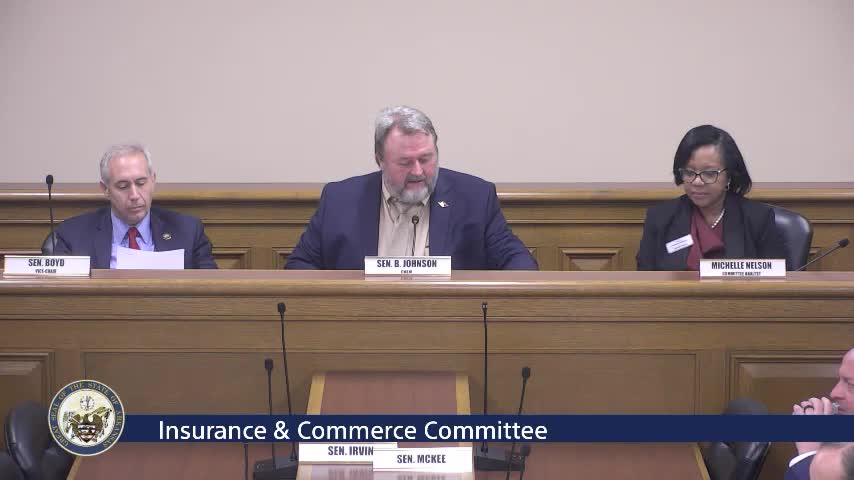
The Senate Insurance & Commerce Committee adopted procedures for use of a contracted health‑benefits actuary and moved that bills which may increase costs to the state and public school life and health insurance program must carry a fiscal impact statement before committee consideration.
The Senate Insurance & Commerce Committee on an affirmative voice vote adopted procedures for use of a contracted health‑benefits actuary and clarified how fiscal impact statements will be produced and tracked.
Jill Thayer, Bureau of Legislative Research, told the committee that Segal was hired under contract and has begun identifying bills that may require fiscal impact statements under the joint rules. “Segal was hired by legislative counsel, last year. We have them under contract,” Thayer said, adding that the firm began tracking prefiled bills on Nov. 20 and had identified about 27 bills that may require statements.
Thayer said Segal will provide a data request to the Employee Benefits Division (EBD) this week and expects to complete fiscal impact statements within about three weeks after receiving EBD data, releasing smaller statements as they become ready. She noted a provision of the joint rules requiring that “a bill cannot be taken up in committee until it has that fiscal impact statement with it.”
Committee members asked about conflict‑of‑interest checks for the contracted actuary. Senator Boyden asked whether ongoing conflicts can be vetted and whether the vendor could have relationships that affect analysis. Thayer said conflicts were checked during the procurement process and none were disclosed; she added that the executive subcommittee of Legislative Council could request a conflicts check during the session.
After the presentation and brief questions, Senator Boyd moved to adopt the procedures; the motion was seconded by Senator Mark Johnson and adopted on a voice vote. The committee recorded the motion as: “Motion to adopt [procedures for use of the health benefits actuary],” moved by Senator Boyd, seconded by Senator Mark Johnson; outcome: approved by voice vote.
Thayer said staff will notify bill sponsors whose measures were flagged and that the committee will be kept apprised of statement status through EBD. She also asked the committee whether Segal should appear in person to present statements; under the adopted procedure a special order could be set to limit out‑of‑state travel reimbursement if the actuary attends in person.
The procedures affect bills that may impose new or increased costs on the state and the public school life and health insurance program administered by EBD; Thayer told members most flagged bills are before the insurance and commerce committees, with a few in public health committees.
The committee did not change the existing contract arrangement during the meeting; Thayer said Segal’s prior procurement included disclosure of conflicts and that the executive subcommittee can request further checks if desired.
The committee chair said staff will continue to circulate agendas showing which bills are pending fiscal impact statements and to notify members and sponsors as statements are completed.