Get Full Government Meeting Transcripts, Videos, & Alerts Forever!
Get email alerts on the Education Choice topic
No spam. Unsubscribe anytime.
Senate committee advances Wyoming Freedom Scholarship bill after heated debate and multiple amendments
Summary
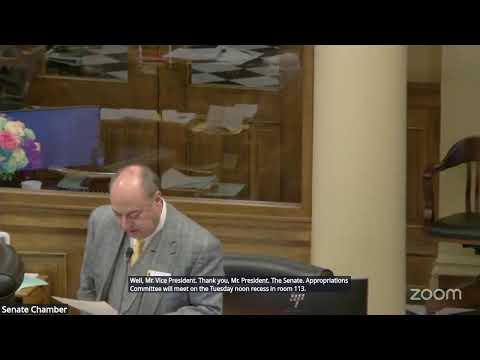
The Wyoming Senate Committee of the Whole on Feb. 14 considered House Bill 199, which would convert and expand the state's education savings account program into the Wyoming Freedom Scholarship Act; after sustained debate and several amendments the committee reported the bill favorably to the Senate.
The Wyoming Senate Committee of the Whole on Feb. 14 considered House Bill 199, the Wyoming Freedom Scholarship Act, and ultimately reported the bill favorably to the Senate after intense floor debate and several amendments.
House Bill 199 would convert and amend Wyoming's education savings account program into a scholarship account program. Key changes discussed on the floor included a shift in the funding mechanism from the general fund to a portion of mineral royalty funds (as drafted in the bill), an increase in the maximum per‑student allotment to $7,000 (the sponsor said the figure reflects average private school tuition), and a $30 million appropriation identified in the bill language. The bill also renames and restructures program certification, eligible expenses and testing requirements.
"This is House Bill 199, the Wyoming Freedom Scholarship Act," Senator Brennan said in opening remarks on the bill. He walked senators through changes to statute 9‑4‑601, discussed the funding switch, and described how the accounts are administered and the $7,000 figure.
Amendments and accountability
Senators spent substantial floor time on multiple amendments addressing accountability, funding sources and eligibility limits. A standing committee amendment reinstated testing and assessment requirements for scholarship recipients: students receiving scholarship funds must take the statewide assessment or a nationally normed achievement exam, Senator Olson said while explaining the committee's changes.
The committee considered several funding approaches. One amendment moved the program toward an income‑based, means‑tested model that set tiered amounts based on household income measured against the federal poverty level (for example, $6,000 for households at or below 150% of FPL, $4,800 for 150–200% and $3,600 for 200–250%), while barring deposits for households above 250% of FPL. Proponents said the tiered approach might reduce constitutional risk cited by several senators; opponents said means testing undermines universality and fairness.
Other amendments adjusted the program's funding source to avoid drawing from the School Foundation Fund or Federal Mineral Royalty (FMR) allocations, with proponents arguing such steps limit legal exposure under state constitutional provisions cited in debate. Senators raised multiple Wyoming Constitution provisions during debate, including Article 3 Section 36 and Article 7 Section 8, which were cited in opposing legal interpretations about whether public funds may be used to support private education.
Votes and outcomes recorded in the transcript
- Standing Committee Amendment No. 1 (added accountability/testing and other changes) — passed, 16 ayes, 10 noes. - Standing Committee Amendment No. 2 (funding mechanism moved to general fund to reduce constitutional risk) — passed (voice vote; chair recorded as passing). - Committee of the Whole Amendment No. 1 (reintroduced an income‑based tier to address constitutional concerns) — passed, 15 ayes, 14 noes. - Committee of the Whole Amendment No. 2 (attempt to adopt a one‑year tiered means test then universal thereafter) — failed (standing count recorded as 14 ayes, 15 noes).
After the amendments, senators voted to report House Bill 199 favorably from the Committee of the Whole (voice vote recorded in the transcript). The transcript does not record a subsequent roll‑call passage on the Senate floor that day.
What the bill would do if enacted
- Rename and expand Wyoming's education savings accounts into a state scholarship program (several names were proposed, including "Wyoming Freedom Scholarship Act" and an amendment that would have renamed it the "Steamboat Legacy Scholarship Act"). - Change the funding mechanism in draft language (debated options included mineral royalty allocations, general fund appropriations and hybrid options); the bill text included a $30 million figure for the program. - Set a maximum account amount of $7,000 per eligible student (sponsor's figure tied to private tuition averages), and list qualifying expenses and administrative rules managed by the state superintendent. - Require accountability tests — either statewide assessments or nationally normed exams — for participating students under committee amendments.
Why it matters
Supporters said the scholarship program would expand parental choice and provide options for students with special needs, bullying, or other situations where public schools are not meeting a family's needs. Opponents warned of significant constitutional risk under Wyoming's constitution and said the bill removes the pre‑K allocation included in last year's statute, which currently serves a discrete set of pre‑K students (the transcript shows 44 pre‑K students currently enrolled under existing provisions). Several senators urged caution, proposing means testing or general‑fund appropriations to reduce litigation risk.
Next steps
The Committee of the Whole reported House Bill 199 favorably; the transcript does not record final Senate passage on the floor that day. Given the constitutional concerns raised by multiple senators, legal challenges or a need for a constitutional amendment were raised repeatedly during debate and could affect the bill's final path.