Get Full Government Meeting Transcripts, Videos, & Alerts Forever!
Get email alerts on the Ccap Fraud Detection topic
No spam. Unsubscribe anytime.
DHS details CCAP fraud-detection work, seeks funds for electronic attendance and investigators
Summary
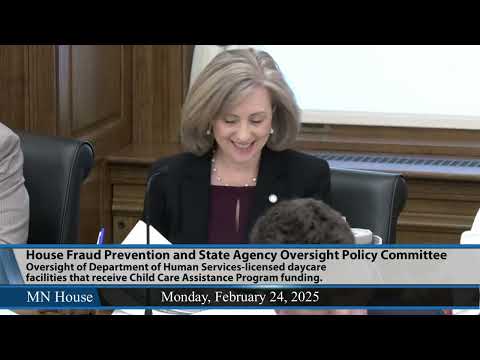
Acting Department of Human Services Commissioner Shereen Gandhi told the House Fraud Prevention and Agency Oversight Committee that DHS uses licensing inspections, a childcare audits and investigations unit and data analytics to prevent, detect and investigate fraud in early‑learning programs, and that the governor’s 2025 package seeks funding for additional investigators and a statewide electronic attendance system.
Acting Department of Human Services Commissioner Shereen Gandhi told the Minnesota House Committee on Fraud Prevention and Agency Oversight that DHS uses licensing inspections, a childcare audits and investigations unit and data analytics to prevent, detect and investigate fraud in early‑learning programs, and that the governor’s 2025 package seeks funding for additional investigators and a statewide electronic attendance system.
“Fraud in these programs is unacceptable. It is not a victimless crime,” Gandhi said, summarizing the agency’s approach to program integrity in the Child Care Assistance Program (CCAP) and the Great Start compensation support payment program.
The committee heard that Minnesota has roughly 1,800 licensed child‑care centers and about 5,800 licensed family child‑care providers; about 3,600 providers are enrolled in CCAP. DHS officials told the panel that the childcare audits and investigations unit has recovered $2,400,000 since 2020, has referred an average of about five cases a year to law enforcement since 2021, and has stopped payments to dozens of providers.
Why it matters
Lawmakers pressed DHS on the scale of recoveries relative to program size. Committee members cited agency estimates that CCAP spending has ranged “from over $200,000,000 to over $300,000,000 a year” (state and federal shares combined); some members described the roughly $600,000 a year in recoveries as “a drop in the bucket.” Representative Rehrig said the recovery figure “just seems like an absolute drop in the bucket,” and asked for more detail on how recoveries were calculated and enforced.
How DHS investigates and acts
Gandhi and Deputy Inspector General Tom Johnson described a multi‑step process: licensors conduct annual and unannounced on‑site inspections and refer concerning findings to CCAP investigators; the OIG data and analytics team screens billing and provider data for anomalies; and the investigations unit pursues administrative remedies and, when there is a credible allegation of criminal fraud, refers cases to the Bureau of Criminal Apprehension (BCA) or federal partners.
“Investigations are based on tips, complaints, and data analytics,” Gandhi said. She described the department’s goal of using a risk‑based approach to focus investigative resources and said DHS works with federal partners including the FBI.
DHS officials explained available administrative actions: warnings, correction orders, stipulated provider agreements, fines, monetary recoveries, payment withholds or stop‑payments, suspensions, conditional licensing and disqualifications. Johnson said recoveries may be collected by withholding future payments from providers who remain active in CCAP or by issuing monetary recovery orders to providers no longer enrolled.
Lawmakers’ questions and gaps identified
Committee members repeatedly asked for follow‑up data the agency did not have on hand: how many of the stopped payments were tied to criminal referrals; how many stopped payments resulted from license suspensions or revocations; and how much of the $2.4 million recovered was cash actually collected versus future‑payment reductions. Gandhi and Johnson said they would supply that information after the hearing.
Members also pressed DHS about in‑person inspections resumed after COVID, the size of the OIG data and analytics team, and how DHS verifies attendance. Jennifer Sommerfeld of the Department of Children, Youth and Families (DCYF) initially said payments were made “based on enrollment,” then corrected herself on the record: “It’s based on attendance, my apologies,” and said counties submit bills through the state payment system.
Licensing thresholds and conditional enforcement
Committee members sought clarity on what licensing violations rise to suspension, revocation or decertification — actions that can trigger stop‑payment authority. Deputy Inspector General and licensing director Alyssa Dotson described a case‑by‑case approach: licensors evaluate the nature, severity, frequency and impact of violations and consult supervisors before using stronger tools such as conditional licenses or temporary immediate suspension.
“There’s not a rubric that equates to this type of violation equals conditional,” Dotson said, explaining licensors weigh harm to children, recurrence and the provider’s corrective actions. She added that for imminent health‑and‑safety risks the agency can immediately interrupt services.
Kickbacks and the legal gap
Several lawmakers pressed DHS about “kickbacks” — payments or incentives paid to induce referrals or access to billing — and whether the department can act at the state level. Tom Johnson told the committee that kickbacks are illegal under federal law and that DHS works with federal partners on such cases. He also said state law currently does not provide DHS with specific authority to act against kickbacks, a gap lawmakers and agency staff agreed could be addressed through statute.
The governor’s package and next steps
Gandhi outlined the governor’s 2025 requests: additional investigators and program‑integrity staff (the agency cited a $1.89 return‑on‑investment estimate for investigator spending), statutory clarifications to allow broader payment withholds and cross‑agency data sharing, expansion of disqualification authority to people under active fraud investigation, and $4.9 million (rising to $2.9 million ongoing) to implement a statewide electronic attendance record‑keeping system for CCAP. Gandhi said the system would standardize attendance data and help detect improper payments.
Committee follow‑ups requested
Committee members asked DHS to provide: a breakdown of stopped payments tied to criminal referrals; the number of CCAP providers on conditional license or suspension; the size and staffing of the OIG data and analytics team; the amount of actual cash collected from recoveries; and a written list of internal thresholds and criteria used to move licensors from corrective action to suspension or revocation. DHS agreed to provide the requested details.
The hearing underscored tensions lawmakers described between protecting program integrity and preserving access to childcare: several members stressed the need to avoid over‑burdening honest providers while ensuring “bad actors” are stopped. Gandhi and DHS officials said they will continue to refine tools and asked for legislative support for the governor’s proposals to strengthen enforcement and data capabilities.
Ending
The committee adjourned after asking the agency for the follow‑up materials; DHS officials said they would supply additional data on recoveries, staffing and enforcement thresholds for further review by the committee.