Get Full Government Meeting Transcripts, Videos, & Alerts Forever!
Get email alerts on the Climate Action Funding topic
No spam. Unsubscribe anytime.
Tualatin council weighs utility franchise fee and permit surcharges to fund Climate Action Plan implementation
Summary
Tualatin city staff and consultant Echo Northwest presented the City Council on Feb. 24 with options to fund a dedicated staff position and initial implementation of the municipality’s Climate Action Plan, including a recommendation that the council consider modest increases to existing utility franchise (right‑of‑way) fees and a permit surcharge to create a recurring revenue stream.
Tualatin city staff and consultant Echo Northwest presented the City Council on Feb. 24 with options to fund a dedicated staff position and initial implementation of the municipality’s Climate Action Plan, including a recommendation that the council consider modest increases to existing utility franchise (right‑of‑way) fees and a permit surcharge to create a recurring revenue stream.
City Manager Sherilyn Lambos said she moved responsibility for the Climate Action Plan into the city manager’s office after adoption “last May” to give the work greater visibility and to highlight the cross‑departmental nature of implementation. She told council the city lacks ongoing funding and a dedicated staff member who would “have overall responsibility for implementing the climate action plan and would work closely with various city departments, public leaders, regional partners and of course the community.”
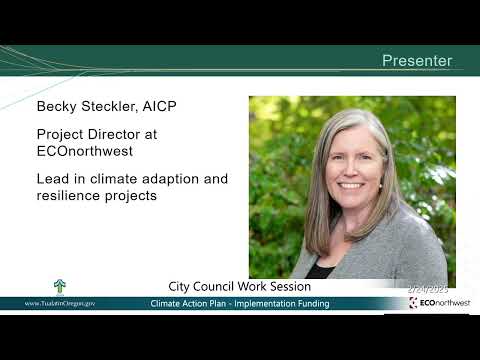
Echo Northwest project director Becky Steckler reviewed short‑ and long‑term revenue tools and an evaluation framework that weighed adequacy, administrative ease, flexibility, stability and equity. For short‑term funding she highlighted two near‑term options: a 0.5 percent increase in the city’s right‑of‑way (franchise) fee applied to electricity, telecommunications and waste management, which Echo Northwest estimated would raise about $327,000 annually; and a 5 percent surcharge on building permit fees estimated to raise roughly $60,000 per year. Steckler said the franchise/right‑of‑way option “is sourced from a really broad tax base” and would be “relatively flexible” for implementing plan actions, while the permit surcharge would concentrate the cost on new development and be more volatile.
Steckler also presented longer‑term options that the firm modeled: increasing all utility franchise/right‑of‑way fees by 1.5 percent (estimated revenue about $1.2 million), a 3‑cent per gallon local gas tax (roughly $250,000), and a 5 percent bump in the city’s transportation development tax (about $70,000). She noted limitations: natural gas already carries a 5 percent fee that Echo Northwest treated as a practical cap for short‑term action, and the firm found the city’s current billing technology does not support a round‑up “opt‑out” utility program without system upgrades.
Councilors asked questions about equity, administrative burden and alternatives. Councilor Chelsea Gonzales criticized the report for not cataloguing “low‑hanging fruit” the city could do with existing resources — irrigation upgrades, park maintenance and a stronger tree program — and said she had voted against the Climate Action Plan because she worried it would increase costs for residents. Gonzales: “What your report failed to highlight is what can we do right now?”
Several councilors signaled preference for a modest franchise/right‑of‑way increase over a gas tax or large permit surcharge. Councilor Socko said the franchise fee option “seems like a more equitable way where everybody’s paying an amount” and noted it is a steady revenue stream that is easier to administer; Councilor Pratt and others voiced concern that a gas tax would be regressive and difficult to pass at ballot. Councilors discussed an alternative flat opt‑in monthly charge billed on city utilities, and staff confirmed the current system can accept a flat added fee though it cannot perform a true per‑bill round up without system upgrades.
Council discussion repeatedly returned to the central staff need: council members said the city wants a coordinator to manage cross‑departmental work, track metrics and pursue grants. Councilor Hillier summarized the question as whether the council will fund a dedicated staff person to coordinate climate tasks: “we are going to have to find a way, if we are going to prioritize even the low‑hanging fruit, to find a way to fund this position.” Several councilors said they would support a modest funding approach aimed primarily at staffing the position with minimal impact on residents; others pushed staff to prioritize internal efficiencies and grant seeking before raising fees.
The council did not take a formal vote on funding tools. Staff and Echo Northwest were directed to refine options based on council feedback, including modeling smaller increments for franchise/right‑of‑way fees, exploring a flat opt‑in utility billing add‑on, assessing whether commercial building fees could be targeted separately from residential permits, and returning with implementation steps, cost estimates, and potential ordinance language.
What’s next: staff said they will return with follow‑up analysis and fee schedule proposals; no formal ordinance or ballot measure was introduced at the Feb. 24 meeting.
Quotes used in this story are drawn from the Feb. 24 Tualatin City Council meeting.