Get Full Government Meeting Transcripts, Videos, & Alerts Forever!
Get email alerts on the Utilities Puc topic
No spam. Unsubscribe anytime.
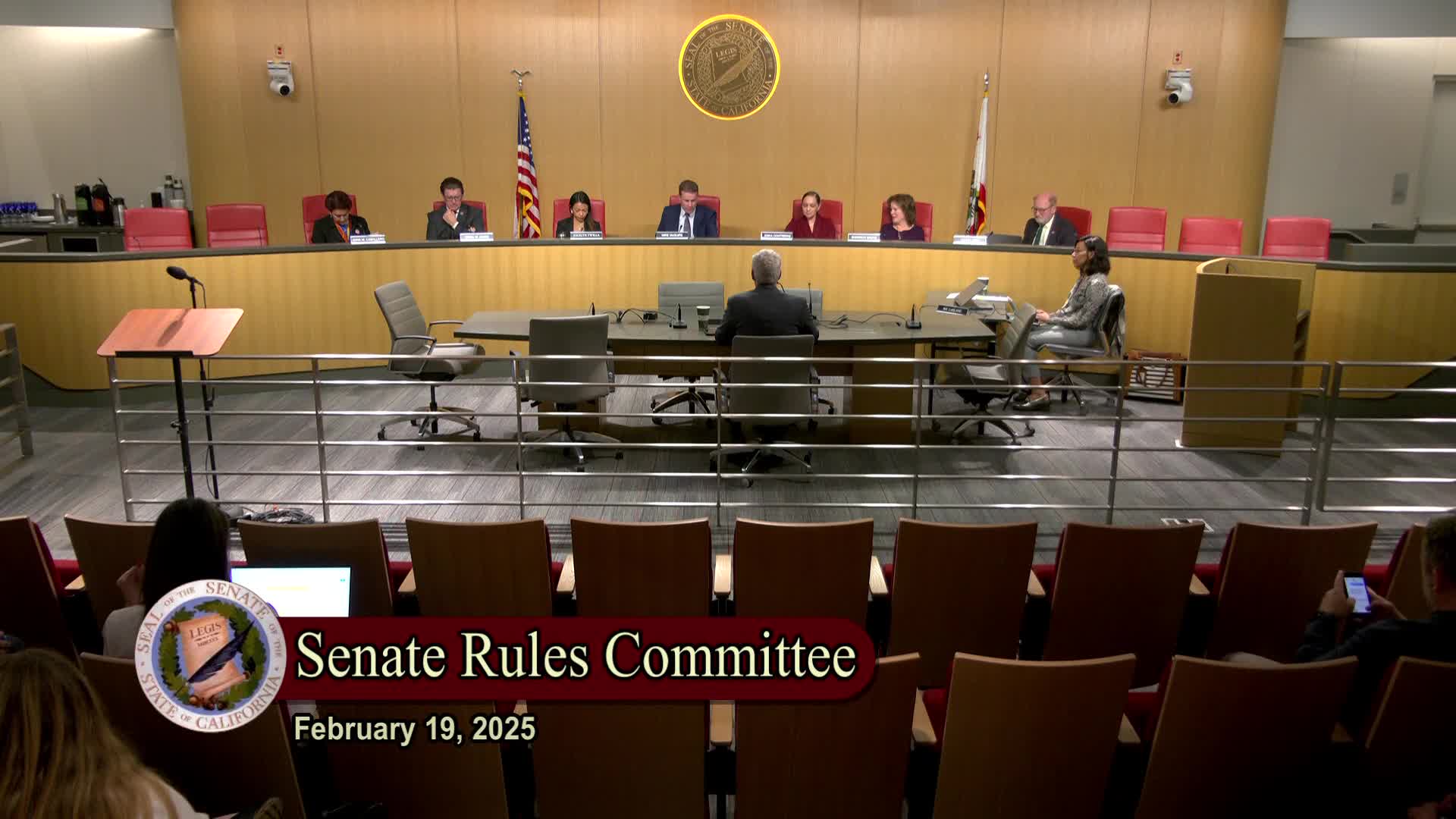
Senate Rules Committee confirms PUC Commissioner Matt Baker after hearing on rates, wildfire costs and battery safety
Summary
The committee advanced Public Utilities Commission nominee Matt Baker to the Senate floor after a hearing that focused on rising utility rates, wildfire mitigation costs, battery‑storage safety (including the Moss Landing fire), hydrogen blending pilots, cybersecurity and broadband deployment.
The California Senate Rules Committee voted 5‑0 to advance Matt Baker for continued service on the California Public Utilities Commission after a confirmation hearing in which senators questioned him about utility affordability, wildfire mitigation costs, battery storage safety and other regulatory priorities.
Baker, a one‑time public advocate and deputy natural‑resources official, told the committee his priorities are “reliable, safe, accessible service, that is affordable to all,” and he said affordability would be his top priority on the commission. He outlined steps he said the commission should take to control costs, including examining whether ratepayers are funding programs that no longer deliver value and looking for lower‑cost ways to perform required work.
Why it matters: The PUC regulates investor‑owned utilities and infrastructure decisions that affect rates, grid reliability and safety. Senators focused on the causes of recent rate increases, wildfire‑related costs now carried on ratepayers’ bills, and the regulatory response to recent battery‑storage incidents.
Committee members asked about several near‑term and structural issues. On wildfire and grid hardening, Baker said regulators should balance “how quickly you can get protections in place” against permanence and cost; he contrasted faster measures such as covered conductors with more permanent undergrounding and said policymakers should weigh speed, durability and cost. On the Moss Landing battery storage fire, Baker said the facility used an older chemistry and that newer chemistries and forthcoming PUC rules will reduce the risk of runaway fires. He said new enforceable standards under proceedings linked to recent legislation will broaden safety, require emergency‑planning consultations with local officials and expand the safety‑enforcement division’s inspection authority.
Senators pressed Baker on affordability, noting that utility bills in many parts of California have risen substantially in recent years. Baker said primary drivers of recent rate increases are wildfire‑related costs and pandemic‑era inflation; he pointed to studies and agency reports showing billions of dollars in added wildfire‑related costs that have been reflected in utilities’ cost of service. He said the commission should seek ways to spread unusually large, storm‑ and wildfire‑related costs across more ratepayers or time and to scrutinize what should be included in rates.
On battery‑storage safety, Baker referenced regulatory work following the Moss Landing fire and said the PUC’s upcoming rules (cited in committee with reference to SB 38 and related measures) will set enforceable operation and maintenance standards and require emergency planning and inspections. He said some developers assume project risk in contracts, but where costs fall to ratepayers the commission should consider that exposure when it evaluates utility proposals.
Law enforcement and security questions were raised: senators asked about cybersecurity warnings from federal agencies. Baker said the larger utilities coordinate with the Department of Homeland Security and FBI and that the commission’s staff is working with smaller utilities that may need attention or help meeting federal guidance.
On broadband and telecommuting infrastructure, Baker said the commission has approved close to $1 billion in last‑mile grants in the past year and moved federal and state funds to get service to more than a million people; he said additional work remains to match middle‑mile and last‑mile projects and to keep low‑income rates affordable.
Committee vote and public support: The committee voted 5‑0 to move Baker’s nomination to the Senate floor. Supporters who spoke during public comment included trade and clean‑energy groups, water associations and environmental groups; no organized opposition was reported in the hearing record.
Ending: With committee approval, Baker’s nomination will go the Senate floor for final confirmation. Senators asked commission staff to provide follow‑up on hydrogen blending pilots, cybersecurity readiness and a short paper on nuclear power options.
Direct quotes (selected): "It is very important for us to be engaged in public service, and I believe public service is especially important in times when times are tough," Baker said. "My top priority is affordability," he told senators. Commissioner Baker also said the Moss Landing fire involved an older battery chemistry and that new rules will make battery storage facilities safer.
The committee recessed after confirming Baker and moved to other business on the agenda.