Get Full Government Meeting Transcripts, Videos, & Alerts Forever!
Get email alerts on the Parole Commission topic
No spam. Unsubscribe anytime.
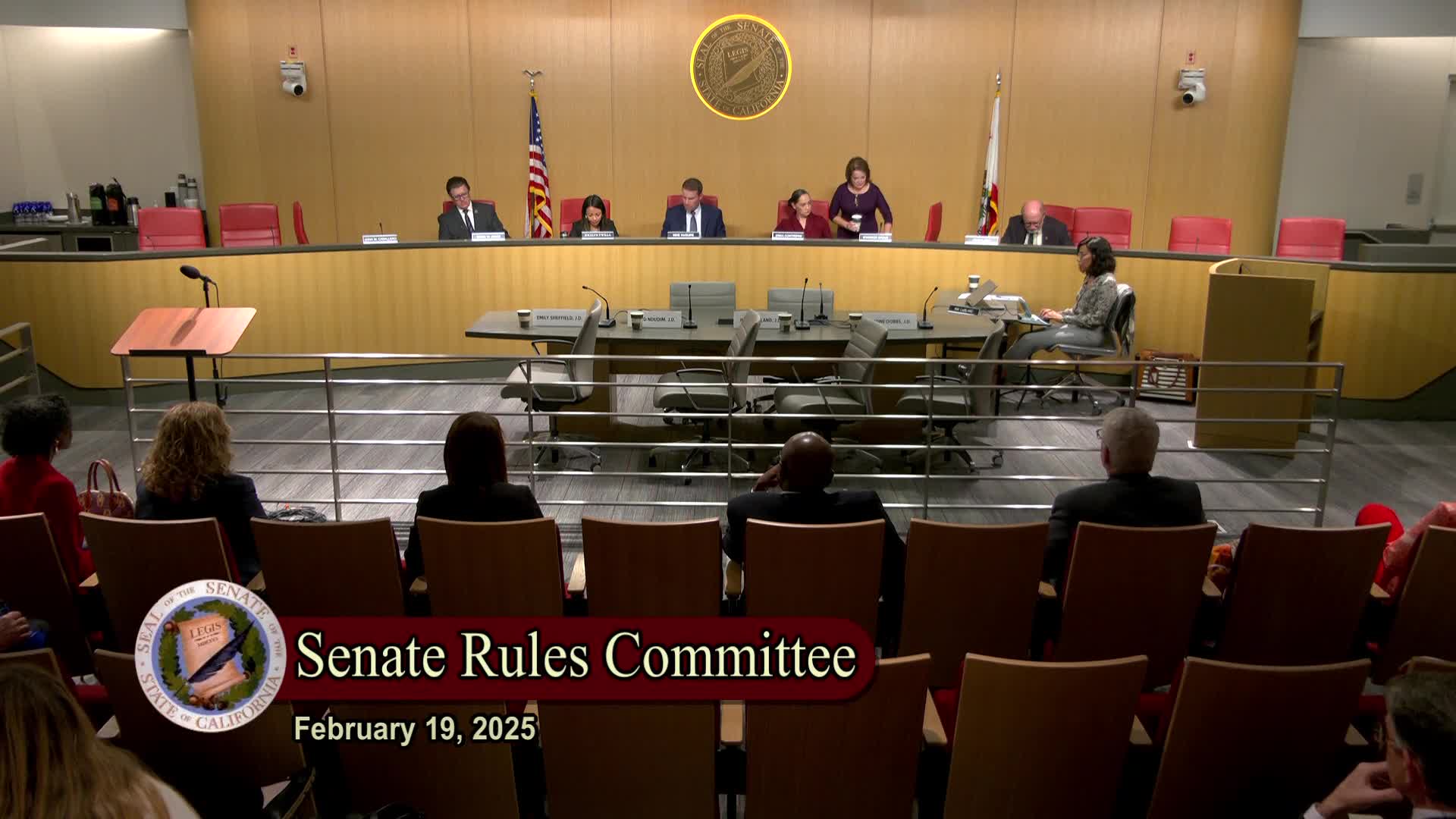
Senate Rules Committee confirms four Board of Parole Hearings commissioners after hourlong questioning
Summary
The California Senate Rules Committee held a confirmation hearing for four gubernatorial appointees to the Board of Parole Hearings, questioned nominees about rehabilitation programs, recidivism and remote hearings, and approved all four commissioners by recorded roll-call votes.
The California Senate Rules Committee advanced four gubernatorial appointees to the Board of Parole Hearings after a confirmation hearing that ranged from questions about rehabilitation program effectiveness to the handling of elderly-parole petitions.
The panel voted to approve Commissioner Heather Sheffield, Commissioner (first name not specified in record) Doudin, Commissioner Garland and Commissioner Dobbs; all four nominations will move to the full Senate. Sheffield, Doudin and Garland were approved unanimously by the committee. Dobbs was approved in a 3-1 roll call with one member not voting.
Committee members spent the hearing pressing nominees on how they evaluate in-prison rehabilitation programs, whether and how the board reviews cases of people who return to prison after being paroled, how disciplinary infractions factor into suitability findings and how remote hearings compare with in-person hearings. Senators also asked about the 2020 budget‑year change that lowered the age threshold for “elderly parole” from 60 to 50 and how commissioners apply that statutory change at hearings.
Why it matters: The Board of Parole Hearings determines suitability for parole in life‑term cases and its decisions carry public‑safety consequences for victims, incarcerated people and communities. The committee’s votes clear the nominees to be considered by the full Senate.
During opening remarks and later answers, each commissioner described how they assess programming and behavior. Commissioner Dobbs said she evaluates “the behavior that the person is displaying during their time in that prison community” as an indicator of whether programs are working. Commissioner Garland, who previously spent 25 years at the attorney general’s office, said serving on the board “and seeing it on a human level day in and day out is a very different experience.” Commissioner Doudin recounted prior experience as a deputy commissioner and nearly a thousand suitability hearings; Commissioner Sheffield described the role as “incredibly meaningful” and said colleagues had helped her transition into the job.
On program evaluation, commissioners said they look for both documented participation and internalization — not just course completion but the extent to which an individual applies program concepts to their own circumstances. “If they can talk about what they learned and apply it to their own experiences,” Sheffield said, “that’s really where the hard work is, and that’s where you see the programming really working.” Commissioners said inmate‑designed programs and mentorship can be meaningful when the person facilitating demonstrates pro‑social thinking and role‑model behavior.
The panel asked whether the board reviews cases in which a person granted parole later returns to prison. Dobbs said, “We actually do look at people who come back,” adding that the board examines the reasons and whether the panel missed a factor at the earlier hearing. Commissioners said such reviews help identify missed issues and occasionally prompt changes in decision‑making practice.
On elderly parole, senators noted the 2020 change that lowered the eligible age from 60 to 50. The panelists said the statute is another factor the board weighs; commissioners told senators they consider age together with incarceration length, institutional conduct and medical condition when assessing “current dangerousness.” Sheffield summarized the board’s role as determining the person’s present risk rather than implementing policy choices that set who will be eligible to appear.
Senators also raised victims’ privacy. Committee members said they had received stakeholder concerns that, in rare cases, victims’ full names had been read into the public hearing record. Commissioners responded that they train to avoid re‑victimization, give victims options to remain anonymous or use a Jane Doe identifier, and that they intervene if incarcerated people attempt to name victims during a hearing.
Votes at a glance: • Commissioner Heather Sheffield — Motion to approve by Senator Laird; roll call: Maguire (aye), Grove (aye), Caballero (aye), Jones (aye), Laird (aye); outcome: approved, 5‑0. • Commissioner Doudin — Motion by Madam Vice Chair; roll call: Maguire (aye), Grove (aye), Caballero (aye), Jones (aye), Laird (aye); outcome: approved, 5‑0. • Commissioner Garland — Motion by Senator Caballero; roll call: Maguire (aye), Grove (aye), Caballero (aye), Jones (aye), Laird (aye); outcome: approved, 5‑0. • Commissioner Dobbs — Motion by Senator Caballero; roll call: Maguire (aye), Grove (no), Caballero (aye), Jones (not voting), Laird (aye); outcome: approved, 3‑1 (one not voting).
Committee context and next steps: Each confirmation now moves to the full Senate for floor consideration. Senators asked nominees to follow up during implementation and for staff to provide additional information on program availability across institutions when appropriate.
The hearing included a brief and formal public‑comment period; no organized opposition surfaced during the comment segment. The committee recessed afterward and moved on to other agenda items.
Ending: The committee chair thanked the commissioners for their service and closed the confirmation segment, noting the nominees’ next stop is the Senate floor.