Get Full Government Meeting Transcripts, Videos, & Alerts Forever!
Get email alerts on the Harmful Communications Minors topic
No spam. Unsubscribe anytime.
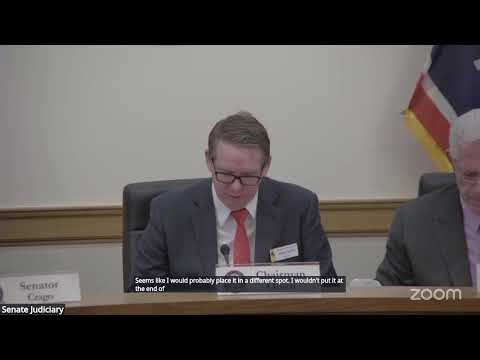
Committee sends bill to criminalize harmful communications with minors to Senate floor after amendments
Summary
House Bill 189, sponsored by Representative Jamie Lean, would create a new offense for repeated sexually explicit or grooming communications with minors, add civil remedies, and allow device forfeiture and social-media restrictions after conviction. The Senate Judiciary Committee approved the bill with amendments by a 5–0 vote.
The Wyoming Senate Judiciary Committee voted Tuesday to advance House Bill 189, legislation that would create a new offense for repeated harmful communications with minors, add a civil cause of action and penalties, and permit certain post-conviction restrictions and forfeitures.
Representative Jamie Lean (R), the bill sponsor, told the committee the measure is designed to address grooming behaviors and online communications that often precede sexual abuse of children. “When an adult involves any child in a sexual act … the statistics become shocking,” Lean said, citing figures she presented to the committee on forensic interviews and the prevalence of abuse.
Lean told the committee 774 children in the state were served with forensic interviews and 306 of those were sexual abuse cases; she said 79 percent of offenders were relatives in the cases she referenced. The bill creates a new statutory section titled “harmful communication with minors,” defines “obscene” communications and “personal sexual gratification,” and sets out a pattern-based offense that applies when an actor knowingly engages in repeated written, electronic or verbal communications targeted at a minor or a person purported to be a minor.
Under the draft language presented, the bill included tiered criminal penalties tied to repeat offenses — the first offense punishable by up to five years’ imprisonment and a fine, the second by up to 10 years, and an original third-tier penalty of up to 20 years; sponsors and the committee later adjusted the statutory language and removed a separate third-tier entry during amendment. The bill also would permit courts to order forfeiture of devices used in the communications, and to restrict social-media privileges after conviction while a person is incarcerated, on probation or parole.
Rep. Lean told the committee the statute includes a 4-year age-gap provision so ordinary adolescent relationships are not swept into criminal liability; “we do not want to inhibit the natural course of individuals that are 16, 17, 20 years old that engage in very normal relationships,” she said. The bill includes carve-outs for age-appropriate sex-education curriculum and for minors who are married or emancipated, and it authorizes civil suits by victims or families independent of criminal prosecution, Lean said.
The committee heard supportive testimony from the attorney general’s Division of Victim Services and from the Wyoming Association of Sheriffs and Chiefs of Police (WASCOP). Cara Chambers of the attorney general’s Office said the conduct the bill targets “is a precursor to some other crimes” investigated by the Internet Crimes Against Children unit and that the bill “captures some activity that we do see happening.” Alan Thompson, executive director of WASCOP, said law enforcement consulted on the bill and expressed broad support for the concept.
Witnesses from Wyoming’s community colleges asked the committee to clarify an exception for educational settings so academic programs that train human-services or criminal-justice students are not inadvertently covered; the committee adopted an amendment to broaden the educational carve-out for academic programs intended to protect children from predators. Dr. Ben Moritz, executive director of the Community College Commission, and Erin Taylor of the Wyoming Association of Community College Trustees supported that revision. Public commenters, including a survivor who urged retaining the civil remedy, also spoke in favor.
Committee members spent much of the hearing discussing how the new offenses would interact with existing criminal statutes governing sexual conduct and explicit-image offenses, the appropriate penalties for first and repeat offenders, age-gap thresholds and registry implications for offenders. Several senators warned the drafting raises complex interactions with current law and flagged the need for cleanup to avoid unintended consequences, such as placing young people in registry categories for consensual conduct that is lawful under other statutes.
The committee adopted a series of floor and drafting amendments, including correcting cross-references, inserting an “or” in a definition to clarify statutory language, and expanding the educational exception to explicitly cover academic programs intended to protect minors. After the amendments the committee voted to pass the bill; the clerk recorded yes votes from Senators Crago, Crum, Cole and Chairman Olsen and an absentee aye from Senator Hicks and announced “5 ayes do pass with amendments.”
The bill as discussed in committee would take effect immediately, per an adopted amendment, and would also add the new offense to cross-references used for offender registration in state statute as drafted in committee discussion. Several witnesses and committee members noted that some statutory citations and cross-references discussed in the hearing should be verified and cleaned up during drafting.