Get Full Government Meeting Transcripts, Videos, & Alerts Forever!
Get email alerts on the Commercial Real Estate topic
No spam. Unsubscribe anytime.
JLL tells Rockville council office vacancy at 31% as life‑science conversions reshape local market
Summary
Jones Lang LaSalle (JLL) presented a commercial market overview on Feb. 10 showing about 31% office vacancy in Rockville municipality, ongoing rightsizing by tenants, a flight to higher‑quality (Class A/trophy) space, and examples of distressed office assets slated for conversion or demolition.
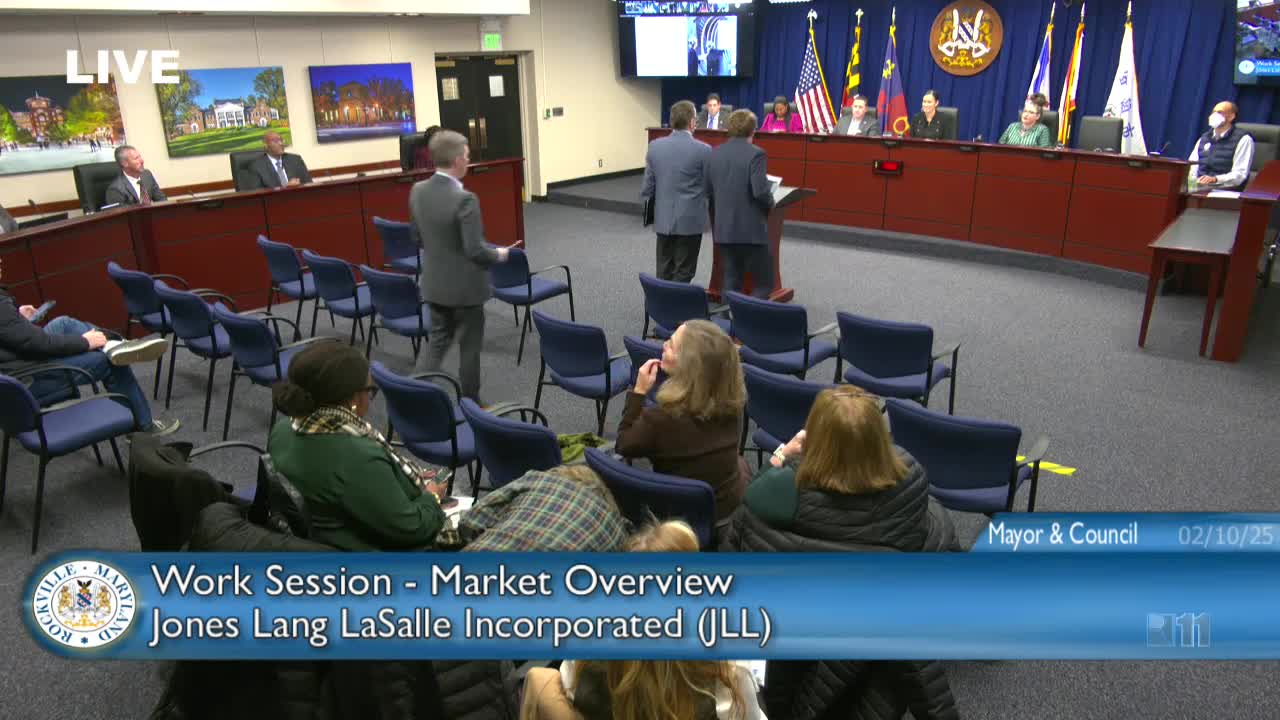
Consultants from Jones Lang LaSalle (JLL) told the Rockville City Council on Feb. 10 that the city’s office market is undergoing a correction driven by tenant rightsizing, life‑science conversions and several recent deliveries.
“Tenant demand has returned to pre‑pandemic levels, but tenants are taking less space,” Michael Hartnett, JLL research lead for the Mid‑Atlantic, said, summarizing a national trend that the firm also sees regionally. Tommy Lanaway, JLL suburban Maryland research analyst, said the flight to quality — tenants migrating to newer Class A and trophy space — is producing bifurcated market results: higher rents and lower vacancy at the top of the market while older stock faces elevated vacancy.
JLL presented municipal figures for Rockville that show about 70 office assets totaling roughly 8.5 million square feet and an overall office vacancy rate of about 31.0 percent; the firm said calendar‑year 2024 absorption in Rockville was negative, with roughly 270,000 square feet of occupancy loss. JLL also reported more than 300,000 square feet of sublease availability in the municipality.
The consultants cited specific local examples of distress and conversion. Morgan Sullivan of JLL listed recent transactions and planned changes: 255 Rockville Pike sold at a steep discount and is slated for demolition with part of the site to become residential; 121 Rockville Pike (the former Choice Hotels administrative headquarters) was sold at a discount and will be redeveloped; and a multistory office building on Research Boulevard is planned for demolition and replacement with townhouses. JLL said those conversions reflect broader market dynamics in which some older office buildings no longer show a clear path to re‑tenanting as office use.
JLL also noted several tenant consolidations that removed large blocks of space from the market (for example, Westat’s consolidation and Choice Hotels’ move to Pike and Rose), and the consultants warned that lender‑driven distress can make short‑term vacancy and repurposing more likely because lenders and owners may lack capital to renovate older buildings.
Council members asked JLL questions about hotel performance, medical office space and workforce implications. JLL responded that Rockville’s hotel occupancy (reported at about 60.9% for early FY25) trails some nearby markets and that medical and life‑science space show different dynamics — life‑science firms often require in‑person space and have a stratified progression from cheap startup labs to higher‑quality leased or purpose‑built facilities. JLL also identified artificial intelligence and clean‑tech as growth areas the region could target given its talent base and institutional assets.
JLL’s consultants advised that the city’s mixed tenant base — federal, corporate and life‑science users — provides diversification that can mitigate downside risk, but they emphasized that conversions, financing constraints, and materials cost increases (noted in the presentation as a potential effect of tariffs) could prolong the correction and affect new construction timelines.
The JLL presentation concluded with an invitation to continue coordinated market strategies and to consider how the city’s zoning, development incentives and partnerships could support desired outcomes for downtown and transit‑oriented locations.