Get Full Government Meeting Transcripts, Videos, & Alerts Forever!
Get email alerts on the Water Wastewater topic
No spam. Unsubscribe anytime.
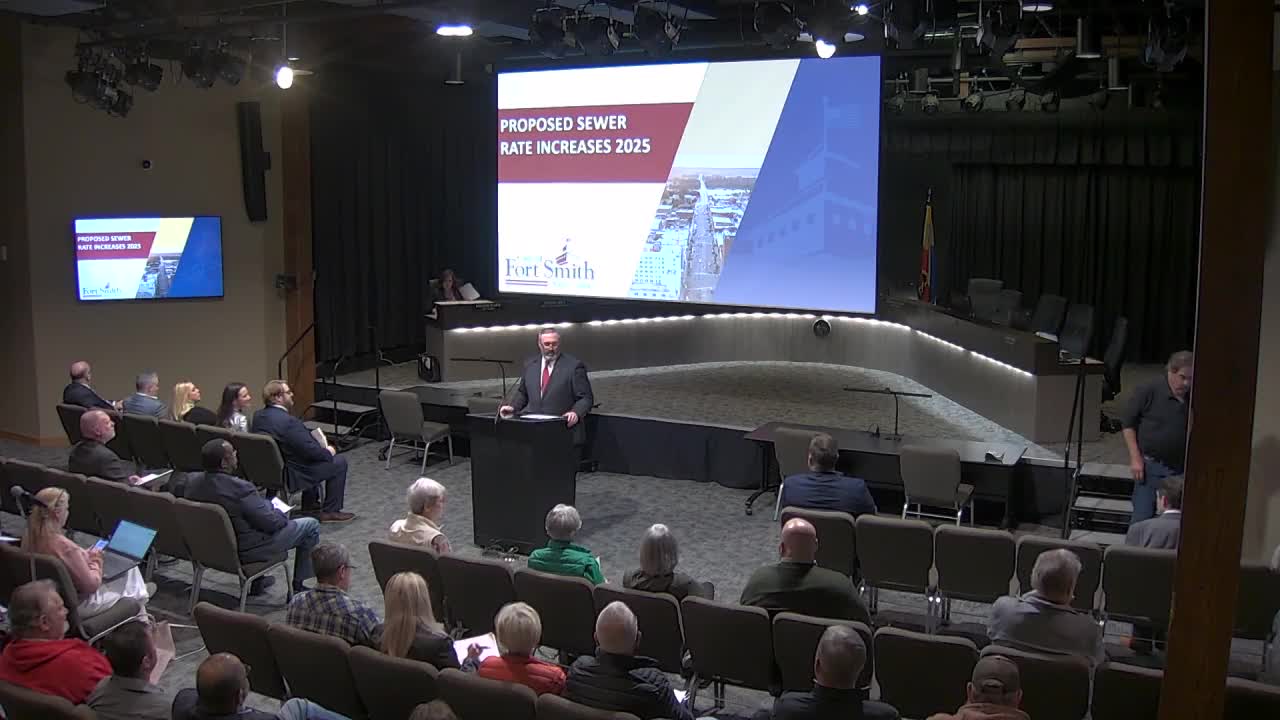
Fort Smith board delays vote on proposed sewer rate increases tied to federal consent decree
Summary
After a public hearing with more than a dozen citizens speaking, the Fort Smith Board of Directors voted 6–1 to table an ordinance that would have started a 3.5% sewer rate increase on June 1 and annual 3.5% increases thereafter through 2030 while staff provides more information.
Interim City Administrator Jeff Dingman opened a public hearing on proposed sewer-rate increases tied to the city’s federal consent decree, saying the Environmental Protection Agency and Department of Justice “insist on compliance with the Clean Water Act regulations, and we are not in compliance.”
The Fort Smith Board of Directors heard a detailed presentation from water utilities staff on the scale and history of required sewer repairs, the city’s funding efforts and a financial plan that would pair user-rate increases with existing and potential sales-tax revenue. After public comment and board discussion, the board voted 6–1 to table the ordinance and seek more details.
The board was asked to consider an ordinance that would impose a 3.5% increase to sewer rates effective June 1, 2025, and then apply a 3.5% increase annually on Jan. 1 each year through 2030. City staff told the board those increases would help cover operating and maintenance costs and current debt service, and would generate about $629,000 in additional revenue in the first partial year and roughly $1.5 million for a full year after the next annual increase.
Why it matters
Fort Smith is operating under a federal consent decree requiring upgrades and ongoing maintenance to reduce sanitary sewer overflows (SSOs). City staff said the work is costly and the scale of remediation rose as more thorough assessments showed pipes and manholes in worse condition than earlier estimates indicated.
City presentation and key figures
Interim City Administrator Jeff Dingman and Lance McEvoy, director of water utilities, described the multi-decade history of federal oversight and recent project spending. The city reported that total spending or contracts related to the consent decree since it was lodged in 2015 is “just under $136 million.” Staff said some consent-decree projects currently under contract account for roughly $64 million of that total.
Staff also told the board the city has reduced measured sanitary sewer overflows from about 22,300,000 gallons in 2015 to about 5,400,000 gallons in 2024, but that the goal under the consent decree and good operations is zero SSOs.
McEvoy and staff detailed the effect of a 2019 flood that damaged 14 pump stations and redirected some funds to repairs; FEMA reimbursed roughly 75% of eligible costs, the presenters said. Staff described a financial plan the city submitted to the DOJ and EPA that pairs proposed sewer-rate increases with existing revenue — a five-eighths (5/8) of 1% sales tax voters approved in 2022 dedicated to consent-decree projects — and a proposed voter reallocation of an additional three-eighths (3/8) of 1% of an existing streets/drainage sales tax to make a full 1% available for consent-decree work.
Public comment
More than a dozen citizens spoke during the public comment portion of the hearing. Speaker concerns included the scale of prior and proposed rate increases, allocation of city revenues, the pace of leak repairs and requests for greater transparency and reprioritization of discretionary spending.
• Crystal Cadelli, a resident, urged tighter overall city spending and said: “This city is in a serious financial crisis… I believe that this city can do better than just increase rates.”
• Jo Elsken said many residents have seen large past increases and asked the board to reconsider prior water-rate changes and to speed leak repairs.
• Several speakers pressed the board to identify what nonessential spending could be redirected toward infrastructure and asked how much additional revenue the proposed 3.5% increase would produce; the CFO later gave the dollar estimates noted above.
Board discussion and vote
Board members pressed staff for missing details during the presentation: exact dollar impacts by year, how previously approved sales-tax and capital projects had been used, and the staffing and equipment the water utilities department needs to clear the backlog of leaks. Director Christina Kitsavas (first reference: Director Christina Kitsavas) said she would “not [be] prepared to vote for this tonight” and moved to table; a colleague seconded the motion.
After discussion, the board voted to table the rate-adjustment ordinance until the next regular meeting so staff could provide additional analyses, including a clearer projection of dollar revenues from the 3.5% increases and more detail on how existing sales-tax revenues and general-fund options had been considered. The clerk recorded the roll call and the motion to table passed 6 in favor and 1 opposed.
What the tabling means
Tabling leaves the existing rates in place. Staff told the board the 3.5% increase was intended to be the city’s chosen path in order to avoid steeper federally directed rate increases; Kitsavas warned the board that federal reviewers could seek larger increases if the city’s financial plan is judged insufficient.
Next steps
The board asked staff to return with more precise revenue estimates, a clear accounting of prior uses of dedicated sales-tax and other funds for consent-decree projects, and clarification of water-utility staffing and equipment needs so the board can better weigh rate increases against other budget choices.
Ending
The public hearing and two-hour discussion made the board’s concerns and residents’ frustrations clear: citizens want faster leak repairs and more evidence that the city has reprioritized discretionary spending before asking ratepayers for additional funds. The board’s vote to table gives staff time to provide the requested details and the board time to consider the financial plan before voters or rates change.