Get Full Government Meeting Transcripts, Videos, & Alerts Forever!
Get email alerts on the Land Use Zoning topic
No spam. Unsubscribe anytime.
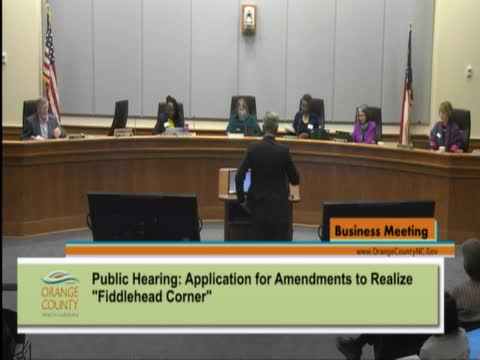
Orange County continues hearing on Fiddlehead Corner rezoning after packed public comment
Summary
The Board of Commissioners opened public comment on a proposed master-plan rezoning for the 90-acre Fiddlehead Corner property but continued the hearing to March 6 after hours of testimony and a late change to the applicant's development plan.
Orange County commissioners opened a public hearing Feb. 4 on a rezoning and parallel text and comprehensive-plan amendments proposed for a 90-acre property at the intersection of Goldmine Loop and Morrow Mill Road but continued the hearing to March 6 after lengthy testimony and a late revision to the applicant’s plan.
The applicant seeks to rezone the site from agricultural-residential (AR) to a master plan development conditional district (MPD CD), to amend Appendix F of the county comprehensive plan to allow MPD CD within rural neighborhood activity nodes, and to amend the Unified Development Ordinance (UDO) so family care facilities are a permitted use in the MPD CD. Planning staff told the board the UDO amendment to recognize family care facilities in residential districts is necessary to conform with state law.
Why it matters: The package would change how development is allowed in one of Orange County’s rural neighborhood activity nodes and would make the MPD CD zoning option available countywide in activity nodes. Planning staff said any future MPD CD rezonings would still require full legislative review, but opponents warned that approving these text changes would open rural nodes to higher-density projects in places without municipal water and sewer.
Most immediate actions and status - The public hearing for the rezoning and associated UDO and comprehensive-plan amendments was opened Feb. 4 and continued to March 6, 2025, at 7 p.m. at the Whitted Building (motion by Chair Bedford; second not specified; motion carries). The board directed that those who signed up at the Feb. 4 meeting be eligible to speak at the continued hearing. - Planning staff noted the county planning board previously recommended denial at its July 2024 meeting. No final vote on any of the applicant’s rezoning, UDO text amendment, or comprehensive-plan amendment occurred Feb. 4.
What was proposed and what changed Staff and the applicant described a multi-piece application. The property owner and applicant materials in the packet proposed a master plan for a residential community with supporting amenities, including two family-care facilities and community water and wastewater systems. The applicant presented a revised plan at the hearing, reducing the number of proposed dwelling units from 150 to 100. The applicant said the reduction was in response to community concerns about intensity.
Planning staff described the regulatory steps required: because the MPD CD in the county’s UDO is conditional and the proposed zoning is not currently listed as compatible with the Rural Neighborhood Activity Node on Appendix F of the comprehensive plan, approval would require corresponding amendments to the UDO and to Appendix F, plus legislative rezoning. The staff presentation also recommended updating the UDO’s family care facility definition and shown uses so the MPD CD would allow family care facilities consistent with state law.
Key technical points discussed - Site and land use: The property is roughly 90 acres; planning staff reported about 71.6 acres would be moved into the rural neighborhood activity node from agricultural-residential, leaving roughly 18.5 acres already in the node. Staff estimated about 37–40% of node acreage countywide is developed under their parcel-assessment method. - Density and open space: The applicant’s revised plan proposes 100 dwelling units. The applicant said the modified plan would leave about 70% of the site as “common open space” and roughly 85% as total open space. They also offered to design to an impervious surface ratio lower than the maximum typical for protected watersheds, stating an impervious target of about 15% for the modified plan and proposing to follow the 24% protected-watershed maximum even though the site sits in the Haw River unprotected watershed. - Water and wastewater: The applicant proposes two community wells (the state requires a second well after the first 50 dwelling units) and shared wastewater systems; those systems would be permitted and regulated by the North Carolina Department of Environmental Quality (DEQ). Applicant team members said DEQ had inspected the site and that soil borings and geologic work show numerous locations suitable for wastewater dispersal; they also said preliminary well siting work indicates the site can yield potable water, but final state permits would be required before construction or occupancy. - Transportation and services: A traffic-impact analysis was submitted and reviewed by NCDOT and county transportation staff, according to planning staff. The master-plan submittal includes utility, architectural, and stormwater concepts as required for MPD CD applications.
Arguments from supporters and opponents Public comment was extensive and split. Supporters—many identifying themselves as members or backers of Hands 4 Development (also referenced in materials as H4D or the cooperative)—said the project would provide modest-sized housing suited to older adults, preserve two-thirds of the parcel as forested open space, and offer a community-centered alternative to typical commercial or suburban subdivision development. Peggy Craft, identified in the meeting as a Hands 4 Development Cooperative director, told commissioners the cooperative had intentionally chosen a 55-plus model and the reduced unit count “was not done lightly.” Other supporters framed the proposal as nonprofit-led, community-oriented senior housing.
Opponents, many of whom live on or near Goldmine Loop and Morrow Mill Road, urged denial. Their principal concerns included groundwater and well impacts, the long-term reliability and public-health risk of private wastewater systems, traffic and safety on narrow rural roads, the scale of parking and buildings relative to surrounding farms and houses, and precedent for allowing MPD CD in rural neighborhood nodes countywide. Speakers referenced the planning board’s unanimous denial recommendation in July 2024 and asked the board not to amend county policy outside the comprehensive long-range planning process.
Staff and legal guidance during the hearing Planning Director Sai Stober explained the interdependence of the three pieces—UDO text amendment, comprehensive-plan map and text amendment, and the rezoning—and emphasized that the family-care-facility use is treated as residential under state law. Stober said, “family care facilities are required, by state law, in all residential zoning districts,” and staff recommended the UDO definition and use table be updated to conform. County staff and the county attorney also advised the board that a late change in the applicant’s site plan (the reduction from 150 to 100 units) was not, by itself, a procedural bar to the hearing so long as the revised plan was presented publicly and participants had an opportunity to comment; nevertheless, the board concluded it was appropriate to continue the hearing to allow more review and public notice for the revised plan.
Process and next steps The board voted to continue the public hearing to March 6, 2025, at 7 p.m. at the Whitted Building for additional public comment and deliberation. Staff said that any of the three proposed legislative actions (UDO text amendment, comprehensive-plan amendment, and zoning atlas amendment) could be considered separately, but recommended the board consider them together to assure consistency. The planning board’s earlier denial remains part of the public record and will be considered when the board resumes the hearing.
Other formal actions that evening - The board unanimously adopted a Black History Month proclamation (motion made, seconded; “Motion carries”). - The board approved the consent agenda by a 7–0 vote.
What the continuance means for neighbors and applicants Commissioners indicated those who had signed up to speak at the Feb. 4 hearing would be allowed to speak at the March 6 continuation. County attorneys said the board would provide further guidance and an informational memo before the continued hearing outlining the legal scope of what the board may consider in making its decision.
The county’s planning staff and the applicant made clear numerous technical approvals (well approvals, wastewater permits, detailed stormwater and site engineering) remain subject to state permitting and subsequent county plan-review processes; those permitting outcomes were not decided Feb. 4. The commissioners gave no timetable for deliberation beyond scheduling the March 6 continuation.
Ending note: commissioners and staff asked for civility and patience during the extended hearing process and encouraged residents to review submitted materials in the county packet and to attend the continued hearing.