Get Full Government Meeting Transcripts, Videos, & Alerts Forever!
Get email alerts on the Parks And Recreation topic
No spam. Unsubscribe anytime.
Redding Council directs staff to develop city-run model to keep Sports Park operating
Summary
After months of temporary operations, the City Council directed staff to develop a City-run operations and maintenance model for the Redding Sports Park and to solicit community ideas; council will review a staffing-and-budget package at its March meeting.
The Redding City Council voted to direct staff to develop a City of Redding staffed operations and maintenance model for the Redding Sports Park and to return to the council with a staffing plan and budget for consideration at the March meeting.
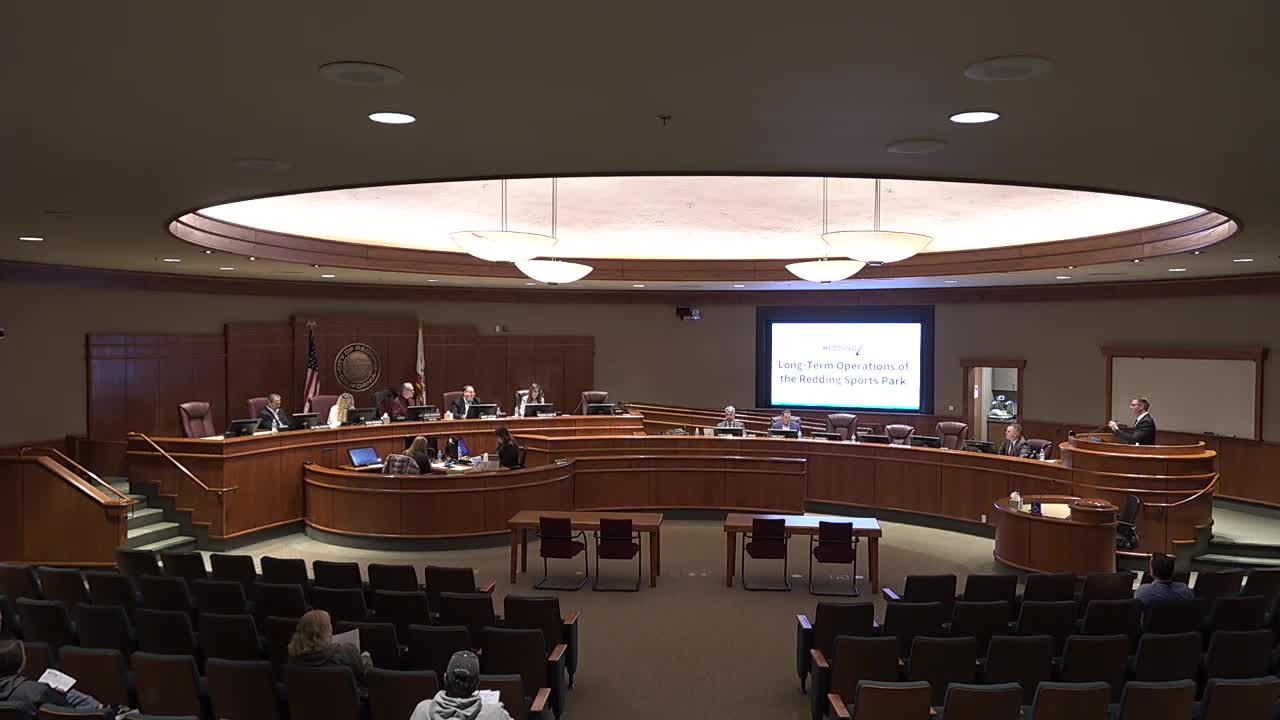
The council action follows a multi-hour discussion of long-term options for the sports complex, including continuing a city-run model, issuing a request for proposals for a third-party operator, or shuttering or selling the facility. Council members and public commenters stressed the park’s community value but also warned that the facility requires substantial capital work to remain viable.
Travis Meany, Community Services director, told the council the city opened the park under a short-term plan on Oct. 1 using a $200,000 allocation for operations, maintenance and repairs. “We have had 15,700 people come through the door,” Meany said, and the city has secured sponsorship and grant funding including a $200,000 sponsorship from the Reading Tourism and Marketing Group for sand-volleyball courts and a $150,000 lighting grant for one field. Meany said those funds and current revenues make the short-term model operationally sustainable but not a long-term solution.
Meany presented three long-term paths: (1) continue as a city-run facility with a planned investment that he estimated could be about $5 million to recondition fields (with up to $10 million for additional upgrades); (2) issue an RFP for a third-party operator that could run concessions and potentially invest in capital improvements; or (3) temporarily shutter or sell the facility — a difficult option because of parkland restrictions. He cautioned that without capital investment the turf and other systems could reach a point in a few years where the facility would no longer be safe or usable.
Public speakers urged the council to keep the park open. Toni Cowell, board president of the Shasta Roller Hockey League, said the temporary city plan revived roller-hockey play and that her league has doubled in size in recent years. “We were incredibly grateful,” Cowell said, urging the council to “keep the Reading Sports Complex operational by moving forward with a long-term plan.” Jessica Santos, who operates the Reading Slow Pitch Softball League, described 28 local businesses that have sponsored teams and urged improvements to the turf and accessibility features.
Council members debated whether a city-run model would merely delay an inevitable capital funding decision and whether an RFP or request for ideas would surface nonprofit or private partners willing to invest. Several members noted other city-owned venues have required large, ongoing subsidies and that Recreation and Parks staff have limited capacity to run an expanded operation without new positions.
Council discussion produced a motion directing staff to prepare a City-run staffing model and associated budget materials and to notify the public that the city is open to receiving proposals or ideas from outside organizations; staff was asked to return with the materials for council consideration at the March meeting. Council members said the March return should include any contacts or proposals that the city received during the interim so the council could compare options.
Meany told the council the city intends to pursue modest near-term revenue options — such as continuing food trucks and exploring concessions or limited third-party food operators — while preserving authority to pursue grants, sponsorships and partnerships. He said staff will propose specific position descriptions, a budget resolution, and revenue assumptions for the council’s review.
Council members emphasized the decision does not guarantee long-term capital funding. Mayor Pro Tem Resner and others reiterated that, without a funding plan to address the cited $5 million–$10 million range of needed capital work, the city’s operation may only be a two-year window to identify more permanent funding or partners. Meany and staff said the city’s parks nonprofit partner (Reading Parks and Trails Foundation) and external sponsors would continue to be engaged in fundraising efforts.
The council’s direction keeps the park open under city management in the near term and commits staff to return with a clear staffing-and-budget proposal and any outside proposals received for council comparison at the March meeting.
The council indicated it would not immediately pursue a full food-and-beverage RFP for a full-service restaurant because the building requires substantial refurbishment; staff was asked to explore limited concessions and food-truck options in the interim.
Votes at a glance: The council voted to direct staff as described above; the meeting record shows the motion passed and staff will return to the council with the staffing plan and budget for consideration at the March meeting. The transcript does not include a roll-call vote tally in the public segment provided.
Ending: Staff committed to prepare the operations-budget materials and to issue a public notice inviting interested parties to submit ideas or proposals; the council will consider the staff package and any outside submissions at its next March meeting.