Get Full Government Meeting Transcripts, Videos, & Alerts Forever!
Get email alerts on the Water topic
No spam. Unsubscribe anytime.
Abilene leaders outline water strategy, cite PFAS cost risks and new regional partnerships
Summary
City officials said securing new water supplies and addressing PFAS are top priorities. Officials outlined progress on Possum Kingdom access, the Cedar Ridge permit process and a West Texas groundwater partnership while warning of large potential PFAS treatment costs.
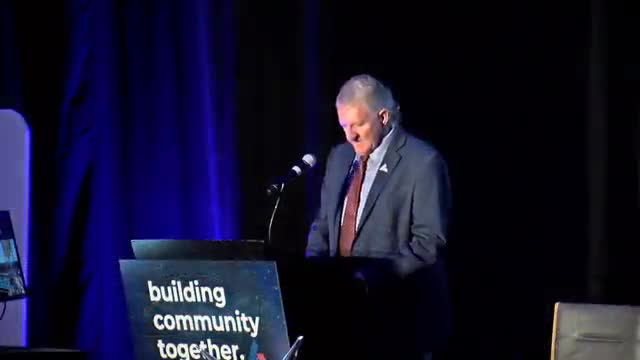
City of Abilene officials onstage at the State of the City event said water supply and water quality remain the city’s highest long-term priorities, describing new regional arrangements and regulatory risks that could carry major costs.
Mayor Waldenhurst and City Manager Robert Hanna described a portfolio approach that includes activating the city’s connection to the Possum Kingdom supply, restarting permitting for the Cedar Ridge reservoir and participating in a West Texas groundwater partnership with Midland and San Angelo.
“Water is always on our mind. The future of Abilene depends on water,” Mayor Waldenhurst said in the presentation, outlining steps taken over the last decade to add capacity and reuse treated flows. City officials said Abilene has secured an additional 11,000,000 gallons per day of new raw water allocation and roughly 8,000,000 gallons per day of treated reuse capacity.
Hanna said the city is preparing to activate the Possum Kingdom connection “probably about maybe 12 months away,” and that the state of Texas is expected to issue a draft water-rights permit for Cedar Ridge in the near term. He described the West Texas Water Partnership as an arrangement to move roughly 25,000 acre-feet of groundwater from Pecos County to partner cities, and said design work is underway on conveyance and delivery.
Officials also raised PFAS — the class of persistent contaminants regulated by the U.S. Environmental Protection Agency — as a policy and cost risk. “There are EPA regulations that … [make it] impossible for us to remove these levels,” Mayor Waldenhurst said, and presented a city estimate that full PFAS compliance could cost on the order of $300 million to $400 million over the next five to 10 years if federal or state requirements are stringent.
City staff and speakers stressed the projects are at different stages: some are operational planning (Possum Kingdom), some are in permitting (Cedar Ridge, Corps of Engineers engagement) and others are in engineering and design (the West Texas groundwater conveyance). Officials repeatedly framed the approach as multi-step and multigenerational rather than a single fix.
“There’s a lot of steps over many generations,” said a longtime water employee, Rodney Taylor, who was recognized at the event as retiring after nearly four decades with the city’s water utility.
Officials said they are engaging state and federal partners on PFAS, pursuing regulatory clarity, and planning to “exceed regulatory requirements” while seeking any available legislative or federal relief to lower compliance costs.
The remarks were part of a broader mayoral presentation that also covered streets, parks and economic development. Abilene leaders emphasized that water capacity underpins residential, commercial and industrial growth and that the city must keep pursuing multiple supply and treatment options.
Ending note: City officials did not present binding commitments to a single new reservoir or pipeline today; they described ongoing permitting, engineering and intergovernmental work and cautioned that costs and timelines remain subject to permits and partner approvals.