Get Full Government Meeting Transcripts, Videos, & Alerts Forever!
Get email alerts on the Child Custody topic
No spam. Unsubscribe anytime.
Senate Judiciary Hears Wide-Ranging Testimony on Shared‑Parenting Bill; Committee Takes No Action
Summary
Wyoming Senate Judiciary Committee heard hours of testimony on Senate File 117 (shared‑parenting presumption). Judicial, child‑support and family‑law stakeholders highlighted drafting problems—statutory conflicts, a 300‑mile provision, and paternity inclusion—and committee members did not move the bill, instead adding the topic to interim study.
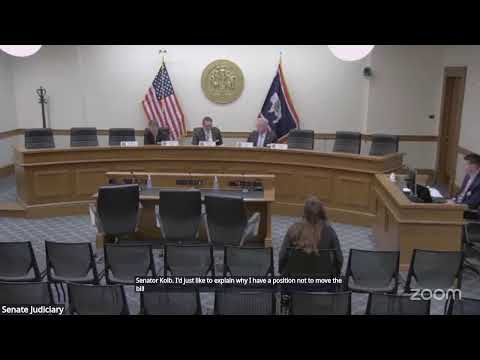
The Wyoming Senate Judiciary Committee heard more than three hours of testimony on Senate File 117, a proposal to create a presumption of shared parenting for custody cases, but the committee did not move the bill and closed public comment.
Supporters said the bill would normalize shared parenting and keep both parents involved; opponents and state agencies warned the draft contains drafting conflicts and could increase litigation or create unintended involvement by the child‑support system.
Alisa Butler, state court administrator for the Wyoming Judicial Branch, told the committee the branch had no formal position but warned the bill as written could interfere with how judges analyze custody. “We actually anticipate that this will create more contention between the parties,” Butler said, adding that the draft raises questions about how judges should reconcile the bill’s presumption of shared custody with the existing “best interests of the child” framework and its 10 statutory factors.
Officials from the Wyoming Department of Family Services said the legislation is primarily a private custody matter but noted the bill could implicate child‑support processes if paternity actions are swept in. Mike Williams, an attorney who represents the child‑support office in Sheridan and Johnson counties, asked the committee to add an exemption: “except in actions brought by the Child Support Enforcement Agency,” so that paternity filings initiated by the agency would not automatically convert into mandatory custody proceedings.
Witnesses described competing practical concerns. Lynn Story Hyler, director of Safe Harbor at the Children’s Justice Center in Cheyenne, said judges need flexibility and urged the committee to reject the bill, citing cases in which standard visitation was unsafe. “Robbie was dead because the courts didn't have a way to assess how people maybe were gonna be in that child's life,” she said describing an early case that led her program to form.
Family‑law attorneys, including Abigail Fournier of Cheyenne, told senators many Wyoming judges already order shared custody where appropriate and cautioned the bill would remove judicial discretion. “This bill seeks to fix a problem that doesn't exist,” Fournier testified, saying the bill’s changes to legal custody language could generate more emergency hearings over day‑to‑day decisions such as medical treatment or schooling when no tie‑breaker is provided.
Practitioners and advocates disagreed on systemwide effects. Beth Lance of the Wyoming Trial Lawyers Association and other family‑law practitioners expressed concern about limited exceptions in the draft and the potential for courts to face fact patterns they cannot easily resolve. Conversely, representatives of the National Parents Organization and several parents testified that states with shared‑parenting presumptions have seen more shared orders and, in some reports, reductions in certain harms.
Committee members focused on several recurring drafting issues identified in testimony: conflicting placement of the new presumption relative to the existing “best interests” factors (transcript references to subsection A vs. subsection D), a 300‑mile residence provision and a broadly worded “catchall” exception (romanette 5), the standard of proof (clear and convincing vs. preponderance), and the bill’s potential to bring paternity actions under mandatory custody requirements (lines cited as “lines 23 in subsection A”). Several witnesses urged clarifying language or a statutory carve‑out for child‑support enforcement actions.
Senators and witnesses also discussed implementation timing. One longtime practitioner urged the committee to make the law effective immediately if passed; others suggested a temporary presumption during pendency could allow courts and families to test shared parenting, a change some attendees said could establish a status quo that tends to persist.
After public testimony, committee members declined to move the bill. Several senators said they supported the concept of increased shared parenting in principle but found the current draft legally and practically problematic and better suited to interim study and stakeholder negotiation. Senator Kolb requested the topic be considered as an interim study; Chairman Olsen confirmed it would be added to the interim topics list. Without a motion to advance the bill, the committee closed the hearing and adjourned.