
Council adopts zoning changes to implement housing element, permits certain housing uses in Stanford Research Park
Get AI-powered insights, summaries, and transcripts
Sign Up Free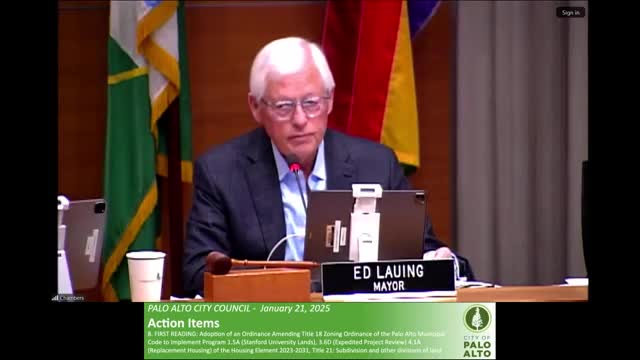
Summary
Palo Alto's council voted to change municipal zoning code to implement several housing element programs, including allowing housing in the Stanford Research Park as a permitted use with exemptions; one council member recused for Stanford ties.
The Palo Alto City Council adopted a package of municipal code changes on Jan. 21 to implement portions of the city's 2024 housing element, including amendments that will permit certain housing uses in the Stanford Research Park.
Planning Director Jonathan Lait and Senior Planner Vishnu Krishnan presented the ordinance amendments, which update Titles 18 and 21 of the Palo Alto Municipal Code to implement programs from the certified housing element. The changes submitted to council include permitting multi-family residential uses within Stanford Research Park (with exemptions for sites subject to the city's hazardous materials rules), limiting the number of Architectural Review Board public meetings for certain projects, setting no-net-loss standards for demolished housing, and enabling a range of housing types required by state law (such as group homes, low-barrier navigation centers and farmworker housing in specified zones).
Before the council took action on the provision that would change the Research Park from requiring a conditional-use permit to allowing housing as a permitted use, Vice Mayor Venker recused herself because she provides patent services to Stanford and had a potential conflict. City Manager Ed Shikada also stepped aside for that segment because of a family connection to Stanford Health Care.
Council Member Burt moved and Council Member Stone seconded the council's segmented action to adopt the portion of the ordinance that removes the conditional-use requirement for housing in the Research Park; the motion passed on a 6-0 vote with Vice Mayor Venker recused. After the Research Park segment concluded and recused members returned, the council then proceeded to act on the remaining ordinance elements. Council Member Stone moved adoption of the remaining staff-recommended amendments and Council Member Rekdal seconded; that motion carried unanimously.
Council members discussed several policy points during debate, including the importance of continuing work on youth-focused suicide prevention and the interplay between housing choices, parking and downtown land use. Staff said the code amendments were needed to meet housing element implementation deadlines set by state housing authorities and to remove local regulatory barriers described in the housing element.
Ending
The ordinance amendments are effective immediately as adopted; staff will return to council if additional refinements or implementing actions are necessary. Council members emphasized that community engagement and interagency coordination (for example on hazardous materials and farmworker housing standards) will continue as projects proceed under the new code rules.