Get Full Government Meeting Transcripts, Videos, & Alerts Forever!
Get email alerts on the Signs topic
No spam. Unsubscribe anytime.
Planning commission backs ordinance change to treat roof signs as freestanding signs
Summary
The Moab City Planning Commission voted unanimously Dec. 12 to recommend city council approve Ordinance 2025-01, which would allow roof-mounted signs to be regulated and counted as freestanding signs under Moab Municipal Code section 17.93.060, preserving existing size limits while giving downtown businesses a rooftop option.
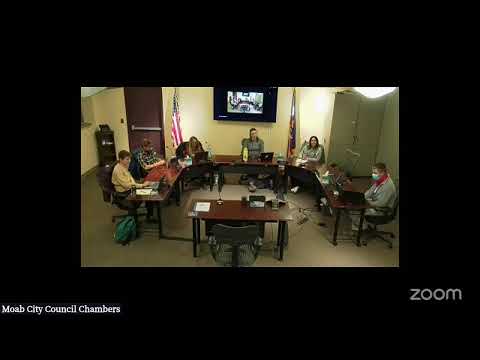
The Moab City Planning Commission voted unanimously Dec. 12 to forward a positive recommendation to the City Council on Ordinance 2025-01, an amendment to Moab Municipal Code section 17.93.060 that would allow roof-mounted signs to be regulated and counted as a property’s freestanding sign.
The change would let a business use a roof-mounted sign in place of a freestanding pole sign without expanding the total allowed sign area or exceeding the existing 28-foot height limit, proponents said.
Corey Shirtleff, city staff, explained the amendment is a development-code text amendment submitted by a downtown business owner to resolve a narrow regulatory inconsistency. Shirtleff said current code treats roof signs differently from freestanding signs and that, in some cases, a business could “manipulate” the rules depending on mounting style. The proposed language would make design rules “more consistent regardless of mounting or installation style” and count a roof sign as one of a property’s allowed freestanding signs if the owner chooses that option.
Applicant Will Petty, owner of the Jailhouse Cafe, told the commission he is opening a new downtown business, Elsie’s Old World Delights, and wants the option of a roof-mounted neon sign that would fit the site and avoid placing posts in an outdoor dining area. “What I’m asking is an amendment to the sign ordinance that would say, okay, well, if you want to consider a roof sign to be your primary sign…that 1 sign doesn’t have to meet the requirements for roof and wall signs, but it still has to meet the requirements of a primary sign. It’s limited to, like, 28 feet,” Petty said.
Commissioners discussed placement, adjacency and how the amendment would operate in different zones. Several commissioners said the change effectively creates an “either/or” option — a property could either place its primary sign on posts in front of the building or on the roof, but not both. Commissioners and staff observed the proposal does not increase permitted sign area or height but changes where a primary sign may be sited. Staff noted the proposed language in the packet was applicant-drafted and appeared concise; staff suggested minor edits to align it with other code language.
Commissioners also asked about other agencies’ roles. Shirtleff said the Utah Department of Transportation has authority over signs in its right-of-way and that in practice UDOT becomes involved when signs encroach in the right of way, and the electric utility or other companies may be consulted for technical matters. Commissioners asked about the town’s lighting and dark-sky rules; Shirtleff said neon is an acceptable lighting style under the city’s dark-sky-related regulations and that the sign code’s illumination and intermittent-flashing limitations and curfews (illumination tied to business hours and restrictions on flashing) would still apply.
Miles Lofton moved that the commission forward a positive recommendation to the City Council on Ordinance 2025-01. The motion was seconded by Mikkel Layton and passed unanimously.
The commission’s recommendation will go to the City Council for final action; staff and the applicant said they intended to pursue the ordinance through council in the coming weeks.
The amendment does not change existing height limits or square-footage allowances; it changes whether a primary sign may be roof-mounted and counted as a freestanding sign under the same dimensional limits.