Get Full Government Meeting Transcripts, Videos, & Alerts Forever!
Get email alerts on the Adu And Planning Updates topic
No spam. Unsubscribe anytime.
Broomfield staff outlines multi-year planning code updates; council gives preliminary direction on ADU changes required by HB 24-1152
Summary
City planning staff reviewed a multi-year work program to update Broomfield's planning and development regulations and sought council direction on accessory dwelling unit code changes required by HB 24-1152.
City planning staff reviewed a multi-year work program to update Broomfield's planning and development regulations and asked for council direction on accessory dwelling unit (ADU) changes required by recent state legislation (HB 24-1152).
Deputy Director Lynn Merwin described 2025 priorities including a major comprehensive plan update, an I‑25 subarea rewrite, energy code updates and a fast‑track review for income‑aligned housing. She said several items are driven by state mandates, including ADU code changes, parking minimum updates, transit‑oriented community requirements and landscaping changes to reduce nonfunctional turf.
Senior planner Ted Harburg presented the ADU-specific implications of HB 24-1152. Current Broomfield rules, Harburg said, allow ADUs attached, detached or interior to the principal dwelling; cap ADUs at 50% of the primary dwelling footprint and 800 square feet maximum; require one off‑street parking space per ADU; require owner occupancy of either the ADU or the primary dwelling; and prohibit ADUs from being used for short‑term rentals.
HB 24-1152 requires jurisdictions to allow ADUs where single‑unit homes are permitted and includes additional provisions that differ from Broomfield's current code. Harburg identified the state's three items of interest for local code changes: minimum/maximum ADU size thresholds (the bill forbids forcing ADUs smaller than 500 sq ft or larger than 750 sq ft), restrictions on design standards that are stricter for ADUs than for primary homes, and limits on requiring a new off‑street parking space (with exceptions such as parcels that currently lack any off‑street parking or blocks where on‑street parking is prohibited). He also noted the state offers a voluntary ADU supportive‑jurisdiction report and potential grant funding administered by the Department of Local Affairs; that report is due June 30 for initial consideration.
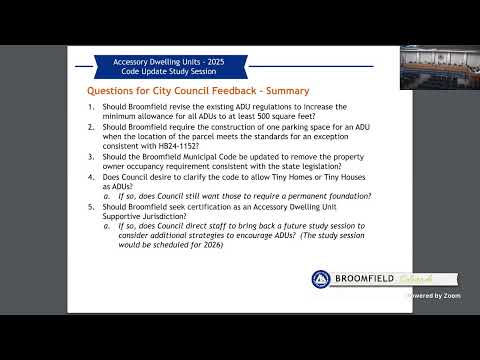
Council discussion covered a range of issues. Several council members supported raising Broomfield's ADU minimum to 500 square feet, opposed requiring new off‑street parking for every ADU, and emphasized continuing the city's prohibition of ADUs used as short‑term rentals. Council members were split on removing the property‑owner occupancy requirement; some said state compliance means the local code must change, while others worried about absentee landlords. On tiny homes, the council asked staff to clarify definitions and safety requirements. Chief Building Official Tim Pate explained Broomfield's soils conditions and recommended foundations or engineered tie‑down systems for tiny homes; council members proposed alternatives such as engineered tie‑downs or slabs as lower‑cost options but emphasized safety and neighborhood character.
Staff identified several cleanup items to bring to the code update: harmonizing local definitions for mobile/manufactured/modular/tiny homes with state definitions, resolving rare zoning districts where accessory setbacks exceed principal setbacks (for example the E‑3 district where accessory side setbacks are larger), and clarifying whether ADUs trigger additional water license fees or public land dedication (staff said Broomfield currently does not require new water license fees nor public land dedication for ADUs).
On timing and next steps, staff said a first reading of an ADU ordinance is tentatively scheduled for March if council directs staff to proceed; staff also warned that the multi‑year work program is contingent on staff capacity and that large development workloads could delay some items. Staff also noted that homeowner association (HOA) bans on ADUs are preempted by the state starting June 30, 2025, meaning homeowners in HOAs should first review HOA rules and then consult the city when ready to pursue an ADU.
Council provided preliminary direction (no formal vote): proceed to draft code amendments necessary to comply with HB 24-1152, consider a 500‑square‑foot minimum ADU allowance, keep the city's prohibition on ADUs as short‑term rentals, avoid blanket new‑parking requirements except in the state's listed exceptions, clarify tiny‑home standards with foundation or engineered tie‑down options, and return with a draft ordinance and public outreach plan. Staff and council members disagreed on whether the city should apply now to the state ADU supportive‑jurisdiction program; a number of council members said they were not convinced the potential grant benefits justify staff time and uncertain grant outcomes.