Get Full Government Meeting Transcripts, Videos, & Alerts Forever!
Get email alerts on the County Recorder Appointment topic
No spam. Unsubscribe anytime.
Cochise County supervisors set timeline for county recorder appointment, seek Republican input
Summary
The Cochise County Board of Supervisors agreed on a recruitment timetable and public-input steps after Recorder David Stevens submitted his resignation. The board will require appointees to be Republican registered voters and set a Feb. 11 application deadline, with finalists reviewed publicly Feb. 18 and an appointment effective March 1.
The Cochise County Board of Supervisors set a schedule to fill the vacancy in the county recorder’s office after Recorder David Stevens submitted his resignation, and the board directed staff to solicit applications and gather input from local Republican precinct leaders.
“Recorder David Stevens gave his resignation a couple weeks ago,” said Miss Gilman, a county staff member, noting that the person appointed would serve until the 2026 primary and then must run to complete the four-year term. The board agreed to an expedited timetable that would allow handoff time before Stevens’ departure.
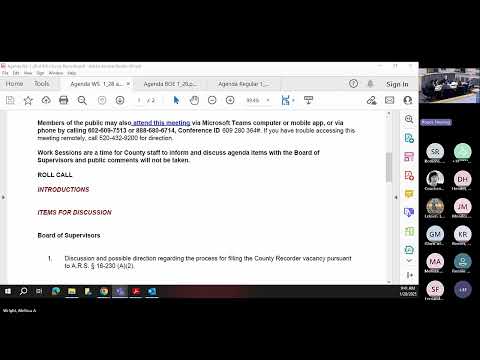
The board’s planned process, as discussed at the Jan. 28 work session, calls for the clerk of the board to accept letters of intent and resumes and for staff to compile applicant packets for the supervisors to review. The board directed staff to set Feb. 11 as the deadline for applications, to select finalists and solicit public comment on Feb. 18, and to make an appointment effective March 1 if a candidate is chosen.
Why this matters: the recorder’s role combines administrative duties — maintaining voter rolls, recording deeds and official records — with statutory and election-related responsibilities that can require legal defense and interaction with other elected officials. Board members emphasized the office is partisan and that appointees must be Republicans and qualified electors under state statute.
Board members discussed multiple elements of the process: whether to accept applications before the board officially acknowledges the vacancy, how to vet residency and party affiliation, whether to request recommendations from county Republican precinct committeemen, whether deliberations and interviews should occur in executive session, and whether to run criminal background checks on finalists.
Miss Gilman advised the board that state statute requires the board to appoint a replacement but does not prescribe a detailed process. “All statute says is that you shall appoint. It doesn't give a process and that the person must be Republican and of the party that you were and a qualified elector,” she said. The board directed staff to verify party registration and residency status for applicants.
Several supervisors urged a process that balances transparency with candidate privacy. The clerk will compile application materials; the board may screen a larger pool and reduce it to a smaller group of finalists (members discussed three to five as typical ranges). Finalists’ identities and application materials would be made public at the point the board formally notifies them of interviews. The board also discussed allowing precinct committee recommendations as an advisory input rather than a binding shortlist.
Board directions and timeline discussed at the session: - Feb. 11 — deadline for letters of intent, applications, and resumes to the clerk of the board. - Feb. 18 — public-input session on finalists in the morning, interviews in the afternoon, followed by potential executive-session deliberation and a formal appointment in open session. - March 1 — effective date the board discussed for the new recorder to assume duties if appointed.
Supervisors recommended adding vetting steps such as a criminal background check and arranging a short office handoff or walkthrough for finalists so candidates understand the scope of responsibilities. They also noted the coming legislative session and ongoing litigation related to elections, underscoring the importance of appointing someone able to handle legal and political pressures in the role.
The board did not take a formal vote during the work session; members reached agreement on directing staff to publish the notice and follow the timetable outlined above. The board will place the official acknowledgment of the vacancy on a future agenda as the first formal step toward appointment.
Looking ahead: the board said it will finalize the number of finalists to interview when applications are screened and expects public input on the finalists before making a final choice. The appointed person, if selected under the discussed timetable, would receive several days for a handoff before Stevens’ last day and would be required to run in the 2026 primary to seek the remainder of the term.