Get Full Government Meeting Transcripts, Videos, & Alerts Forever!
Get email alerts on the Student Outcomes Monitoring topic
No spam. Unsubscribe anytime.
SFUSD monitoring: 3rd‑grade literacy flat with EL gaps; 8th‑grade math shows mixed results and pilot gains
Summary
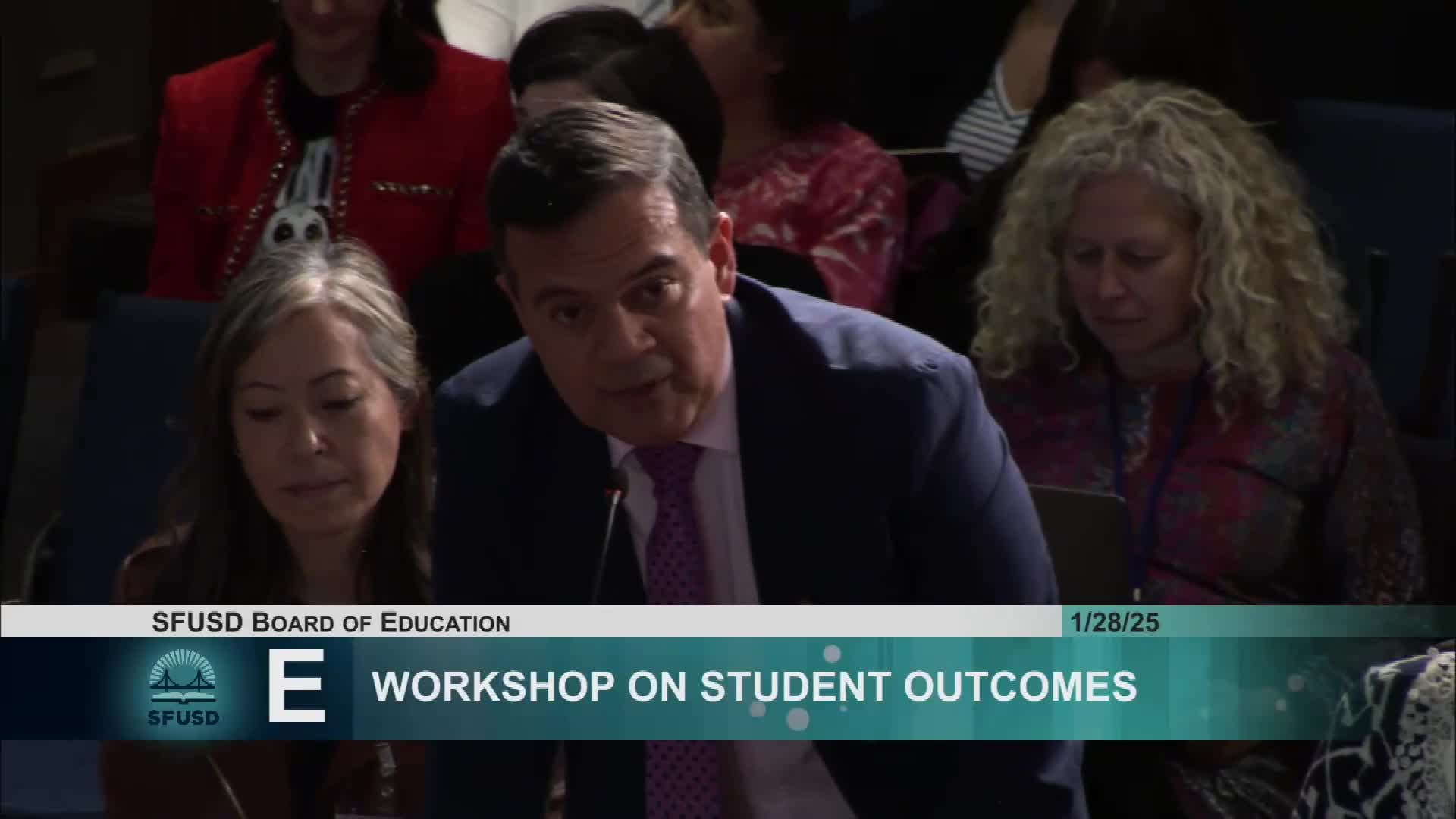
District staff presented progress monitoring for Goal 1 (3rd‑grade literacy) and Goal 2 (8th‑grade math). Presenters reported flat long‑term literacy performance with English‑learner gaps and early signs of stronger math results at the middle grades tied to curriculum pilots and coaching.
District staff told the board that the district’s interim monitoring data show divergent patterns for the two student outcome goals presented at the workshop.
For Goal 1 (3rd‑grade English language arts measured by SBAC), staff said the overall pattern over recent years has been generally flat with a small decline in 2024. Staff explained that the district revised the short‑term target trajectory after 2024 performance fell short; the long‑term target of 70% proficiency in 2027 remains the stated aim. Staff flagged that participation rates on interim STAR assessments increased in some grades and noted a bright spot: African American and Pacific Islander kindergarten cohorts performed well in fall assessments. Conversely, 3rd‑grade English learners scored lower than other cohorts, prompting district emphasis on language transfer strategies, bilingual curriculum alignment and targeted coaching. Staff said mid‑year STAR results (a February window) were not yet available at the time of the presentation and will be used to assess growth.
For Goal 2 (8th‑grade math measured by SBAC), staff presented a longer downward trend in historical results but said the most recent fall interim results showed improvement across cohorts. Staff reported that middle‑school curriculum pilots and targeted professional learning were showing early, promising signals. An in‑house preliminary analysis that staff described as tentative found a positive association between participation in middle‑grade curriculum pilots and fall assessment performance; those effects were seen at the middle level in the preliminary work and will be analyzed more deeply with winter assessment data.
Across both reports, staff described implementation work that aims to translate new materials into classroom practice: learning walks (internal and external), coaching cycles, a Language and Literacy Institute for teachers, grade‑level planning, and targeted professional learning for multilingual learners. Staff also noted implementation challenges — for example, a limited pool of credentialed coaches for math because teaching vacancies constrained hiring for coaching positions, and patchy usage of some digital tools where very few eligible students reached recommended usage dosages.
Board members asked for more disaggregated and site‑level analysis to identify bright spots (schools with strong gains) and to map how staffing vacancies and coach placements correlate with outcomes. Several board members expressed interest in seeing examples of school‑level practices linked to outcomes (for example, school leaders’ use of lesson study and principal leadership moves that accompany measurable gains) and requested clearer executive summaries in monitoring materials. Staff agreed to provide deeper site‑level analyses and to return with additional data after the winter STAR administration.
The monitoring presentations emphasized that efforts to improve outcomes include new curriculum adoptions, increased use of coaches, lesson study networks and curriculum pilots; staff said they will continue to connect implementation measures to student outcomes in subsequent reports.