Get Full Government Meeting Transcripts, Videos, & Alerts Forever!
Get email alerts on the National Guard Deployment topic
No spam. Unsubscribe anytime.
Wyoming committee passes 'Defend the Guard' bill after debate, adopts amendments to soften enforcement language
Summary
Representative Nate Singh told the Education Committee House Bill 265 would require a formal congressional declaration of war before the Wyoming National Guard could be deployed into active combat zones overseas.
Representative Nate Singh, sponsor of House Bill 265, told the Education Committee that the bill would bar the Wyoming National Guard from deployment into active combat zones overseas unless Congress issues a formal declaration of war.
The bill’s sponsor presented the measure as a constitutional safeguard, citing Article I, Section 8, Clause 11 of the U.S. Constitution and arguing that state Guardsmen have been deployed without congressional declaration under broad authorizations such as the post-9/11 Authorization for Use of Military Force.
The bill prompted extensive testimony and questions from committee members. Major General Greg Porter, Wyoming’s adjutant general, and other military leaders urged the committee to reject the bill, saying it would risk federal funding and equipment support because roughly 95% of the Guard’s budget is federal and the Guard serves as a primary combat reserve for the Army and Air Force. Porter warned that restricting federal access could jeopardize Wyoming’s aircraft and other capabilities and hamper the state’s ability to compete for new equipment such as a modern C-130J aircraft.
Retired Chief Master Sergeant Exe Brown and the Greater Cheyenne Chamber of Commerce also testified in opposition, citing mission-readiness and budgetary risks. Opponents argued the bill could prompt the Department of Defense to reassign missions or withhold modernization if the Guard’s federal availability were limited.
Supporters, including Representative Tyler Lindholm, student groups from the University of Wyoming and veterans, told the committee the bill would restore constitutional war powers to Congress and protect Guardsmen from open-ended overseas combat deployments that do not have explicit congressional authorization. Student leaders and local veterans framed the measure as a statement in defense of federalism and the original role of state militias.
Committee members debated enforceability and potential legal conflict with federal law. Several members said the bill as originally drafted used mandatory language that likely could not withstand federal preemption and judicial review. To address those concerns, the committee approved two amendments that softened the bill’s enforcement language: one replacing the word "shall" with "should" in a key provision and striking a sentence directing the governor to "take all actions necessary to comply with the requirements of this section." The committee also amended a second clause to change a strongly worded preemption phrase into a legislative expression of desire rather than a direct legal instruction.
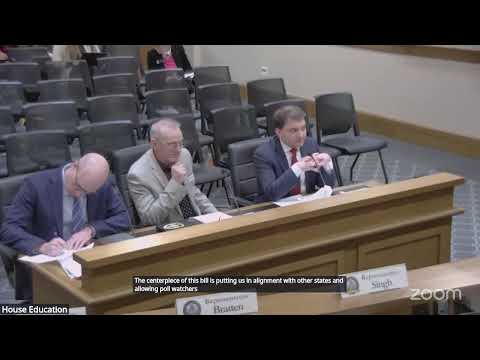
After debate and the amendments, Representative Straka moved that House Bill 265 do pass as amended; the motion was seconded by Representative Singh. The committee voted by roll call: Representatives Bratton, Erickson, Guggenmoss, Kelly, Lawley, Singh, Strock, Williams and Chairman Andrew voted "Aye." The committee reported the bill as passed (9 ayes). No "no" votes were recorded in the transcript roll call.
The bill’s supporters framed the amended measure as primarily symbolic: a state-level policy statement urging that the Guard not be used overseas in active combat absent a congressional declaration. Opponents cautioned that even as a statement the measure could have practical consequences if the federal government reacted by limiting access to equipment or missions. Committee members discussed whether a resolution or softer statutory language would better reflect the bill’s intent without risking the Guard’s readiness or violating federal supremacy.
The committee did not adopt language creating specific criminal penalties or enforcement mechanisms. Several speakers said the bill left the president’s powers under Title 10 and the federal mobilization authorities intact; the sponsor and others stated the measure is intended to prevent Wyoming Guardsmen from being used in combat absent a declaration of war while preserving their ability to train, conduct humanitarian missions, and respond to disasters.
The committee forwarded HB 265 to the next stage as amended. The transcript shows the bill generated significant public testimony and interjections from both military leadership and student and veteran advocates, and it prompted the committee to change mandatory enforcement terms to advisory language to address legal concerns.
Ending: The committee’s action sends HB 265 forward as an amended statement-of-policy measure. Supporters hailed the vote as a defense of constitutional war powers; opponents warned of unintended effects on Guard readiness and federal support.