Get Full Government Meeting Transcripts, Videos, & Alerts Forever!
Get email alerts on the Zoning And Development Code topic
No spam. Unsubscribe anytime.
Skagit County staff propose reorganization of Title 14 to streamline residential permitting
Summary
A consultant briefed the Planning Commission on reorganizing Skagit County Code Title 14 to improve readability and speed residential permitting, including changes to setbacks, lot-certification, tables for zoning standards, and codifying director interpretations; critical areas work will be deferred to a second phase.
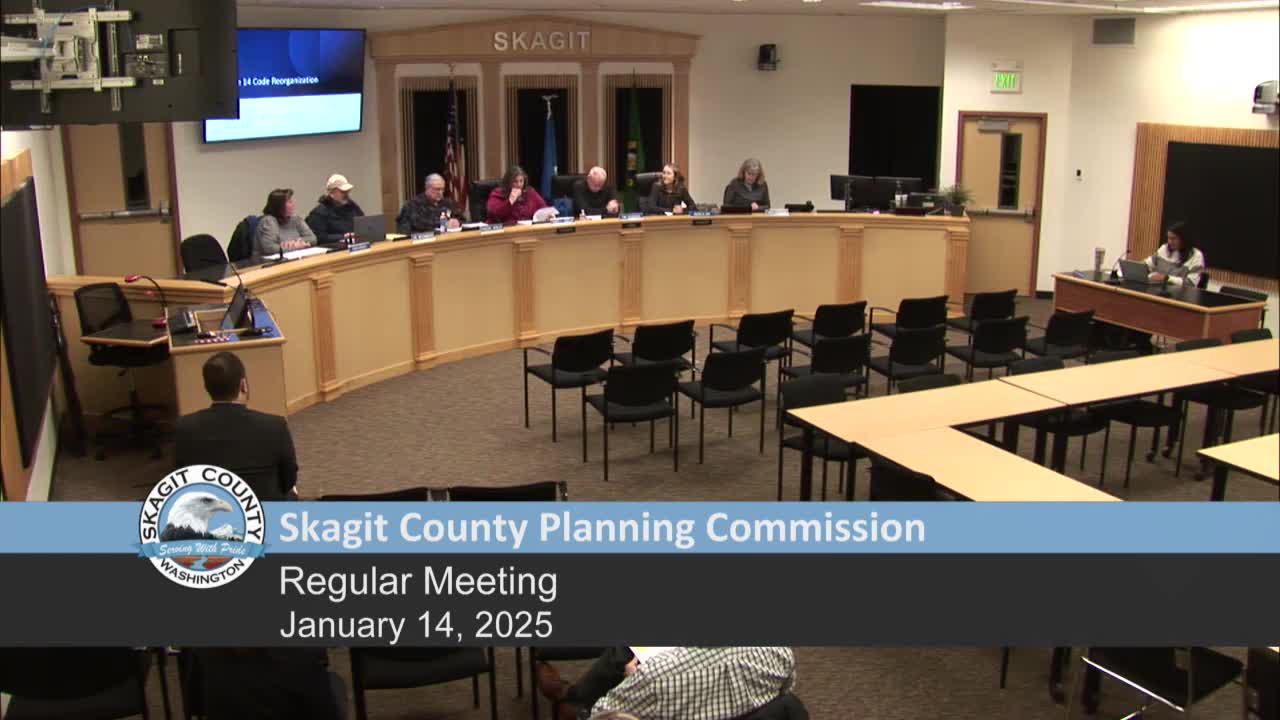
Ryan Walters, a private legal consultant to the Skagit County Planning Department, told the Planning Commission on Jan. 14 that staff plan a mostlyorganizational update to Title 14 of the Skagit County Code aimed at improving usability and reducing obstacles to residential permitting.
Walters said the project will group related chapters into six divisions, convert long narrative sections into tables (for uses, setbacks and dimensional standards) and remove non-development items from Title 14. He said the effort is intended to reduce the number of variances required when houses cannot meet current setbacks and to simplify the lot-certification process. “We’re not proposing to rewrite the entirety of Title 14,” Walters said. “It’s really reorganization with limited rewriting.”
Why it matters: staff and commissioners described the changes as intended to reduce time and cost for common residential permits without increasing development entitlements. Walters said typical permit obstacles — such as expensive variance proceedings and a cumbersome lot-certification process — are priorities for streamlining.
Key proposed changes and scope - Organization: Title 14 would be rearranged into six divisions (general provisions; zoning and land uses; special entitlements; land divisions; land-disturbing activities/stormwater; critical areas and shorelines; and public facilities). Many long chapters would be split into shorter chapters for ease of online navigation. - Zoning tables: Uses, setbacks, lot coverage and dimensional standards would be placed in code tables so differences among zones are visible and easier to harmonize. - Variances and setbacks: Staff will consider substantive setback changes intended to reduce reliance on the variance process, which Walters described as costly and time consuming. - Lot certification: The department will pursue streamlining lot certification requirements that staff say are often an obstacle to straightforward residential permits. - Director (formerly administrative official) interpretations: Walters said administrative interpretations issued over the years will be collected and proposed as code text so those interpretations are subject to legislative review rather than remaining only on a web page. “What we will do is gather up the director interpretations and move them into the code so the public and the commission can weigh in,” he said.
Critical areas and shorelines: deferred to a second phase Walters said critical areas (chapter currently numbered 1424) and shoreline regulations will be held for a second phase because consultants working on those topics are preparing substantive updates; staff want the Commission and public to evaluate those substantive changes separately from a broad reorganization.
Schedule and next steps Walters described a draft timeline in which staff would provide complete revisions to the department by April 6, 2025; the department would publish materials for public comment, with a Planning Commission public hearing tentatively set for May 6, and Commission deliberations May 20. Walters said the Board of County Commissioners’ deliberations were anticipated in June and staff were “hopeful” adoption might occur before the end of June to meet comp‑plan deadlines.
Public and commission questions focused on naming conventions for divisions, how a use matrix would work, the mechanics of incorporating director interpretations into code and whether the reorganization would require renumbering chapters. Walters said general‑provisions chapters would likely retain existing numbers, and the draft will use highlighting and explanatory boxes (as used during last year’s permit-procedures update) to show where text originated and where administrative interpretations are being codified.
What will not change, according to Walters, is the underlying policy outcomes: the stated objective is to improve clarity and permit processing efficiency, not to expand development rights.
Next steps: staff will draft the reorganization package and return with a full draft for review and public comment according to the schedule Walters presented.