Get Full Government Meeting Transcripts, Videos, & Alerts Forever!
Get email alerts on the District Instructional Strategy topic
No spam. Unsubscribe anytime.
District outlines data teams, LinkIt analytics and expanded small‑group instruction to improve outcomes
Summary
District leaders described the use of LinkIt analytics, regular data teams, a district assessment calendar, and an expansion of small‑group instruction and foundational phonics (Foundations/Wilson) in primary grades as strategies to boost student performance.
District leaders presented strategies the Office of Teaching and Learning is using to support student performance, centered on data use, targeted small‑group instruction and expanded foundational literacy programs.
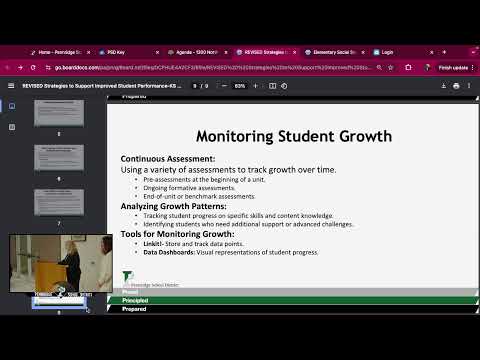
Presenters described LinkIt as a district data warehouse and analytics platform that aggregates classroom assessments, state tests, attendance and behavior data. The district uses data teams—comprised of administrators, IST teachers, guidance counselors and classroom teachers—at most schools to analyze assessment results and plan interventions. The district assessment calendar sets beginning‑, mid‑ and end‑of‑year checkpoints using tools such as DIBELS (K–3), LinkIt benchmark assessments and existing diagnostic tools.
Administrators said they transitioned secondary math and ELA to consistent benchmark assessments via LinkIt this year; those assessments provide comparable, non‑adaptive questions so teachers can isolate standards and plan small‑group instruction. The district reported an increase in small‑group instruction, especially in secondary math, and described physical changes in classrooms (whiteboards and horseshoe configurations) to facilitate rotation and targeted teaching.
Leadership also reported expansion of a Foundations phonics program in K–2 with in‑district master trainers from Wilson to certify district staff. The district plans to have five certified facilitators by the end of the school year to support implementation and coaching across the seven elementary schools.
Presenters said these measures are part of an ongoing, monitored approach—assess, teach, intervene, monitor—and that the district will report periodically on SMART goals and implementation progress. No new funding amounts or formal policy actions were recorded in the provided transcript.