Get Full Government Meeting Transcripts, Videos, & Alerts Forever!
Get email alerts on the Transmission Cpcn Waiver topic
No spam. Unsubscribe anytime.
Public Service Commission takes Potomac Edison CPCN waiver under advisement after questioning on cost allocation and reliability
Summary
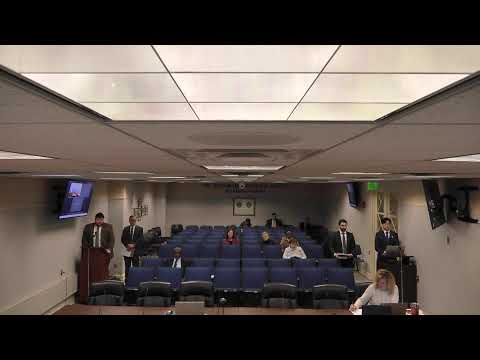
Potomac Edison asked the Public Service Commission on Feb. 19 to waive the CPCN requirement for two 230 kilovolt transmission line loops and related switching work to serve a proposed data center in Frederick County, but the commission took the matter under advisement after commissioners pressed staff and the company for more information on cost allocation and reliability.
Potomac Edison asked the Public Service Commission on Feb. 19 to waive the certificate of public convenience and necessity requirement for two 230 kilovolt transmission line loops and related switching work to serve a proposed data center in Frederick County, but the commission took the matter under advisement after commissioners pressed staff and the company for more information on cost allocation and reliability.
The request seeks authorization under the Public Utilities Article §7-207(b)(4)(i) to install two 230 kV transmission line loops connecting existing lines into a new switching station and to extend the lines to an aligned substation that will serve the data center campus. Staff told the commission it found the statutory criteria for a waiver had been met and recommended the waiver be granted, while noting the project will provide improved reliability through an additional substation and line loop.
Why the request matters: the project is part of a broader buildout Potomac Edison says is needed to interconnect a large industrial load — a data center campus at the Quantum Loophole/Quantum Blue Pool site in Frederick County — and has a sizable price tag that could be allocated across customers depending on tariff screening and FERC rules.
Staff and company figures presented at the hearing indicated a roughly $32 million total project cost for the transmission and switching work. Potomac Edison representatives said the cost of the aligned substation itself is not included in that $32 million and will be borne directly by the customer. Joey Chen, counsel for Potomac Edison, told commissioners, “the $32,000,000 does not include the cost of the aligned substation. Those costs will be handled by the customer.”
Commissioners pressed staff on whether reliability benefits drove the recommendation. Michael Dean of commission staff testified that he considered reliability in his review but said the staff recommendation rests on whether the statutory conditions for the waiver are met. Dean told the commission, “it was a factor, but the project itself, I believe, fits the mandatory requirements too.”
Cost-allocation was a central point of questioning. Staff and the company explained application of Potomac Edison’s line-extension tariff and a revenue-screening calculation will reduce the amount the new customer ultimately pays. Potomac Edison estimated the customer’s gross responsibility for non-network components at about $1.9 million and, after applying revenue screening, a net responsibility in the neighborhood of $1.617 million; the company said the balance would be allocated to distribution rates and, ultimately, other customers in accordance with tariff rules and FERC allocation.
Commissioner Sussman and Commissioner Richard repeatedly sought clarity on what the commission could or could not do about allocation. Staff counsel said the commission’s ability to direct transmission cost allocation is constrained by federal (FERC) jurisdiction. At one point a commissioner summarized the concern: if the company allocated more of the $32 million to ratepayers rather than the data-center customer, staff would still be compelled to recommend approval if statutory waiver conditions were met.
The commission asked Potomac Edison for additional, broader documentation of how this project fits into the utility’s multi-year planning (for example, its five-year reliability planning) and for a clearer explanation of how the company made cost-allocation decisions and applied the revenue-screening calculation. Potomac Edison said it could provide more information within one to two weeks and asked the commission for a decision by mid-April to meet the company’s construction timeline (company witnesses said transmission construction is scheduled to begin in June 2025, with an in-service date roughly January 2026).
No formal waiver was granted on Feb. 19. Instead the commission took the filing under advisement and said it would issue a written order giving further clarity on the scope of any waiver and next steps. Commissioners expressed interest in receiving the company’s planning materials and the detailed cost-allocation work so the commission and staff can assess reliability and rate impacts before ruling.
What’s next: the commission asked Potomac Edison to submit additional documentation on system planning and a breakdown of the cost-allocation and revenue-screening calculations. Potomac Edison requested a ruling on the statutory question should the commission choose to deny the waiver; the company asked the commission to make a clear ruling given the statutory basis of its request.
Speakers quoted in this article are from the hearing transcript and were present at the Feb. 19 Public Service Commission administrative meeting.
Ending: The commission did not rule Feb. 19; it requested additional filings from Potomac Edison and said it would issue a written order after reviewing the materials and the arguments presented at the hearing.