Get Full Government Meeting Transcripts, Videos, & Alerts Forever!
Get email alerts on the Civil Rights Immigration Readiness topic
No spam. Unsubscribe anytime.
Philadelphia council committee holds hearing on readiness to protect immigrants, LGBTQ+ and other marginalized groups
Summary
City officials, legal advocates and community leaders told a Philadelphia City Council committee the city has legal protections in place but needs more funding, fuller implementation of school protocols and expanded legal representation ahead of anticipated federal policy shifts.
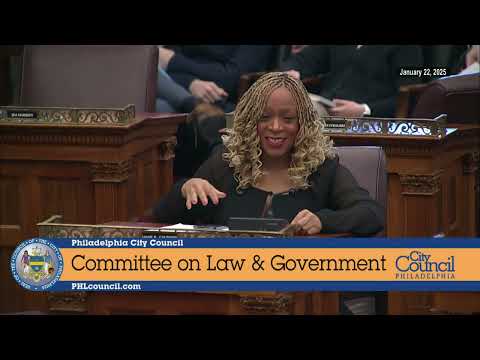
The Philadelphia City Council Committee on Law and Government held a public hearing Jan. 22 on Resolution 241090, which calls for hearings exploring the city’s readiness to protect immigrants, LGBTQ+ people and other marginalized communities in light of recent federal executive orders.
The hearing drew city officials, legal experts, school district leaders, nonprofit service providers and dozens of community speakers. Councilmember Rachel Landau, sponsor of the resolution, opened the hearing saying the session was “a collective call to defend the dignity, safety, and very existence” of communities she said face new federal threats.
City Solicitor Renee Garcia reviewed local legal protections, citing the Fair Practices Ordinance and two city executive orders: EO0809, which restricts collection and sharing of immigration status for most city services, and EO0516, which directs the city not to honor ICE detainer requests absent a judicial warrant. “We do not honor detainer requests,” Garcia said, adding that the city will honor judicially signed warrants.
Speakers highlighted three recurring needs: more funding for immigration legal defense, clearer and faster implementation of school district sanctuary-school protocols, and sustained city leadership to defend existing nondiscrimination and confidentiality protections. Bob Lisenby, first assistant district attorney, told the committee that aggressive federal enforcement can chill victims and witnesses from cooperating with prosecutions and that the DA’s office will use its powers “to protect our community and also to enforce the laws.”
Advocates and service providers urged the council to expand universal representation in immigration court. The Nationality Service Center and the Defender Association described gaps in representation — one presenter said 65% of recent Philadelphia immigration cases lacked counsel — and requested additional city funding to expand staff and intake capacity.
School district officials described revised policies for LGBTQ+ and immigrant students and staff, including a 2016 sanctuary schools resolution, guidance for handling ICE presence on campuses and new toolkits and trainings. Dr. Jamie Banks, chief of student support services, said the district has 104 GSAs and will add an LGBTQ+ coordinator; Dr. Natalie Nere, chief of special education and diverse learners, said the district has a protocol to refer any ICE requests to the Office of General Counsel and is preparing communications for families.
Legal advocates from the ACLU and other groups defended Philadelphia’s existing policies limiting cooperation with federal immigration enforcement, arguing the city’s approach is grounded in constitutional protections and reduces civil‑liability risk. Harper Seldin of the ACLU LGBT & HIV Project warned of likely federal attacks on transgender rights and urged the city to fund and support local services and legal challenges.
Multiple community organizations and individual residents used the public-comment period to recount personal experiences with detention, language access gaps, and the effects of past convictions on immigration status. Community groups pressed for immediate steps including full implementation of the sanctuary‑schools resolution, funding for newcomer programs, expanded language and interpretation services, and targeted funding for legal representation and refugee resettlement supports.
No formal votes or policy changes occurred at the hearing. Councilmembers and witnesses said follow-up briefings, budget requests and further oversight conversations would be needed to translate the hearing’s requests into concrete actions.