Get Full Government Meeting Transcripts, Videos, & Alerts Forever!
Get email alerts on the East Adams Redevelopment topic
No spam. Unsubscribe anytime.
Syracuse officials propose fronting $2 million to speed NEPA and unlock $30 million for East Adams redevelopment
Summary
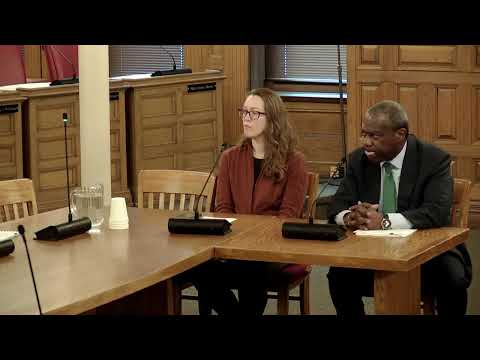
Syracuse City staff on a joint Economic Development and Public Works study session proposed using $2 million in city capital to advance the environmental review needed to unlock $30 million in federal Reconnecting Communities and Neighborhoods funds for the East Adams neighborhood.
Syracuse City staff on a joint Economic Development and Public Works study session proposed using $2 million in city capital to advance the environmental review needed to unlock $30 million in federal Reconnecting Communities and Neighborhoods funds for the East Adams neighborhood.
Sarah Walton, a staff member with the Department of Neighborhood and Business Development, told councilors the city received $30,000,000 of Reconnecting Communities funding allocated through the New York State Department of Transportation and that completing a National Environmental Policy Act (NEPA) review is required "to unlock those funds." She said the city has a separate $10,000,000 allocation from the governor administered through Empire State Development (ESD) to cover predevelopment expenses, but that ESD's disbursement timeline is later than the schedule needed to meet Federal Highway Administration design deadlines.
Completing NEPA by May is the stated deadline. Walton said the proposed approach is for the city to temporarily advance funds so McCormack Baron Salazar (the housing authority's master developer) can contract Langan, the engineering firm already conducting environmental work for the housing component, to complete a single, comprehensive environmental review covering both housing and public-street improvements. Walton said the city would use unallocated cash capital to "front the money, the $2,000,000 and then we're gonna be reimbursed by ESD. At some point, what point would we" be reimbursed in 2025, she said.
Walton described the ESD allocation as fully reimbursable: "all of the funds, all $10,000,000 but especially the $2,000,000 we would use upfront are completely reimbursable by ESD." She said the city would enter an agreement with McCormack Baron Salazar (MBS) so MBS can hire the environmental firm and start predevelopment work immediately to meet the May NEPA target.
Walton noted ESD funding carries procurement and MWBE requirements and said MBS is already using Langan for the housing environmental review; combining the public-infrastructure review with the housing review would produce a more comprehensive analysis, she added.
Bill Simmons of the Syracuse Housing Authority confirmed his board passed a resolution at its last meeting supporting the project and discussed the related land-swap and appraisal work tied to the redevelopment. Simmons said the housing authority has a draft appraisal for Eastwood Heights near $2.6 million and that an outstanding appraisal for Latimer Terrace (the site proposed for the Children's Rising Center) remains pending. He warned delays could increase project costs to the housing authority and developer.
Michael Collins, Commissioner for Neighborhood and Business Development, told councilors that separate appraisal and land-swap issues remain outstanding and said those matters likely warrant follow-up at a later public meeting. Collins said conditional approval in a February council meeting would be important to avoid contractual and financing impacts to the housing authority.
Walton and other staff said the full redevelopment program will ultimately produce about 1,404 housing units and that the broader portfolio of funding across the project includes tax credit subsidies and other sources; she characterized the overall redevelopment as a near-billion-dollar investment once tax credits and other financing are included. Walton said the housing authority has secured approvals from the state housing agency (HCR) for its low-income housing tax credit applications and that the ESD and federal grant agreements have been signed.
On potential financial impacts tied to timing, Simmons said a reduction in the tax-credit subsidy rate from an example of $0.86 on the dollar to $0.82 on the dollar could cost the project "over $400,000," and staff noted a difference in projected future PILOT (payment in lieu of taxes) revenue of roughly $52,000 depending on appraisal and swap outcomes.
No formal council action to authorize the city to advance the $2 million occurred at the study session; staff presented companion pieces of legislation that would be placed on the council's agenda to allow the Department of Neighborhood and Business Development to enter the ESD agreement and for the Department of Engineering to enter an agreement with McCormack Baron Salazar to advance predevelopment and environmental work. The meeting concluded without substantive votes on those items.
Next steps described by staff include council consideration of the companion legislation on the study session agenda and starting the environmental work immediately if the council authorizes the funding advance, with the goal of completing NEPA by May and then receiving reimbursement from ESD to flow the reconnecting communities funds into public-improvement and housing construction work.