Get Full Government Meeting Transcripts, Videos, & Alerts Forever!
Get email alerts on the Cpc Governance Bylaws topic
No spam. Unsubscribe anytime.
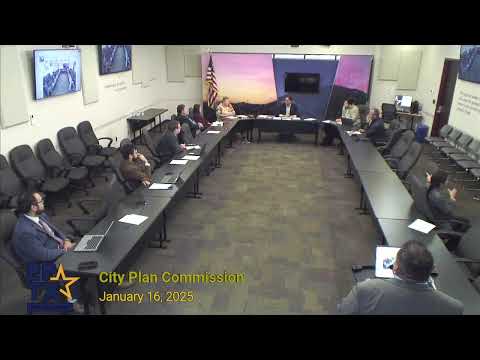
City Planning Commission re-elects Borrego as chair; debates bylaws on remote attendance, applicant time limits and term limits
Summary
At its Jan. 16 annual meeting the El Paso City Planning Commission reappointed Alfredo (Fred) Borrego as chair and considered bylaw updates on remote attendance, limits on applicant presentations and term-limit guidance.
The El Paso City Planning Commission completed its annual business agenda on Jan. 16 by re-electing its officers and discussing several proposed bylaw updates, including rules for remote participation, applicant presentation time limits and term limits for commissioners.
Alfredo (Fred) Borrego was reappointed chair after a motion and second were recorded; Commissioners Gorski and Hansen were elected as first chair and second chair, respectively. The motions were moved and seconded on the record and “motion carries unanimously,” according to the meeting transcript; the commission did not record a roll-call vote count in the transcript.
Commissioners then spent substantial time reviewing possible bylaw changes. Commissioner Brandon Carrillo asked staff and legal about providing searchable, selectable-text minutes rather than scanned PDFs and sought clarity on remote participation rules for commissioners. Kevin Smith of Planning Inspections said the city uses Microsoft Teams for virtual participation and that staff will coordinate with the City Attorney’s Office on legal limits for a state-created planning commission.
On remote attendance, commissioners split on policy. Commissioner Borrego said he preferred in-person meetings except in emergencies; Commissioner Sal Masood and others argued remote attendance expands civic participation for people who cannot travel to City Hall. City Attorney staff told the commission they could propose bylaw language defining when remote attendance is permitted and what conditions (for example, camera-on requirements) would apply.
Commissioner Carrillo proposed a 10‑minute time limit for an applicant’s presentation, with subsequent public speakers retaining the standard three minutes under public comment. Commissioner Carrillo said applicant presentations sometimes stretched to 15–60 minutes when multiple people spoke; he argued limiting applicant time would increase fairness and efficiency. Planning staff and Commissioner Sal Masood supported the 10‑minute proposal with a caveat: the commission could include language allowing extensions “upon the discretion of the commission.” No formal bylaw amendment was adopted at the Jan. 16 meeting; legal said staff would return with draft language.
On term limits, Planning Inspections staff (Kevin Smith) reminded the commission that city council has already set term-limit rules in city code section 2.04.005 for boards and committees; the code allows reappointment if an individual sits out a term, which resets eligibility. Staff noted appointments remain the prerogative of the mayor or a city council member. Commissioners discussed outreach and mentoring to broaden the applicant pool and reduce industry concentration among appointees.
Commissioners also requested more structured orientation for new appointees; staff said an orientation program already exists and is provided to new commissioners.
No bylaw changes were adopted at the Jan. 16 meeting; staff and legal said they will draft proposed amendments and return at a future meeting for consideration.