Get Full Government Meeting Transcripts, Videos, & Alerts Forever!
Get email alerts on the Parking topic
No spam. Unsubscribe anytime.
Hollywood commission approves expanded paid-parking zones, resident passes and other downtown changes
Summary
After hours of debate, the City Commission approved a package of changes expanding paid parking in downtown Hollywood and the beach, creating new resident permit rules, adjusting enforcement windows and making targeted changes to garages and surface lots.
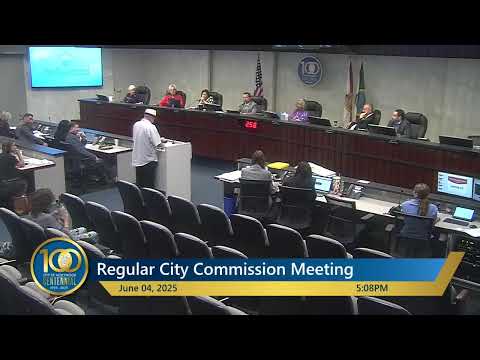
The Hollywood City Commission on June 4 approved a package of parking policy changes that expands paid parking into additional downtown blocks, creates or extends resident-permit options for nearby streets, narrows free on-street time limits in several blocks and directs staff to make targeted rate and enforcement adjustments intended to shift drivers into underused garages.
Commissioners and staff spent more than an hour discussing specific neighborhoods, enforcement practicality and impacts on businesses before voting unanimously to adopt the changes. Commissioner Maria (last name not specified in the transcript) moved the motion to approve; Vice Mayor Quintana seconded. The vote was 7–0.
Why it matters: Downtown and beach parking demand has risen with recent development. City officials said the changes are intended to limit long-term vehicle storage in prime on-street spaces, preserve short-term access for customers and residents, and make better use of underfilled garages — thereby protecting business activity and reducing circling traffic.
Most important decisions and direction - Paid-parking expansion: The commission agreed to expand paid parking into the blue-highlighted areas shown in staff materials (areas around Hollywood Boulevard, portions of Polk/Tyler/Seventeenth corridors and adjacent side streets). The commission directed staff to implement resident permit (RPP) programs for shaded blocks where residents lack on-site parking. - Time limits and local exceptions: Several on-street blocks were set to retain short free limits (two-hour or similar) and then convert to meter or permit enforcement beyond that window; specific block-level outcomes included leaving two blocks (identified in the staff map as Areas 11 and 19) free 24 hours and converting others (Areas 35, 36, 43, 48) to a two-hour free window followed by paid enforcement. - Golf-course perimeter (Areas 73 and 85): The commission agreed to add hourly paid parking on the west and south perimeters of the golf course while offering an annual resident permit for households whose homes on those shaded blocks lack adequate on-site parking. Permits will be limited (two permits per household was discussed) and restricted to vehicles registered to the household address; staff will return final program rules and eligibility language. - Polk/Post Office lot (Polk-Tyler): The commission accepted staff plans to incorporate the roughly 143-space Polk Street/Post Office lot into the city parking inventory; that lot will offer hourly and permit options and be included in employee/visitor permit mixes. - Keating Park lot: Commissioners expressed concern that nearby condominium residents are using the city-owned Keating lot as de facto private parking. The commission directed staff to phase out or otherwise restrict annual/ citywide permits at Keating pending a short audit of building parking inventories and permit holders; staff was asked to propose practical transition measures (including 30-day notice and prorated refunds for recent purchasers) and to return with recommendations. - Employee permit fee: Commissioners agreed to adjust the downtown/garage employee permit fee (discussion settled on lowering the $35/month permit to $30/month for employees as an incentive to use off-street garages). - Rate positioning and garage strategy: The Nevada (sometimes called Nebraska in staff materials) garage was identified as underused. Commissioners directed staff to use pricing and signage to move routine beach/downtown parkers into garages (for example, by modestly lowering Nebraska garage hourly rates and emphasizing it through wayfinding), while keeping on-street premium and time-limited for short visits.
What commissioners asked staff to do - Finalize RPP eligibility and enforcement rules, including limits per household and guest pass allowances (the commission discussed twice-per-month guest passes in line with the Lakes program). - Produce clear signage and outreach explaining new zones and where lower-cost garage alternatives exist. - Return with an implementation plan listing start dates, equipment needs and a public-notice timeline (including a proposal to phase changes to avoid sudden impacts on permit holders).
Discussion highlights and concerns - Business impact: Several commissioners expressed concern about hurting small businesses by introducing new fees in areas that rely on short, convenient visits. That led the commission to adopt compromises: two-hour free windows in some blocks, lower employee permit fees, and targeted rather than wholesale rollouts of paid meters. - Enforcement practicality: Commissioners and staff discussed enforcement burden and technical options (license-plate readers and drive-by LPRs vs. time-marking). Staff said modern LPRs and back-office review can reduce manual chalking; enforcement resources will be aligned to new time limits and LPR workflows. - Equity/affordability: The commission prioritized affordable resident permit rates for locals who lack on-site parking; resident discounts will continue to apply and staff was told to simplify enrollment.
What the city will do next Staff will prepare formal ordinance/resolution language and a granular implementation schedule. Parking staff will (1) begin public outreach to downtown businesses and residents, (2) coordinate signage and ParkMobile updates, (3) produce an exemption/transition plan for recently purchased annual passes (prorated refunds were discussed), and (4) return with final program rules regarding guest passes and enforcement windows.
Ending note: Commissioners framed the package as an effort to better manage finite curb space as downtown grows and to reduce “parking hogging” by some residents or employees. Several commissioners asked staff to return with a clear community-education plan before enforcement begins.