Get Full Government Meeting Transcripts, Videos, & Alerts Forever!
Get email alerts on the Sign Code topic
No spam. Unsubscribe anytime.
Planning commission backs sign code revisions for murals, portable signs and electronic displays
Summary
The commission voted to recommend City Council adopt amendments to Bend’s sign code to allow mounted murals, limited portable signs, modest electronic sign elements and higher wall-sign heights on taller buildings.
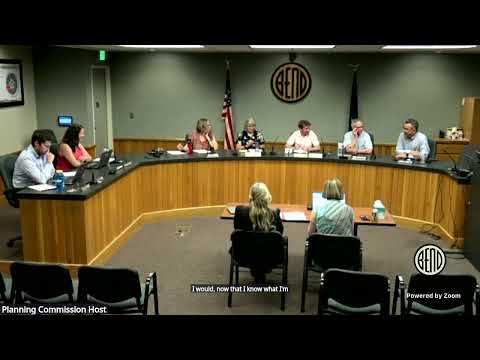
The Bend Planning Commission on June 9 recommended that City Council adopt revisions to Chapter 9.5 of the Bend Development Code that would update rules for murals, portable signs, electronic components and wall-sign height.
Amy Berry, principal planner for the city, presented the legislative package and told commissioners it implements council direction to examine murals and portable signs and to clean up other code provisions. She said the proposal would allow mural panels up to three inches thick to be mounted to buildings (still subject to structural and building-code review), permit downtown-style portable A-frame signs in nonresidential areas under a simple registration and spacing rules, authorize limited electronic components (for example, up to 25% of allowed freestanding sign faces or electronic drive-through menu displays under strict illumination limits) and raise the standard maximum wall-sign height from 24 feet to 30 feet (and up to 38 feet on buildings taller than three stories).
On murals, staff proposed two notable changes: allowing hand-painted murals to be mounted on panels that can be attached to a building, and enabling property owners to agree to more frequent mural change-outs (less than the current 12-month minimum) when all parties consent. Staff also preserved an exception for historic structures, where mural work will require additional building- and historic-review oversight.
Portable signs would be limited to business hours, not permitted in medians or roundabouts, must avoid ADA routes and bike racks and must be spaced from other portable signs. Commissioners and staff discussed details such as sidewalk clear width and how portable signs could be secured. Staff said temporary riverfront and other problematic uses (balloons, inflated signs) remain restricted.
On electronic displays, staff said the amendments codify an existing administrative practice that allowed some electronic menu boards and panels; the proposal limits changeable content (for example, a modest number of content changes per day) and sets brightness and illumination limits to avoid highway-style animated signage. Wall-sign area calculations and measurement rules were clarified, including how multi-tenant facades divide permitted sign area and how freestanding sign cabinet area is measured.
Commissioners asked a range of technical and design questions about how sign area is calculated, sight-line clearances for monument signs, and where neon or illuminated signs remain restricted. The draft keeps illuminated signs prohibited in residential sign districts and retains a cap on billboards.
After discussion the commission voted to recommend the code amendments to City Council. The commission asked that a planning commissioner attend the City Council hearing to represent the commission’s recommendation; the City Council hearing was scheduled for June 18. The recommendation does not itself change city code; it forwards the proposed amendments and staff findings to council for final legislative action.