Get email alerts on the Walkable Design Standards topic
No spam. Unsubscribe anytime.
Tualatin staff outline state-mandated walkable design standards, plan April draft code
Summary
City consultants reviewed Oregon's Climate Friendly and Equitable Communities (CFEC) walkable design rules, explained how they apply to the Portland metro area and to Tualatin, and said draft code amendments will be brought to council in April with final changes targeted by June.
City staff and consultants told the Tualatin City Council at a Feb. 10 work session that the city must adopt walkable design standards as part of the Climate Friendly and Equitable Communities (CFEC) rules and that draft code amendments will come back to council in April.
Kate Rogers, lead consultant on the project, said the CFEC rules are a state response to a directive to reduce greenhouse gas emissions from transportation and are codified in state law and administrative rules. Rogers pointed councilors to the walkable design section of the Oregon administrative rules (commonly referenced in the project as OAR 660-012-0330) and explained the rules apply to the eight largest regions in Oregon, including the Portland metropolitan area.
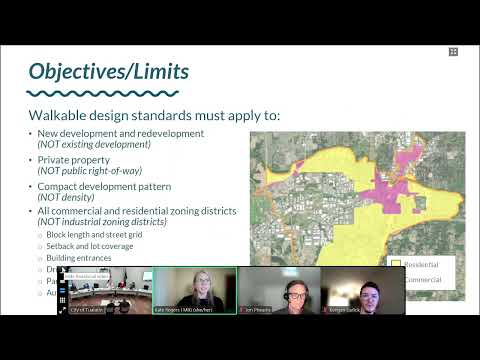
Rogers said the walkable design standards are intended to encourage pedestrian-oriented development, multimodal connectivity and compact development patterns so that more daily needs can be met by walking, cycling or transit rather than driving. She used Orenco Station in Hillsboro as a model example of a walkable, transit-oriented community and noted Tualatin's challenge is that it is largely built-out; the standards therefore will mainly apply to new development and redevelopment rather than existing buildings.
Erin Engman, senior planner, and Steve Cooper, assistant community development director, joined Rogers in explaining the work plan and timing. Engman said the city's Transportation System Plan (TSP) update is expected to be adopted this spring or early summer and that the walkable design code work is tied to that update; the consultant team plans to deliver draft code in April and final code amendments by June. Rogers added the city will request a timeline extension from the state because the code project is expected to finish after the TSP update.
Consultants outlined several code concepts under consideration: reduced block lengths or new standards for pedestrian/bike accessways, maximum building setbacks and rules for building entrances and orientation, shifting parking to side or rear of buildings rather than front-facing lots, and targeted limits or design constraints on drive-through and other auto-oriented uses in pedestrian districts. Rogers said the model code provided by the state is a helpful reference but not mandatory; Tualatin staff and the consultant team will propose locally adapted standards.
Stakeholder outreach included two focus-group sessions and meetings with a TSP community advisory committee and local development professionals. Rogers said developers generally urged flexibility in standards and supported shorter blocks, improved connectivity and more parking-location controls. The advisory committee raised concerns about safety, lighting and maintenance of mid-block pedestrian accessways.
Councilors asked clarifying questions about specific items. Councilor Socko and others emphasized safety and lighting for mid-block accessways and separation between pedestrians, bikes and cars. President Pratt asked about "stacking" lanes and drive-through standards; Rogers explained stacking refers to queuing space for cars that prevents driveway or sidewalk blockage and noted the model code suggests minimum driveway set-backs (for example, a 50-foot separation from an intersection is commonly used for safety) but that exact distances would be proposed by staff for Tualatin. Councilors also discussed whether some standards should vary by street type (local streets versus arterials) and whether any requirements should apply to existing development as buildings expand.
The consultant team confirmed the rules focus primarily on private-property development rather than public right-of-way improvements, which are addressed in the TSP. Rogers said the model code generally does not apply to industrial zones and called out that the city already adopted parking reform last year as part of CFEC compliance.
Rogers closed by asking whether councilors supported the general concepts; staff said they would return with draft code at the April work session and continue stakeholder outreach.
Ending
No formal action or vote occurred on Feb. 10. Staff were directed to continue developing draft code amendments for council review in April and to coordinate the codification timeline with the TSP adoption and a state extension request.
AI generated
The text on this page is AI generated. Summaries, highlights, analysis, and video transcripts are all produced from the original source material.
AI can make mistakes, so if you spot one, and we will fix it for everyone.
Note: the source content is unaltered by us. Any content source we link to, be it a video, an audio recording, or a document, is presented exactly as its publisher released it. That publisher is usually a government body, sometimes an individual official or another organisation.