Get Full Government Meeting Transcripts, Videos, & Alerts Forever!
Get email alerts on the Indigenous Rights Cultural Recognition topic
No spam. Unsubscribe anytime.
Hartford committee sends resolution recognizing colonialism’s impact on Indigenous communities to full council
Summary
The Committee of the Whole voted to forward a resolution that acknowledges the historical impact of colonialism on Indigenous people, and asks the city to pursue education, memorialization, and opportunities for cultural reconnection; presenters urged river access and a cultural center.
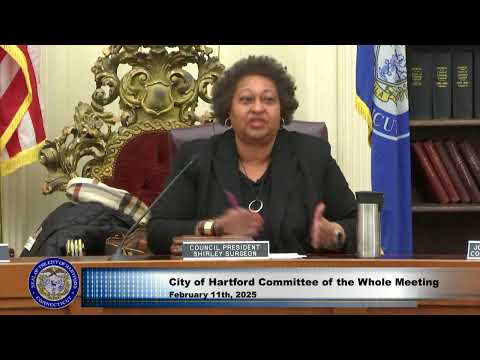
Hartford Court of Common Council’s Committee of the Whole voted Feb. 11 to send a resolution to the full council with a favorable recommendation that acknowledges the historical impact of colonialism on Indigenous communities and directs the city to seek partnerships that promote cultural revitalization and Indigenous self-determination.
The resolution asks the city to “seek to provide opportunities for native residents to reconnect with their cultural practice and ensure that indigenous voices are included in initiatives affecting their communities,” language read aloud at the meeting by Council President Shirley Surgeon.
The measure drew a presentation from Charles Teal, a retired chief of the Hartford Fire Department and longtime local historian, and representatives of the Sukiyag (Sukiyak) intertribal community. Teal, who described his work preserving memory of Hartford tragedies and history, told the committee the proposal rests on three practical goals. “It’s 3 things. Educate, memorialize, and apologize,” Teal said.
Miksa Sean, a presenter with the intertribal group, framed the resolution as a step toward changing civic consciousness. “When you’re an alcoholic, you have to admit that you’re an alcoholic. When you’re in a colonial state of mind, you have to admit that you’re in a colonial state of mind,” Miksa Sean said, urging that recognition precede other actions.
Other presenters described concrete priorities they would like the city to consider if the resolution advances, including identifying public land or a city-owned facility to serve as a cultural center, and restoring or guaranteeing access to the Connecticut River for traditional practices. Caleb Garrett, a member of the Sukiyak Intertribal Council, said the group seeks a “homeland, a location that can be known as Sukiyag territory” and greater access to the river.
Chief Jay Strong Buffalo of the Isola Nation described programming the group hopes to provide, including workshops on traditional land stewardship, herbal medicine and gardening, and youth activities. He said a stable location for gatherings would allow the group to teach skills they believe would benefit broader community health and cohesion.
Council members pressed presenters on practical questions, including whether the group had identified specific properties and whether they could sustain upkeep. Presenters said the intertribal council has organized a multi-year harvest festival and has raised funds through community contributions, and they requested city assistance identifying suitable sites and coordinating with state or federal entities where necessary. Committee members also discussed prior steps the city has taken, noting Hartford’s change to Indigenous Peoples’ Day as an earlier action.
Council President Shirley Surgeon asked staff member Charmaine Craig to convene a smaller follow-up meeting to identify next steps; Majority Leader Marilyn Rossetti and other members supported further talks. The committee recorded a motion to send the resolution to the full Court of Common Council with a favorable recommendation; the motion passed.
Votes at a glance
- Motion: Send the resolution acknowledging the historical impact of colonialism on Indigenous communities to the Court of Common Council with a favorable recommendation. Mover: not specified. Second: not specified. Outcome: approved by the Committee of the Whole and forwarded to the full council for consideration at its next meeting, scheduled for Feb. 24, 2025.
What happened next
Committee members agreed to a staff-led follow-up meeting to pursue potential sites and to coordinate outreach to federal partners where required. Presenters asked the city to consider river access, a designated cultural site, and direct support for living cultural programming rather than only symbolic recognition.
Background and context
Presenters said the intertribal council organizing under the Sukiyak/Sukiyag name formed recently to revive local Indigenous culture, hold public programming, and raise awareness of Hartford’s Indigenous history. Speakers emphasized that many Native people in the area are not federally recognized and that coordination with agencies such as the U.S. Department of the Interior could affect land-access options.
The Committee of the Whole meeting was hybrid; several council members participated virtually. The resolution will next appear before the full Court of Common Council on Feb. 24, 2025.