Get Full Government Meeting Transcripts, Videos, & Alerts Forever!
Get email alerts on the Nonprofit Funding topic
No spam. Unsubscribe anytime.
Council debates rules for financial partners, Mayfield urges strict scoring and limited ARPA use
Summary
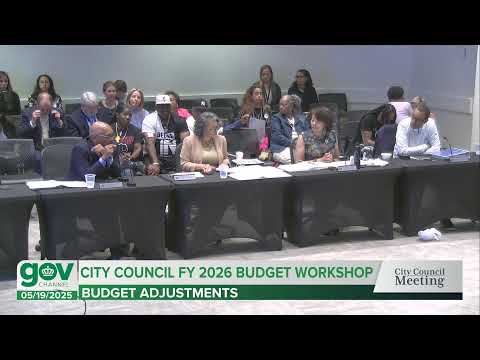
Charlotte City Council members spent most of a budget-adjustment session examining how to apply the city's recently adopted Financial Partners policy and whether to use unallocated ARPA revenue replacement to expand nonprofit grants.
Charlotte City Council members spent most of a budget-adjustment session examining how to apply the city's recently adopted Financial Partners policy and whether to use unallocated ARPA revenue replacement to expand nonprofit grants.
Councilmember LaWanna Mayfield, who led a re-review of 51 applicants, told colleagues she and Strategy & Budget staffer Marie Harris used two basic criteria to trim requests: whether an applicant's requested city funding exceeded 30 percent of the organization's budget and whether the organization scored at or above an average for its category. "The red is saying these are the organizations that did not meet either or both of the initial criteria," Mayfield said, explaining why some groups were removed from her recommended list.
Mayfield proposed adding about $444,430 in extra funding to the manager's recommended financial partners list by applying those two criteria and re-running category averages; that would raise the total recommended financial-partner allocation in her packet from the staff's proposed $812,000 to roughly $1.256 million. She said the expanded list still falls well short of the nearly $8.8 million in requests the city received.
City Manager Marcus Jones and other staff repeatedly stressed that $5.3 million in ARPA revenue replacement remains available as one-time funding and could be used to cover one-time costs tied to the financial partners list. "That $5,300,000 is revenue replacement, so that's available with no time clock on it," Jones said, cautioning that ARPA is one-time money and should not become a new recurring commitment.
Several council members urged caution. Councilmember Matt Mitchell and others said they opposed using one-time ARPA funds to imply multi-year commitments. Councilmember Braxton Brown and others pushed for more funding for items labeled in the "people's budget," saying the scoring approach could exclude organizations that serve the most vulnerable.
Members also debated process and transparency. Mayfield told the council she and Marie Harris spent hours rescoring each category and computing per-category averages so that scoring would reflect the actual applicant pool rather than an arbitrary threshold. "We went through each category, total the number of applications outside of the ones that were already pulled aside because we identified additional funding source for them. And just did old school. We did the average," she said.
Other members asked staff for more detail on what the scoring rubric produced and for historic grant amounts so the council could see which organizations would be cut after prior-year funding. Councilmember Ed Drakes requested a historical overlay showing prior-year grants to avoid harming longtime partners that would be dropped under the new criteria.
The council voted to refer the financial partners recommendations to the Budget, Government & Innovation committee for review, with staff directed to return more analysis to the council at the next regular budget-stage meeting. Manager Jones told members that sending the items for committee review would allow staff to prepare cost analyses and align duplicates or items already funded through department budgets.
What happened next: Councilmembers reached consensus to send Mayfield's package and related financial partners requests to committee for further analysis and to return the committee's recommendation to full council at the next review meeting. Councilmembers also asked staff to clarify where requested partner funding already appeared in departmental budgets so the council could avoid duplication.
Why it matters: The debate determines which local nonprofits receive limited city funding and whether the city will use one-time ARPA revenue to support programs that may require ongoing funding. Council members emphasized transparency and consistency in awarding scarce public dollars.
Next steps: Staff will reconcile duplicates, produce a consolidated list of organizations and recommended funding levels, and return the results to the council in the committee process for a straw vote on the timeline identified by the manager.