
Littleton schedules June hearings on state‑directed ADU rules, parking and turf changes
Get AI-powered insights, summaries, and transcripts
Sign Up Free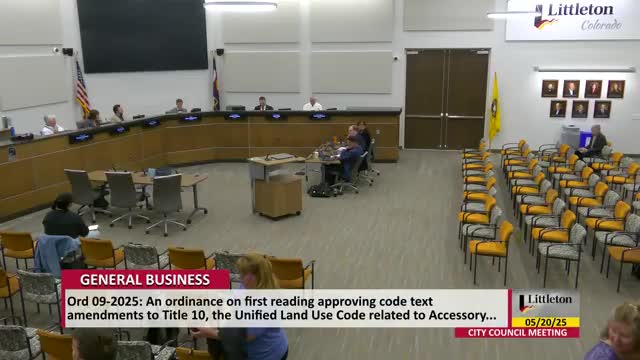
Summary
Council set public hearings for June 3 on two ordinances that implement state 2024 housing and land‑use laws: rules easing accessory dwelling unit (ADU) restrictions; removal of parking minimums near transit; and limits on nonfunctional turf for nonresidential properties.
The Littleton City Council on May 20 voted to publish and set public hearings for June 3 on two ordinance packages that implement state‑level changes and update local land‑use rules.
What the ordinances do: staff said Ordinance 9 updates the unified land use code to comply with House Bill 24‑1152 (state ADU legislation) by loosening certain restrictions on accessory dwelling units, removing some design constraints, and aligning lot‑setback rules. Ordinance 10 bundles multiple 2024 legislative updates, including limits on nonfunctional turf on nonresidential properties and an expansion of state‑authorized parking minimum waivers in designated transit areas.
Key ADU changes staff highlighted: staff proposed raising the maximum size for detached ADUs to 1,000 square feet (from 750 or 800 in some zones), removing a requirement that a detached ADU must be on an alley lot, and allowing ADU heights to approach the district maximum rather than being capped by the primary dwelling’s roofline. Staff said attached ADUs remain limited by the primary house size and that existing coverage and contextual development rules still constrain where larger ADUs are feasible.
Minimum parking and transit area: the city will implement a state rule that removes parking minimums for qualifying multifamily or mixed‑use residential developments near high‑frequency transit stations. Littleton staff proposed applying the exemption to all residential developments (including small multifamily) within the state’s applicable transit area map for the Broadway and Mineral corridors and downtown, rather than limiting it to five‑unit or larger developments.
Nonfunctional turf: staff said the ordinance will prohibit installation of artificial turf and nonfunctional ornamental turf on nonresidential properties and added definitions to distinguish functional recreational turf from nonfunctional landscaping.
Public process and next steps: both ordinances were approved on first reading with a 5–1 vote (Councilmember Driscoll opposed both first readings). Staff will hold the public hearings June 3, at which council will hear public comment and take final votes. Staff emphasized the city retains some local discretion — for example, buffer and setback requirements for visual mitigation will remain in place even as state law reduces some local controls.
Council comment: several councilmembers said they wanted additional public education and an upcoming study session on a separate citizen petition to amend the charter related to land‑use notice and a proposed two‑year pause on residential code changes. Councilmember Zink and others asked staff for clearer outreach so residents understand what the changes mean for their properties.
Outcome: hearings were set for June 3; no final adoption occurred tonight. Staff will return with more detail and public comment.