
Littleton council approves Phase 1 of Mineral Mobility project amid debate over 16-foot concrete trail in Jackass Gulch
Get AI-powered insights, summaries, and transcripts
Sign Up Free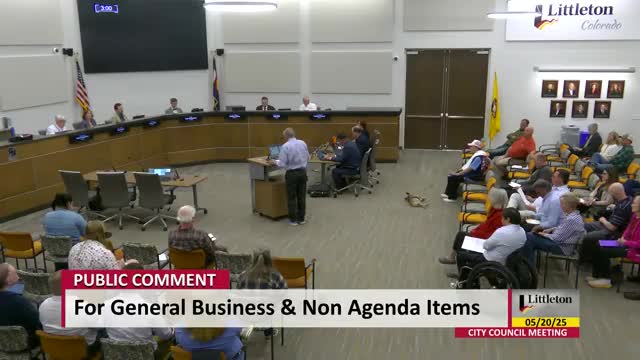
Summary
The Littleton City Council voted 5–1 on May 20 to award a construction contract for Mineral Mobility East Phase 1, a multimillion‑dollar multimodal project that includes a 16‑foot paved trail through Jackass Gulch, traffic calming and other pedestrian and bicycle improvements.
The Littleton City Council voted 5–1 on May 20 to award a construction contract for Mineral Mobility East Phase 1, a multimillion‑dollar multimodal project designed to improve pedestrian and bicycle access between the High Line Canal and the Littleton Mineral RTD station.
The vote advances Phase 1 contract work that staff said must be completed this year to meet grant deadlines. "The Mineral Trail will provide year‑round, high‑comfort bicycle and pedestrian facilities for all ages and abilities," Brent Soderlund, director of public works and utilities, told council during the project presentation.
Why it matters: the project bundles safety upgrades — a mill and overlay of Jackass Hill Road, buffered bike lanes, traffic calming at two intersections, and improved High Line Canal crossings — with plans to pave a 16‑foot‑wide path through Jackass Gulch. Staff and some residents said paved surfaces are necessary to meet ADA requirements year‑round and to satisfy maintenance and grant conditions; opponents warned that a wide concrete corridor would degrade the gulch's open‑space character and that alternatives were not fully explored.
Project background and funding: the Mineral Mobility concept began in 2020 and later secured a Colorado Department of Transportation (CDOT) Safer Main Streets grant along with contributions from Arapahoe County Open Space and South Suburban Parks and Recreation. Staff told council the project has $4.4 million in outside grant funding that requires Phase 1 construction to be finished by Dec. 31, 2025, or Littleton could risk losing those awards.
Public comment at the meeting was long and largely opposed to a single, wide paved road. Mark Flink, who described himself as a 35‑year Southbridge resident, said the proposal "was added to the mobility improvement project through false and misleading statements" and criticized the city for promoting a 16‑foot concrete road that he said does not exist elsewhere in the metro trail network. Several speakers, including Ned Stern and Tammy Whitney, urged the council to preserve the existing crusher‑fines soft trail or to pursue a dual‑surface design.
Disagreement in the meeting centered on accessibility and maintenance. David Ortiz, who described himself as a high‑functioning paraplegic, urged council to prioritize paved, maintainable surfaces: "The part of the plan that seeks to pave for the pedestrians, that's accessible. That's equity," Ortiz said. Staff and the city’s maintenance partner, South Suburban Parks and Recreation, told council they do not plow crusher‑fines trails and that the topography in parts of the gulch makes a stable, year‑round soft surface difficult to maintain.
Council discussion and decision: members raised the tradeoffs between preserving open space character and creating a reliable ADA‑compliant connection to transit. Councilmember Driscoll expressed concern about replacing the existing soft trail and argued the city had not done sufficient due diligence on crusher‑fines options; Councilmember Reichhardt described the safety and accessibility benefits as a key factor in his support. After discussion, the council approved the Phase 1 construction contract by a 5–1 vote; Councilmember Driscoll voted no.
What the contract covers and next steps: Phase 1 includes Jackass Hill Road repairs and traffic calming, buffered bike lanes and enhancements to High Line Canal crossings; staff said Phase 2 will address the remaining intersection work and extend the Mineral Trail to the RTD station. Construction for Phase 1 is expected to begin soon and — per grant conditions cited by staff — must be substantially complete by the end of 2025.
Context and constraints: staff said design choices were constrained by topography, retaining‑wall costs and grant requirements. The city also reported that modifying the scope now would require renegotiation with multiple funding partners — particularly CDOT, which staff said has stricter timing and scope requirements tied to the Safer Main Streets grant.
Council members and staff said they will continue to seek public feedback on design elements and will monitor maintenance, lighting and safety details as the work proceeds.