Get Full Government Meeting Transcripts, Videos, & Alerts Forever!
Get email alerts on the Ceqa topic
No spam. Unsubscribe anytime.
Consultant walks Santa Clara Planning Commission through CEQA basics, mitigation standards and thresholds
Summary
A consultant from David Powers & Associates gave a detailed study-session briefing on the California Environmental Quality Act, focusing on baselines, thresholds, mitigation types, levels of review and public-comment practice. Commissioners and staff asked procedural questions about monitoring, tribal consultation and cumulative impacts.
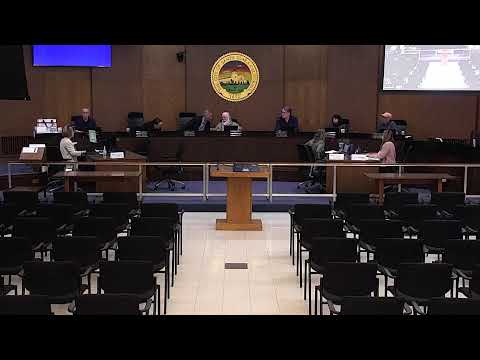
A consultant from David Powers & Associates gave the Santa Clara Planning Commission a primer on the California Environmental Quality Act (CEQA) during a study session on May 21, 2025, outlining how agencies set baselines, apply thresholds and craft enforceable mitigation.
The presentation, delivered by Shannon (David Powers & Associates), said CEQA requires state and local agencies to identify significant environmental impacts of discretionary actions and to avoid or mitigate those impacts when feasible. Shannon emphasized that the baseline — the existing condition against which a project is measured — is frozen at the start of the environmental review (for an initial study) or at circulation of a notice of preparation for an environmental impact report (EIR).
Shannon told commissioners mitigation must be measurable, enforceable and tied by a clear nexus to an identified impact. “It needs to be written really well,” Shannon said, adding that mitigation cannot simply be “another study” and that courts have tightly limited when fees may be considered mitigation. The consultant said mitigation should be proportional to the size of the impact and within the lead agency’s ability to implement.
The presentation reviewed the major levels of review — categorical exemptions, initial studies/negative declarations and EIRs — and explained the legal standards that apply to each. Shannon said the “fair argument” standard that can trigger an EIR following an initial study remains low but legislation under consideration in Sacramento could change that standard. The consultant also summarized what constitutes substantial evidence in CEQA and that disagreement among experts is legally permissible when the lead agency supports its conclusions.
Commissioners asked about enforcement and monitoring of mitigation measures that cannot be measured at the time of project approval (for example, equipment not yet installed or long-term resource use such as water). Shannon said monitoring plans, construction management plans and conditions of approval tied to permits are common ways to require verification; penalties or code enforcement can be applied if measures are not implemented. The consultant noted that in practice some long-term mitigation — for example, ongoing water reporting — is rarely tracked closely by jurisdictions unless it becomes a code-enforcement matter.
Commissioners asked about cumulative impacts when multiple nearby projects proceed at different times. Shannon said EIRs must include cumulative-impact discussions that consider past, present and reasonably foreseeable projects; initial studies have more limited ability to address cumulative effects and categorical exemptions have the least. The consultant noted cumulative thresholds are often higher and that each project is generally responsible only for its incremental contribution.
The study session also covered tribal consultation procedures under CEQA. Shannon said tribes have 30 days to respond to consultation notices and, if tribes request consultation, the city must engage in a good-faith effort to resolve concerns; the lead agency can ultimately document that further consultation is no longer productive. On tribal requests for fees, the consultant cautioned that payments to tribes are not automatically mitigation under CEQA unless they fit narrowly defined legal programs.
The session concluded with a short Q&A. Staff and the consultant encouraged commissioners to raise questions early in the review process so staff and consultants can provide detailed responses at hearings.
Why it matters: CEQA determinations shape whether projects require further environmental study, can be challenged in court and what conditions or mitigation the city can lawfully impose. The session was intended to give commissioners a consistent standard for evaluating environmental documents brought forward by applicants and staff.
Context: The presentation occurred during the Planning Commission’s study session before the regular May 21 meeting. Commissioners were told the material and recordings will be available on the city’s project and meeting pages for reference.