Get Full Government Meeting Transcripts, Videos, & Alerts Forever!
Get email alerts on the Transportation Finance topic
No spam. Unsubscribe anytime.
Cap-and‑Stitch decision and scoring reduce 2026 bond capacity, staff says
Summary
City staff told the bond task force that Austin City Councildecisions on the Cap and Stitch roadway coverage will be paid with a mix of a state infrastructure loan and internal capital funds and that using certificates of obligation lowers the recommended 2026 general obligation bond ceiling from about $750 million.
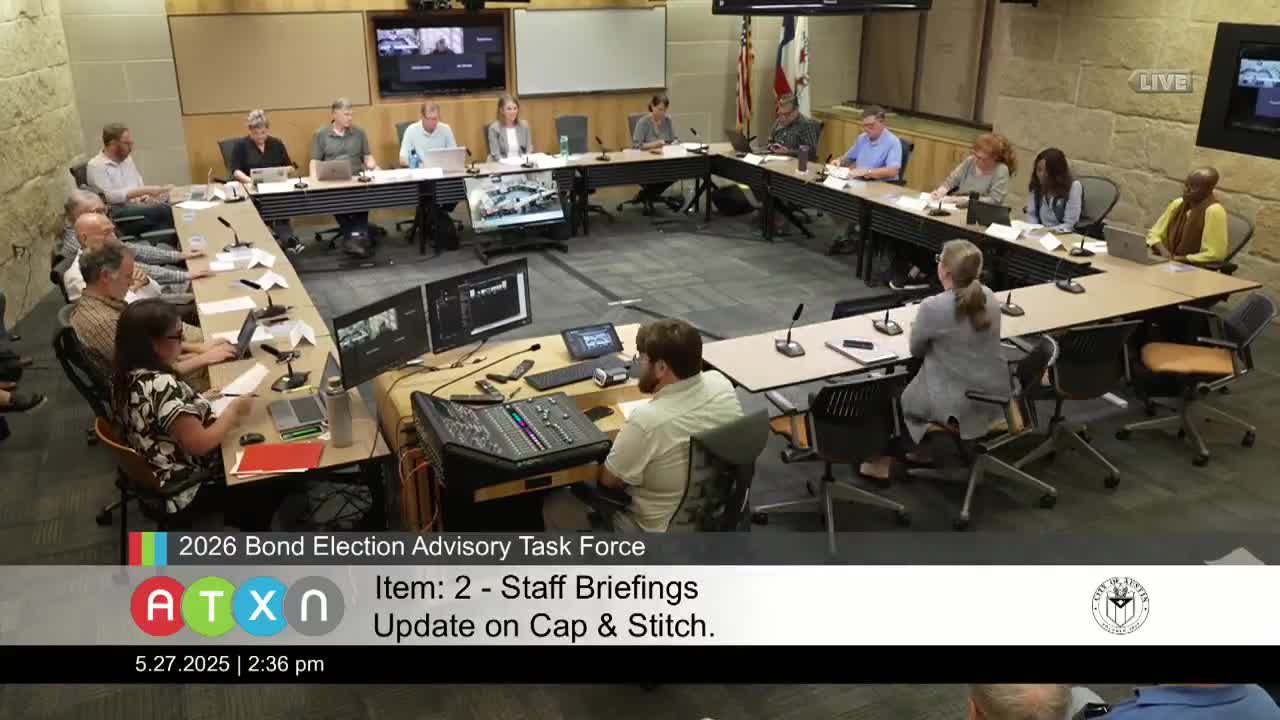
City financial staff told the 2026 Bond Election Advisory Task Force on May 27 that recent City Council action on the Cap and Stitch street coverage plan will be financed with a $41 million state infrastructure bank loan and $63 million in the Transportation and Public Works capital budget, the latter initially backed by certificates of obligation.
The briefing explained why that financing choice affects how much voter‑approved general obligation debt the city can prudently add in 2026. Kimball Avaris, director of Financial Services, said staff and the city's financial adviser analyzed authorized but unissued debt and outstanding obligations and recommended a $750 million ceiling for new voter‑approved general obligation bonds. With the $63 million covered by COs, the available voter‑approved capacity would fall by about $63 million, to roughly $687 million, Avaris said.
Why it matters: credit agencies'debt metrics, particularly debt per capita used in the S&P scorecard, influence the city's ratings. Avaris said the $750 million recommendation is a conservative midpoint that aims to avoid reaching a scorecard tipping point. He said the state loan was accounted for already in the calculations and that TxDOT's design schedule (30% now, 60% later this year) could change estimates.
Details: Avaris described the $41 million from the state infrastructure bank as an advanced funding agreement that will be repaid from the city's debt service. The $63 million in construction costs is currently reflected as certificates of obligation, non‑voter‑approved debt issued under the city's general‑obligation credit. Staff told the task force they will continue to pursue additional funding sources and do further cost updates as TxDOT completes design.
A task force member asked whether additional cap‑and‑stitch commitments could further reduce bond capacity; staff replied that costs could move either direction as design and updated estimates are delivered. Staff also said some older authorized but unissued transportation bond dollars have been reviewed and in a few cases may be candidates for deauthorization, but legal and contract constraints can limit repurposing.
What happens next: staff said the city will not need to return to TxDOT with a new decision until November 2026 and that staff are working internally to reach that deadline and to explore funding partnerships. The task force requested additional analysis such as projected property tax impacts and a district‑level breakdown of needs to inform prioritization discussions.