Get Full Government Meeting Transcripts, Videos, & Alerts Forever!
Get email alerts on the Zoning Planning topic
No spam. Unsubscribe anytime.
Council holds first reading of neighborhood design district zoning ordinance for Cedar Valley and Seider Hill
Summary
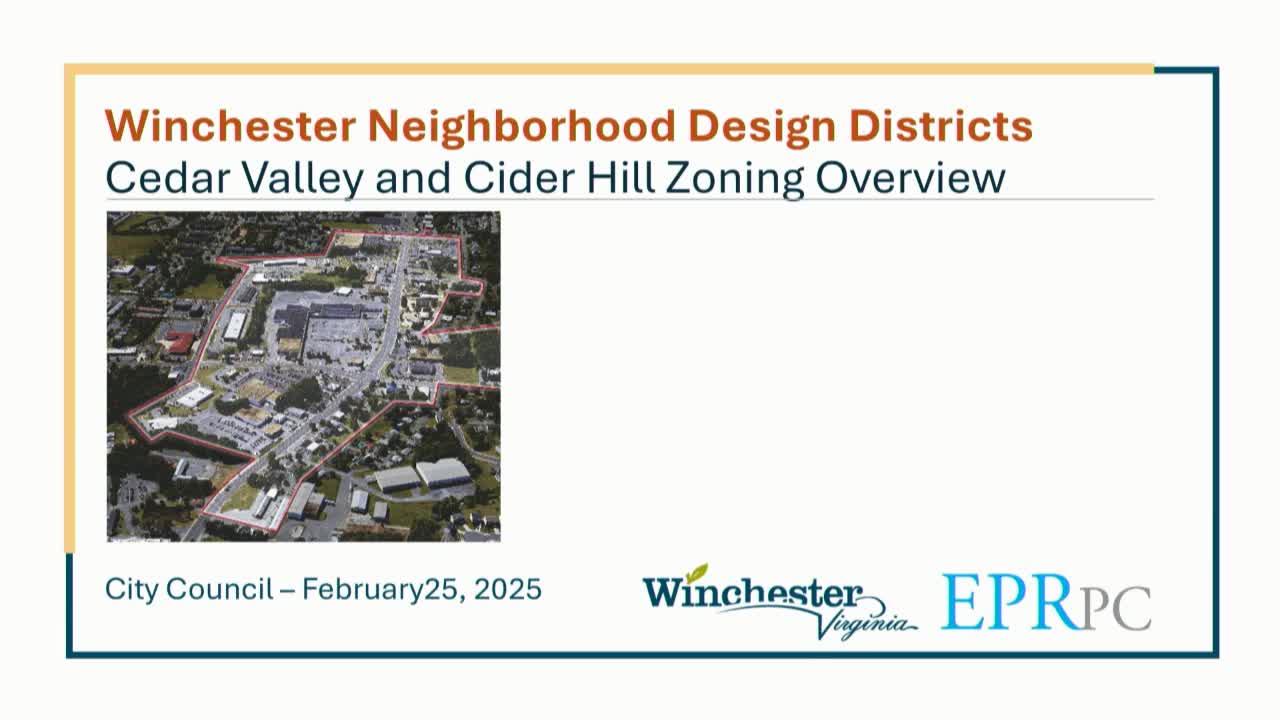
Council received a first reading of an ordinance that would create a new Neighborhood Design District (NDD) zoning category to implement the Cedar Valley and Seider Hill concept plans; the ordinance creates form‑based standards but does not rezone properties at this stage.
The Winchester City Council heard a first reading of a proposed Neighborhood Design District (NDD) zoning ordinance intended to implement two neighborhood plans — Cedar Valley and Seider Hill — and create a new form‑based zoning framework for designated areas.
"This is not rezoning the properties at this stage. That'll be a future step," said Mike Ruddy, director of community development, in presenting the draft ordinance. Ruddy described the text as a hybrid of several existing zoning approaches — elements of the central business district (B-1), planned unit developments (PUD), corridor enhancement and new form‑based elements — tailored to the neighborhood design districts. He said the ordinance aims to allow a flexible mix of residential, commercial and civic uses, with buildings oriented to the street, pedestrian improvements, public parks and higher densities paired with form‑based standards for facade articulation and building placement.
Emily Windle, chair of the Planning and Economic Development Committee, and Ruddy noted the ordinance does not itself change parcel zoning. "Once that [zoning text] is established in the ordinance, then there will be a city‑sponsored zoning map amendment, which takes the properties that are within the boundaries of the neighborhood design district and actually rezones them from what they are today," Ruddy said. He added that the next step after adopting the ordinance text will be a public hearing and a city‑sponsored rezoning for properties within the district boundaries.
Council members and staff said the work grew from a year‑long neighborhood participation process begun in early 2024 and that planning commission and neighborhood committees reviewed the draft. Council members expressed support for the collaborative process; Councilor Herbstree called the work "really exciting" and praised community participation.
No ordinance vote was taken; Ruddy said the zoning text will return for a public hearing and subsequent vote, and any map amendment will be a separate action.
Public comment during the meeting included concerns from residents about infrastructure and building scale in adjacent neighborhoods. Arthur Christjohn, who identified himself as a Fairmont Avenue resident, said the area slated for higher density lacks sufficient water pressure and stormwater infrastructure and objected to proposed four‑story buildings and certain recreational facilities that he said would increase noise and construction impacts.
Council did not take final action on the ordinance at the meeting; staff indicated the measure would return to council for a public hearing and formal vote in the coming weeks.