Get Full Government Meeting Transcripts, Videos, & Alerts Forever!
Get email alerts on the Courts Prop36 topic
No spam. Unsubscribe anytime.
Judges, probation officers warn Prop 36 will increase court oversight and probation workloads
Summary
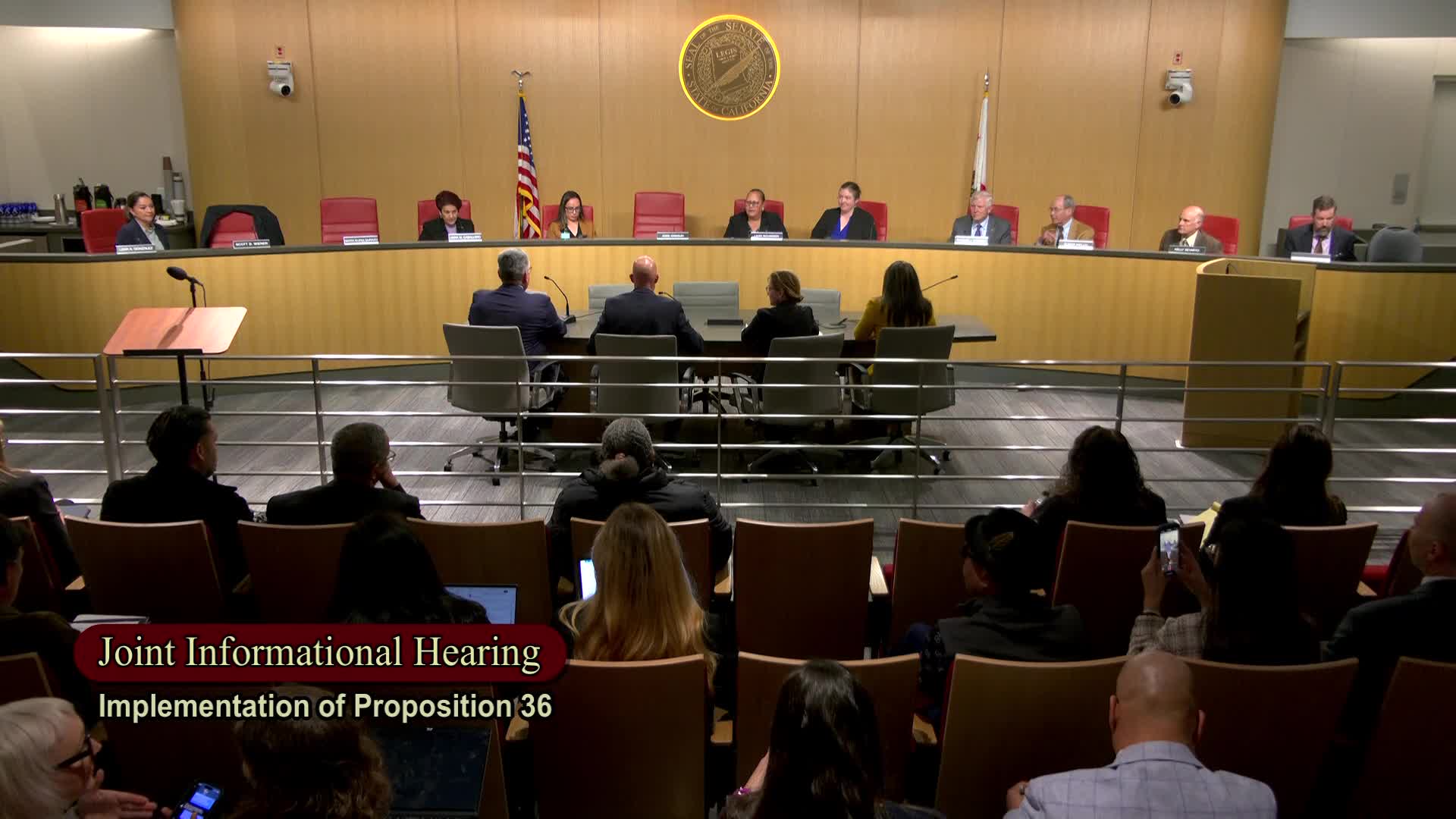
The presiding judge of the Los Angeles Superior Court, the Judicial Council and chief probation officers testified that Proposition 36 will require more court oversight, add pretrial and sentencing workload and increase the need for probation‑led supervision and post‑release services.
Judicial and probation officials told the Senate hearing that Proposition 36’s treatment‑mandated felony and other reclassifications will increase court calendar demands and create new probation responsibilities.
Presiding Judge Sergio Tapia of the Los Angeles County Superior Court said cases classified as treatment‑mandated felonies require “significantly more judicial oversight,” including regular status hearings and progress reports, especially when cases proceed through “community collaborative courts” or drug courts. Judge Tapia noted Los Angeles County had filed 401 cases under Penal Code section 666.1 and 172 cases under Health & Safety Code section 11395 since implementation began and that these bookings represented “just over 1% of the approximately 220 daily bookings processed in Los Angeles County” in the early weeks.
Francine Byrne of the Judicial Council said the council initially estimated roughly 50,000 misdemeanor cases could be filed as felonies under Prop 36; preliminary data suggested the number could be higher — roughly 70,000 cases — and that 56 percent of those cases are theft‑related and 44 percent drug‑related. “A felony case requires more court time and is more likely to involve continuances and trials,” Byrne said, and cited research suggesting over $600 in additional adjudication costs per felony case versus a misdemeanor.
Steve Jackson, president of the Chief Probation Officers of California and San Joaquin County chief probation officer, said probation has a central role across pretrial, sentencing and supervision. Jackson said probation departments could scale and coordinate assessments and referrals but will need targeted state funding. He also noted that individuals sent to state prison under the treatment felony become subject to post‑release community supervision, which is administered by probation departments and will create additional workload if prison populations rise.
Why it matters: courts and probation are central to the treatment‑mandated pathway Prop 36 creates. Increased hearings, required court supervision of treatment progress and expanded post‑release supervision will drive additional workload at the court and county level and require funding and staffing decisions.
Sources: Sergio Tapia (Presiding Judge, Los Angeles County Superior Court); Francine Byrne (Judicial Council); Steve Jackson (Chief Probation Officers of California) testimony at the Senate hearing.