Get Full Government Meeting Transcripts, Videos, & Alerts Forever!
Get email alerts on the Implementation Disparities topic
No spam. Unsubscribe anytime.
Counties report uneven Prop 36 rollout: prosecutors, defenders and sheriffs describe different charging and treatment realities
Summary
District attorneys, public defenders and sheriffs told senators county responses to Proposition 36 vary widely — from DAs applying local 'washout' policies to sheriffs and public defenders reporting increased theft filings, racial disparities in charging, and scarce treatment capacity.
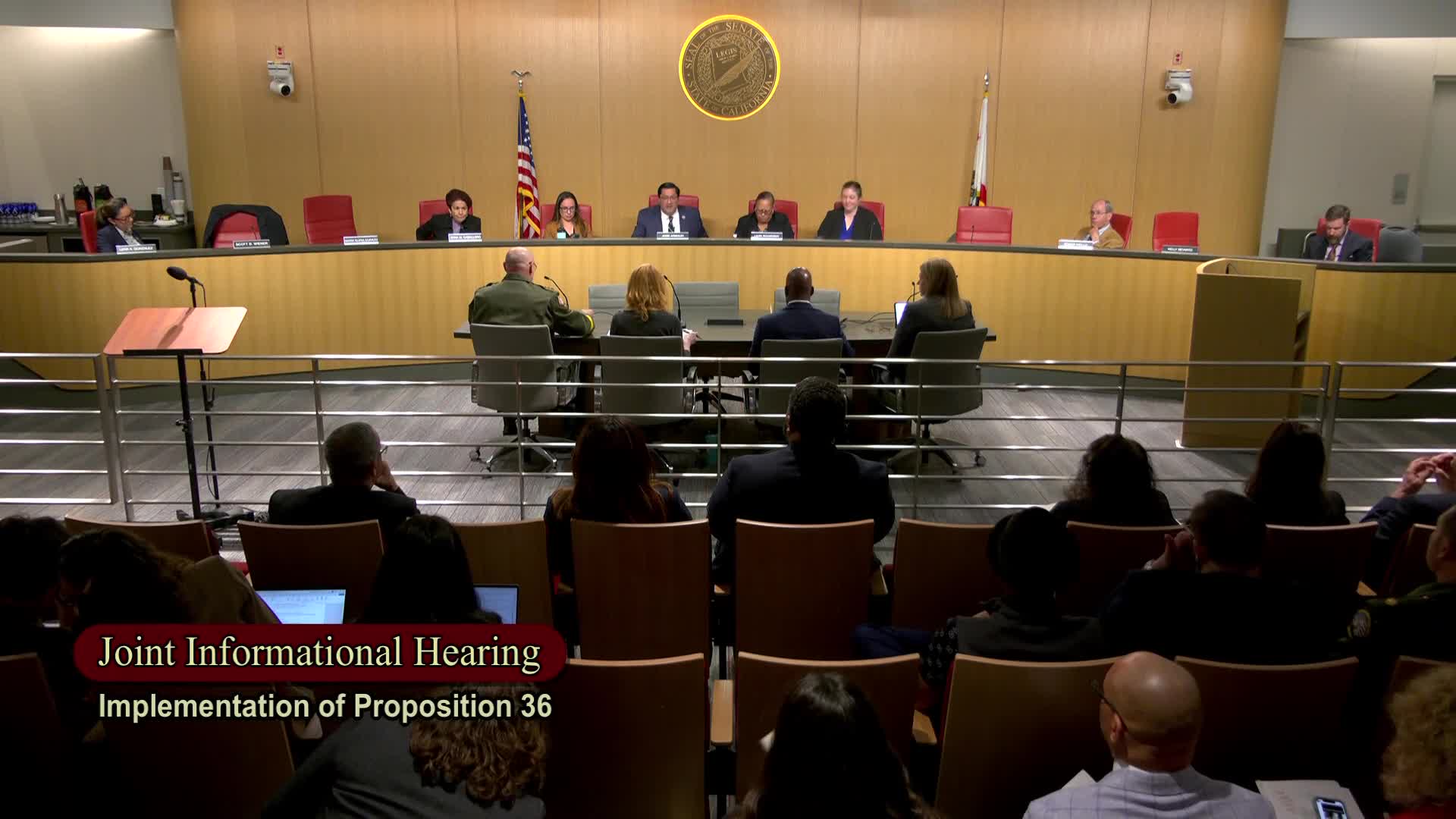
County officials and criminal‑justice practitioners told the Senate joint hearing that implementation of Proposition 36 has been uneven, with prosecutors, defenders and law enforcement taking different approaches to charging and treatment.
Allison Haley, Napa County district attorney, said her office supports the measure and has adopted a local approach to prioritize repeat, recent offenders. “In Napa, I implemented washout periods. So we aren't charging these cases unless the priors were committed within roughly the last 10 years,” Haley said, adding that in the first two months since the law took effect Napa had not seen a defendant opt into court‑mandated treatment.
By contrast, Alameda County Public Defender Brandi Woods (transcribed as Bridal Woods) described a rapid rise in theft‑related prosecutions in that county. She said Alameda opened nearly 300 theft‑related charging files in January 2025, a roughly 50 percent increase over the previous January, and that in North County courthouse filings under Penal Code section 666.1 (petty theft with a prior) were about 90 percent Black even though the county population is about 10 percent Black. Woods also said treatment‑mandated felony filings in Alameda were rare in the early rollout.
Stanislaus County Chief Public Defender Jennifer Jennison reported heavy use of the treatment‑mandated felony in her county: “In Stanislaus County, over 140 mandated treatment felonies have been filed since January 1. All of these individuals were arrested and booked into jail, and many of them remain in jail right now,” she said, noting some alleged priors cited by prosecutors were over 30 years old.
San Benito County Sheriff Eric Taylor said patterns vary by county: retail theft dominates in some urban counties, he said, while in his rural county “drug offenses are more common.” Taylor told senators local jails have become “the primary delivery system for substance use disorder treatment” in many counties and urged more outpatient and community treatment capacity to avoid jail stays.
Brandi Woods also cited Orange County public data showing more variation: local officials there had filed 757 treatment‑mandated felonies under Health & Safety Code section 11395 and 160 cases under Penal Code section 666.1; according to Woods she was told only 11 people in Orange County had opted into treatment, and 95 percent of those charged with 11395 violations in Orange County lacked permanent housing.
Why it matters: the differences in charging policies, local “washout” practices and treatment capacity affect who is booked, who receives court‑ordered treatment and how much pressure courts and jails face. Public defenders, sheriffs and DAs urged coordinated statewide metrics and funding to reduce arbitrary disparities.
Sources: testimonies from Allison Haley (Napa County DA), Brandi Woods (Alameda County Public Defender), Jennifer Jennison (Stanislaus County Chief Public Defender), Eric Taylor (San Benito County Sheriff) at the joint Senate hearing.