Get Full Government Meeting Transcripts, Videos, & Alerts Forever!
Get email alerts on the Criminal Justice Prop36 Law topic
No spam. Unsubscribe anytime.
Senate panel outlines how Proposition 36 alters drug and theft laws, creates court‑ordered treatment felony
Summary
Senior counsel and legal staff told a joint Senate hearing that Proposition 36 creates a new treatment‑mandated felony for repeat drug possession, lowers thresholds and adds enhancements for fentanyl and other drug sales, and expands the circumstances under which low‑value theft can be charged as a felony.
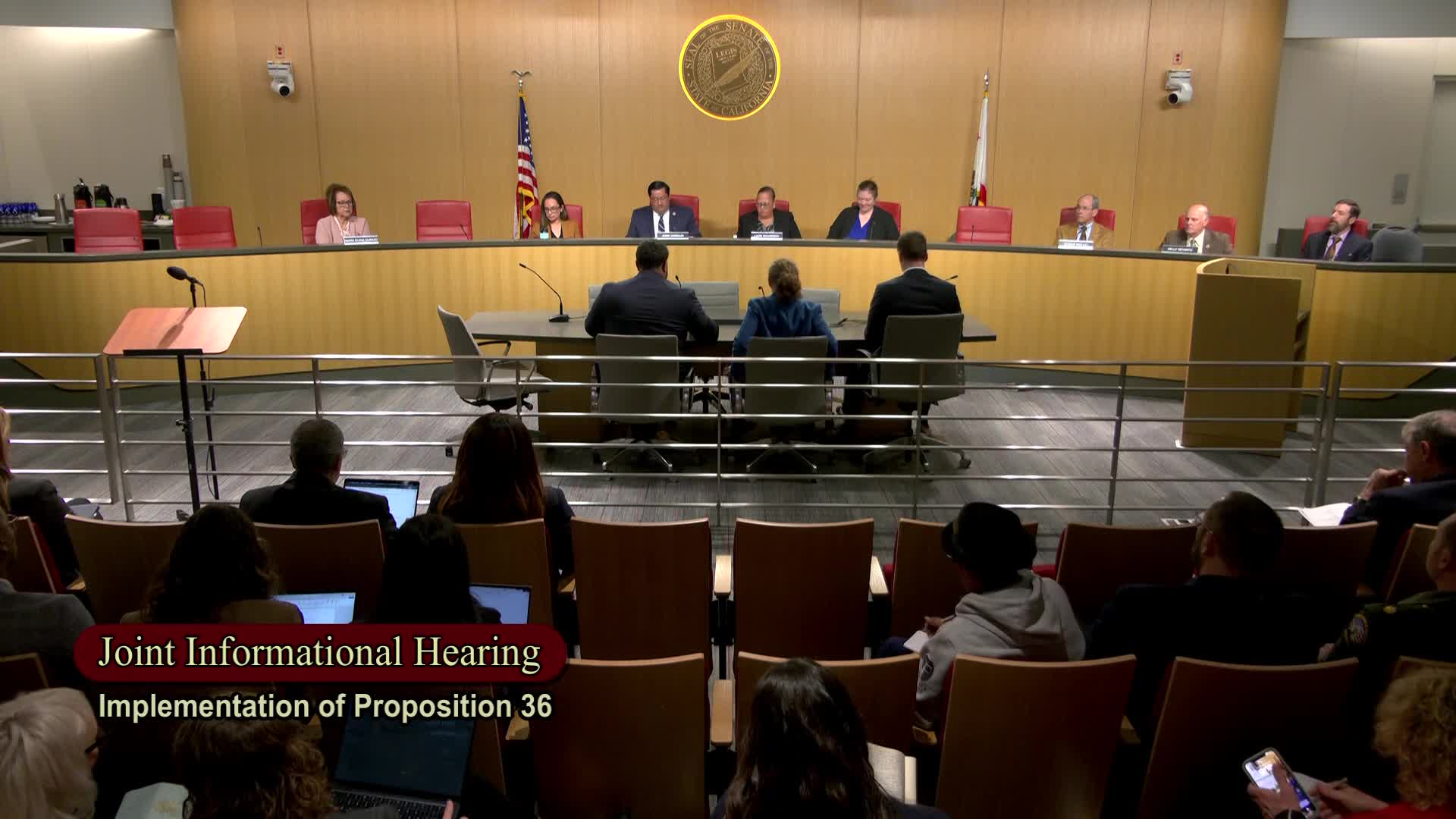
The California Senate Public Safety Committee and Budget Subcommittee No. 5 heard a legal overview of Proposition 36 on the measure’s changes to criminal law and how courts must implement the new provisions.
Rick Owens, senior staff counsel for the Committee on Revision of the Penal Code, summarized the measure’s main legal changes: “The changes that Prop 36 made can be grouped into three general categories. One, created a new treatment mandated felony offense for repeat drug possession. Two, it increased penalties and expanded sentencing enhancements for drug sale offenses, particularly those related to fentanyl. And three, it increased punishment for certain thefts.”
The treatment‑mandated felony applies when someone arrested for possession has “two or more prior convictions for drug offenses, regardless of when those prior offenses occurred,” Owens told senators. The offense is a “wobbler,” meaning prosecutors can charge it as a misdemeanor or a felony. If charged as a felony, Owens said, a person can face up to three years in county jail for a first felony and state prison for later felonies, and the statute requires courts to offer a court‑approved treatment program as an alternative to incarceration.
Owens emphasized procedural points the law leaves to local implementation: defendants must plead guilty or no contest to accept treatment under the statute and must appear periodically in court to show progress; the statute does not define treatment length or conditions and does not specify what happens if no treatment is available at the time of charge.
On drug‑sale enhancements, Owens said Prop 36 lowers the weight threshold for fentanyl‑related enhancements, adds fentanyl as a drug that can trigger a firearm enhancement, and creates a four‑year enhancement for great bodily injury resulting from the sale of drugs. The law also directs courts to advise defendants that they could be charged with murder if someone dies after taking drugs they sold.
For theft offenses, the measure expands the petty‑theft‑with‑a‑prior rule so that thefts under $950 can be charged as a felony when the defendant has two or more prior theft convictions; there is no statutory time limit on how old those priors may be. Prop 36 also broadened aggregation rules allowing values from separate theft acts to be combined toward the felony threshold even when the acts were not part of the same scheme.
The statute’s changes interact with other California sentencing laws. Owens noted that California’s Three Strikes law doubles a felony sentence for anyone with a qualifying prior strike and that consecutive sentencing rules can add months for additional offenses. “A treatment‑mandated felony with a strike prior could see the maximum doubled,” he said.
Why it matters: the legal reclassification refocuses prosecutorial discretion and expands situations where courts must consider treatment programs, while leaving critical implementation details — definitions of suitable treatment, timing of assessments, and capacity questions — to counties and courts.
Sources: Rick Owens, senior staff counsel, Committee on Revision of the Penal Code; exchange with senators and staff during the Senate Public Safety and Budget Subcommittee No. 5 joint informational hearing.