Get Full Government Meeting Transcripts, Videos, & Alerts Forever!
Get email alerts on the Agriculture topic
No spam. Unsubscribe anytime.
Kentucky Senate Agriculture Committee deadlocks on bill to standardize pet-store breeder rules
Summary
Senate Bill 122, which would set statewide standards for pet-store sales and breeder qualifications while limiting sudden local bans, failed in a 5-5 committee vote after testimony from Petland, local animal-control officials and the Kentucky League of Cities.
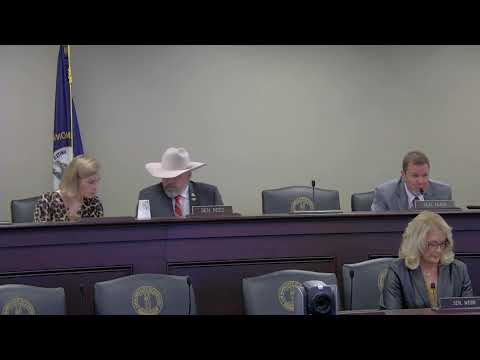
FRANKFORT, Ky. — The Kentucky Senate Committee on Agriculture on Monday considered Senate Bill 122, a measure intended to set statewide standards for pet-store sales and to define qualified breeders, but the panel deadlocked 5-5 and the bill failed to advance.
Chairman Howe opened the roughly 30-minute session by saying his objective in filing the bill was to “balance out protecting private business rights from ... overreach, while still preserving as much local control,” and he told committee members he planned to work with stakeholders on a floor amendment to clarify breeder qualification, monitoring authority, and the destination of fines and fees.
The lead proponents were representatives of Petland. Elizabeth Kunselman, vice president of legislative and public affairs for Petland, told the committee she represented three Petland stores in Kentucky and called SB 122 “a balanced, sensible approach that addresses concerns about irresponsible breeding while protecting the rights and livelihoods of independent law abiding pet retailers.” Kunselman said local bans have closed planned investments and urged legislators to favor statewide standards rather than “unpredictable politically motivated local bans.”
Mehek Cook, identified as counsel with prior state enforcement experience and speaking on behalf of Petland, added that local authorities already have enforcement tools. “Kentucky revised code 2 58 1 95 specifically gives locals the authority to contact animal control. In fact, it says they shall,” Cook said, and she noted consumers may also file complaints with the attorney general and the Department of Agriculture.
Opponents included the Kentucky Animal Care and Control Association (KACCA) and the Kentucky League of Cities (KLC). Colleen Bray, director of Boone County Animal Services, told the committee the bill as written lacks a mechanism for local animal-control agencies to verify the source of a qualified breeder and does not clearly assign enforcement responsibility. “This legislation doesn’t address the care and the condition of the animals while in the custody of those retailers, nor does it offer any transparency for its consumers,” Bray said.
Mister Cheney, speaking for the Kentucky League of Cities, said his organization voted to oppose the bill because it would restrict local decision-making and affect existing local ordinances in multiple cities and counties. Cheney also told the committee there may be pending litigation in Fayette Circuit Court related to local actions on pet-store sales.
Before the final committee vote on SB 122, the committee adopted a committee substitute on a motion by Senator Webb, seconded by Senator Richardson; the substitute passed by voice vote. Chairman Howe said he planned to pursue clarifying language in a floor amendment if the bill moved forward.
The committee then took a formal vote on SB 122. A motion to advance the bill, moved by Senator Boswell and seconded by Senator Webb, resulted in a 5-5 tie and the bill failed to pass the committee.
Members offered a mix of reasons on their recorded explanations: some expressed concern about preserving strong local ordinances and local enforcement (noting counties such as Campbell, Boone and others), while others said they supported moving the bill forward to allow the legislature to create uniform statewide standards and to continue refining language. Chairman Howe said he would continue to work with local governments, animal-control authorities and other stakeholders on language clarifying enforcement, breeder qualifications and fee disposition.
The committee adjourned with no further business.
Votes at a glance - Committee substitute on SB 122: Motion by Senator Webb; second by Senator Richardson — Passed (voice vote). - Final motion on SB 122: Motion by Senator Boswell; second by Senator Webb — Tally: Yes 5, No 5; Outcome: failed.
Context and next steps Chairman Howe emphasized he filed the bill to create statewide standards while preserving local ordinance authority in implementation; he told the committee he intended to seek floor amendments to specify breeder qualifications, define local monitoring authority, and direct where fines and fees would be deposited. Opponents said the current draft lacks mechanisms for local animal-control verification and consumer transparency. Members and stakeholders suggested further drafting and stakeholder meetings before the bill could be reintroduced or reconsidered.