Get Full Government Meeting Transcripts, Videos, & Alerts Forever!
Get email alerts on the Foreign Ownership Land Security topic
No spam. Unsubscribe anytime.
Committee advances bill to restrict foreign-adversary land ownership, amends registry reporting language
Summary
House Bill 224, which would restrict property ownership by designated foreign adversaries and require registration with the Office of Homeland Security contingent on a constitutional amendment, passed the committee after stakeholders and the Office of Homeland Security negotiated deletions to avoid duplicating existing statutory processes.
Representative Banks presented House Bill 224, described as a coordinated effort by the Agriculture Committee, landowners and industry to limit property ownership by nations designated as foreign adversaries. The bill defines foreign adversaries by reference to federal regulation (15 CFR 7914), listing China, Cuba, Iran, North Korea, Russia and Venezuela and including countries designated as state sponsors of terrorism. Representative Banks said the measure is a "trigger bill" that would take effect only if voters approve a constitutional amendment proposed in House Joint Resolution 2.
The bill would require registration of foreign-adversary interests with the Office of Homeland Security and authorize that office to promulgate rules; it would also direct the attorney general to enforce provisions. Representative Banks said the draft is intended to focus on national-security and agricultural concerns, particularly land near military bases and large tracts used in production.
Lynn Budd, director of the Wyoming Office of Homeland Security, told the committee the office already works with counties and conveyance data under existing statute and that a separate bill (House Bill 97) pending elsewhere would change the direction of data flow so the office receives conveyance records. Budd recommended deleting certain reporting language in HB 224 (page 5, lines 4–10) to avoid duplicating processes and to keep sensitive critical-infrastructure zone information secure; she suggested adding registry enforcement language into the Office of Homeland Security’s statutory section instead of duplicating it in HB 224.
Representatives of industry — including the mining, petroleum and agricultural sectors — said they worked with the sponsor and supported the bill’s narrowed definitions. Jody Levin (Trona/mining industry) and others said earlier, broader measures had inadvertently captured extractive-industry entities and that the current draft addressed those concerns. Several veterans and national-security witnesses argued the bill is important to prevent foreign-adversary footholds near bases and other sensitive sites.
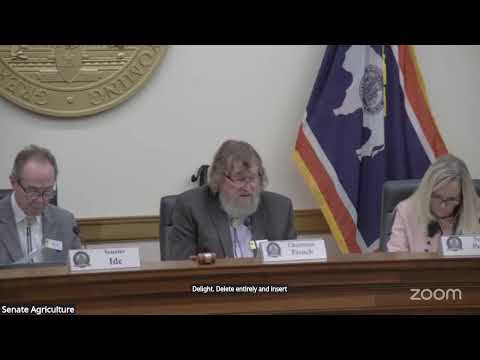
Committee members and the sponsor agreed to delete redundant conveyance-report language (page 5, lines 4–10 and lines 12–20) after the Office of Homeland Security explained potential conflicts with current statute and with House Bill 97. The committee also adopted a staff amendment to clarify the effective date language: the act will be effective only on certification by the secretary of state that electors adopted the constitutional amendment at the 2026 general election (House Joint Resolution 2). After those changes the committee advanced House Bill 224 as amended by unanimous recorded vote.