Get Full Government Meeting Transcripts, Videos, & Alerts Forever!
Get email alerts on the Animal Welfare Working Animals topic
No spam. Unsubscribe anytime.
Committee passes Working Animal Protection Act after debate on local control
Summary
The Agriculture, State & Public Lands & Water Resources Committee advanced House Bill 63, the "Working Animal Protection Act," which would limit local ordinances that ban or unduly restrict use of working animals; the committee amended zoning-related language before approving the bill on a 4–1 vote.
Representative Rachel Rodriguez Williams, sponsor of House Bill 63, told the Agriculture, State & Public Lands & Water Resources Committee the bill is intended to "protect legal, law abiding animal enterprise from the radical animal rights extremist agenda" and to prevent municipal or county bans that she said would harm animal exhibitors and tourism. The bill, as introduced, would prohibit cities and counties from enacting ordinances or policies that "terminate bans or unduly restrict a person from using a working animal in lawful commerce or animal enterprise," while preserving existing state laws on animal care and public health and safety.
The bill’s sponsor defined "working animal" in the draft statute as ‘‘any nonhuman animal used primarily for the purpose in performing of specific duty or function in commerce or animal enterprise.’’ Rodriguez Williams told the committee the measure would not protect activity that rises to the level of animal cruelty and pointed to state cruelty statutes, saying, "we do have law in place already, which is 6 3 2002 cruelty to animals." She said the bill was a proactive response to local land-use regulations and ordinances she and supporters have seen in some counties.
Committee members pressed the sponsor on several narrow points. Senator Hyde asked whether the bill would override local zoning; Rodriguez Williams confirmed the draft currently exempts zoning but recommended committee edits to avoid confusion. Senator Crago and others raised whether the bill should specifically exempt service animals and first-responder dogs; the sponsor said she believes existing state statutes already protect guide dogs and first-responder canines.
Multiple members of the public and stakeholder groups opposed the bill or urged caution. Bob McLaren of the Wyoming Association of Municipalities said the association opposes the bill as a preemption of local authority and asked the committee to vote no, telling legislators that "none of our cities or towns are passing any regulations that would inhibit rodeos or anything that this bill addresses." Britney Tennant, identified as CEO of the Cheyenne bridal shelter and a Laramie County resident, said the measure is "so broad and so vague that it's actually creating far more questions than we have answers to," and warned it could complicate existing local ordinances, including ones intended to promote shelters and rescues. Other opponents said the bill is backed by an out-of-state group and could create loopholes for bad actors such as puppy mills; Sylvia Bagdonis and Madhu Anderson urged the committee to vote no.
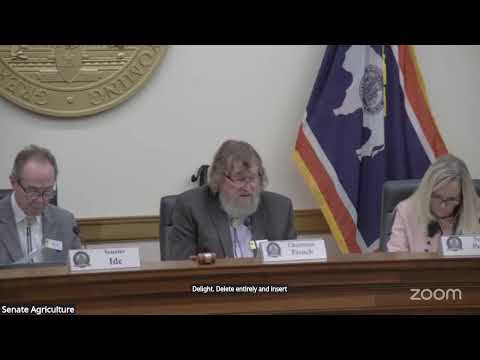
Supporters, including Brett Moline of the Wyoming Farm Bureau Federation, described the bill as proactive and said it addresses problems seen in other states. During discussion the committee identified inconsistent or conflicting language about whether the bill overrides local zoning. Senators moved and approved an amendment that deleted two lines (page 2, lines 8–9; page 3, lines 21–22) to remove ambiguous wording about overriding county zoning.
After debate and amendment, the committee moved the bill. The motion was made and seconded; the committee conducted a roll-call vote and advanced House Bill 63 as amended by a tally of 4 yes and 1 no. Committee chair Chairman French announced, "House Bill number 63 as amended has passed the committee."