Lifetime Citizen Portal Access — AI Briefings, Alerts & Unlimited Follows
USVI committee holds bill that would let legislative police arrest subpoena resisters
Loading...
Summary
A bill to let Capitol Police and other legislative security officers arrest people who refuse legislative subpoenas was debated June 5 and held in committee after lawmakers and police officials raised legal and operational concerns.
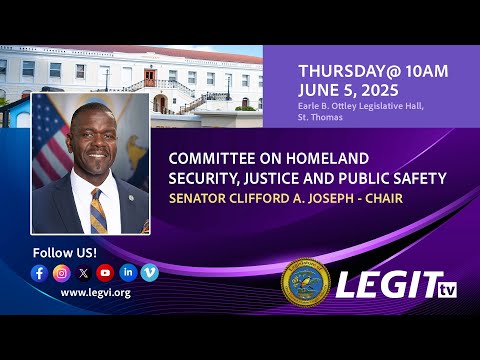
Senators on the Committee on Homeland Security, Justice and Public Safety heard debate June 5 on Bill No. 36-0020, a measure sponsored by Senator Marvin A. Blyden to amend Title 2, Chapter 1, Section 6 of the Virgin Islands Code to allow the police chief of the Legislature, the sergeant-at-arms or any legislative security officer with peace-officer status to arrest a person who neglects or refuses to appear in obedience to a legislative subpoena. The committee ultimately voted to hold the bill in committee.
The bill’s sponsor framed the measure as a protection of the Legislature’s oversight power. “Does the legislature consider itself and set a separate and equal branch of government or not?” Senator Marvin A. Blyden asked, arguing the change would update language written before the Legislature had sworn peace officers and would clarify enforcement powers.
The Virgin Islands Police Department opposed the bill in written and oral testimony. Sean Santos, assistant commissioner for the VIPD, told the committee the proposal “raises serious legal, operational, and public safety concerns” and urged lawmakers not to approve it. Santos cited national practice requiring courts or other executive-branch agencies to handle subpoena enforcement and noted risks of politicization and erosion of public trust if legislative officers were given unilateral arrest authority.
Capitol Police Chief Terrence Manning, who described the Capitol Police as a division of the Legislature with more than 20 POST-certified officers, said his officers are trained and “post certified” to make arrests and that the division stands ready to carry out duties assigned by the Legislature. Manning described the Capitol Police’s authority and the need, in his view, for clarity in the law about who enforces subpoenas.
Legal counsel told senators the current statutory language refers specifically to the ‘‘territorial police force’’ (the Virgin Islands Police Department) and thus does not clearly authorize the Capitol Police to effect arrests under Section 6. Counsel said that is the gap the bill is designed to close but emphasized that policy questions about separation of powers and risk were not strictly legal questions.
Committee members expressed a range of views in a roughly three-hour discussion. Some senators said the change merely reflects reality—Capitol Police already serve subpoenas and are POST certified—while others warned the legislation could create redundancy, jurisdictional confusion, or incentives for political retaliation. Several senators urged strengthening courts’ role in enforcing subpoenas, creating monetary sanctions or other alternatives, or clarifying limits and protections before granting any arrest power.
After debate, Senator Avery L. Lewis moved that the bill be held in committee at the call of the chair; the motion was seconded and carried by recorded tally. The committee minutes record the bill “will be held in committee at the call of the chair.”
The legislation remains under committee consideration; proponents say it updates obsolete code language, while opponents, including the VIPD and several committee members, urged further legal drafting and safeguards to avoid unintended effects on separation of powers and civil liberties.