Get Full Government Meeting Transcripts, Videos, & Alerts Forever!
Get email alerts on the Use Variance topic
No spam. Unsubscribe anytime.
Cheektowaga ZBA tables Empire 1 FCU use‑variance request after neighbors raise traffic, property‑value and construction concerns
Summary
The Zoning Board of Appeals tabled Empire 1 FCU’s request for a use variance to allow commercial office use on two residential lots at 0 Crisfield Avenue and asked the applicant for financial documentation required by state law.
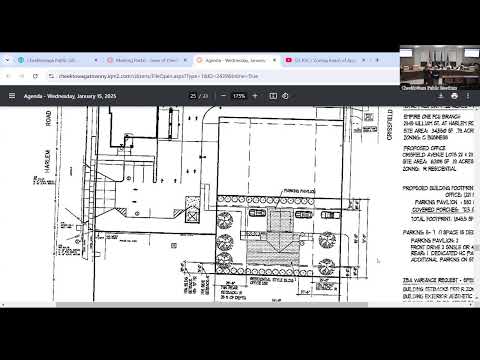
The Town of Cheektowaga Zoning Board of Appeals on an unspecified date tabled an application from Kelly L. Sizer, CEO of Empire 1 FCU, seeking a use variance to establish a commercial office on two residential lots at 0 Crisfield Avenue.
Architect Laurie Hower told the board the planned structure is designed to read as a single small house — roughly 1,300 square feet with a two‑car garage and a rear ramp for accessibility — and that the intended use would be back‑office operations rather than a public branch. “It is designed as a house,” Hower said, adding that staff access and parking would be limited and that “public doesn’t come there.”
The board emphasized the legal standard for a use variance under New York law and outlined the four criteria the applicant must satisfy: (1) demonstrate the property cannot yield a reasonable return if used only for permitted residential uses (dollars‑and‑cents proof), (2) show the property is affected by unique or highly uncommon circumstances, (3) show the variance will not alter the essential character of the neighborhood, and (4) show the hardship is not self‑created. The board also noted that under state procedure an Environmental Assessment Form (EAF) under the New York State Environmental Quality Review Act (SEQRA) must be completed prior to a final variance determination.
The applicant said Empire 1 purchased the parcel as part of a larger acquisition (the Harlem Road property) and that the lots were included in that purchase last March. The applicant asked the board to consider a use that would be low‑traffic and house‑like; she said the building would likely be used during standard business hours and not at night.
Residents voiced strong opposition. A neighbor, Matt Pazderski of 279 Crisfield (who had submitted a written letter), said converting a lot across from his home to commercial use would increase traffic and could lower property values; he also asked whether tax assessments would be adjusted if nearby properties lost value. “If a lot across from me becomes a business that will only compound matters,” Pazderski wrote to the board. Another longtime resident, Nona Gericke, told the board she and neighbors experienced significant disruption during earlier construction activity tied to the project and said, “this whole year was a nightmare,” describing heavy equipment, staging and late‑night idling trucks that she said affected air quality and the neighborhood’s appearance.
Town staff and the applicant said construction activity earlier in the year used the vacant lot as a staging area during building work for the adjacent branch; staff said landscaping was delayed by weather and asserted there is no intent for through traffic across Crisfield from the branch. The applicant and architect stressed the intent to maintain a house‑like appearance, to limit public access to the main branch, and to use the Crisfield property primarily for back‑office employees.
After discussion the board voted to table the use‑variance request and instructed the applicant to submit the financial documentation required to demonstrate lack of reasonable return if the land were limited to allowed residential uses. The board gave the applicant a packet of information about the strict state criteria and said the ZBA would revisit the application after staff review of the submitted materials.
Votes and formal action: the board recorded a motion to table the use‑variance application; board members recorded on the motion as voting “aye” in the transcript included Ms. Wertzak, Mr. Brandon and Mr. Kenny Young; the chair also said he would vote aye. The item remains tabled pending submission of the requested financial and supporting documentation and any required SEQRA materials.