Get Full Government Meeting Transcripts, Videos, & Alerts Forever!
Get email alerts on the Zoning Waterfront topic
No spam. Unsubscribe anytime.
Red Hook delays vote on zoning update after public hearing on waterfront uses and wetlands rules
Summary
The Red Hook Town Board closed a public hearing Wednesday on proposed Local Law D-3, a zoning update that would change how waterfront and wetland areas are regulated, and said it will wait for the planning board's review before taking a vote.
The Red Hook Town Board closed a public hearing Wednesday on proposed Local Law D-3, a zoning update that would change how waterfront and wetland areas are regulated, and said it will wait for the planning board's review before taking a vote.
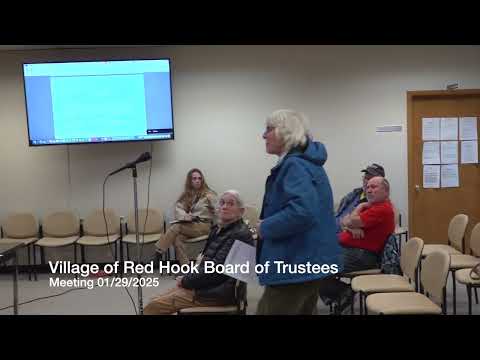
The law drew focused public comment from the town's Local Waterfront Advisory Committee, which urged the board to remove new commercial marina uses from waterfront zoning. "The boat club's been a great neighbor, but we felt the next step was too much," Paula Schumaker, chair of the Local Waterfront Advisory Committee, told the board, arguing that a commercial marina would be "a commercial use in a residential area" and pose ecological risks.
Board members and staff reviewed an environmental assessment and a Local Waterfront Revitalization Program (LWRP) consistency analysis prepared by the town consultant. The consultant said that zoning and lot-size rules already limit where a new marina could be built: the Hamlet (H) zoning district requires a minimum lot area of five acres for new marina uses, and the Low Density (LD) district requires 10 acres. The consultant noted that only one or two parcels along the river would meet those thresholds; one large property identified as Edgewater is roughly 11.6 acres and could be the only parcel the consultant found potentially compatible with a new marina.
Town staff and the consultant also reviewed pending changes to state freshwater-wetlands regulation. The board described a DEC transition period for projects that already have a DEC wetlands permit, a complete DEC permit application, a State Environmental Quality Review (SEQR) determination, or municipal site-plan approval; such projects would be able to proceed under an announced transition schedule that staff said runs through 2027. "There's a transition period that if you meet one of these three criteria ... there's a couple of years to get your project completed," a town official said, advising property owners to contact DEC to understand the new rules.
After hearing public comment and the consultant's presentation, the board voted to close the public hearing and not to make a final determination at the meeting. The board said it will reconvene discussion at its next meeting when the planning board submits its formal LWRP consistency recommendation; the board tentatively scheduled further consideration for Tuesday, Feb. 11.
Why this matters: The proposed local law would change the town's zoning framework for waterfront lands, affecting which commercial activities are permitted along the Hudson River and how local wetlands are treated in the permit process. The DEC's regulatory changes and the town's own minimum-lot-area rules together limit where new marinas could be established, according to staff analysis.
The board opened and later closed the public hearing by motion and voice vote. The board also directed staff to circulate attachments and the consultant's addendum on the LWRP on the town website for public review.
Looking ahead: The board said it will consider the planning board's consistency determination and any additional correspondence at its next meeting before taking a vote on Local Law D-3.