Get Full Government Meeting Transcripts, Videos, & Alerts Forever!
Get email alerts on the Land Use Subdivision topic
No spam. Unsubscribe anytime.
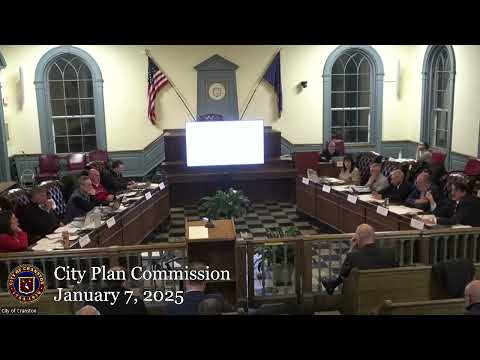
Plan commission approves 9 Clowwell subdivision after split vote, requires two single-family homes
Summary
The Cranston City Plan Commission approved a contested subdivision and zoning relief for 9 Clowwell, voting 4–3 to allow the project on condition that the property be developed as two single-family homes rather than a duplex; opponents cited state hardship law and comprehensive plan density.
The Cranston City Plan Commission on Wednesday approved subdivision and zoning relief for 9 Clowwell, authorizing the applicant to reconfigure the parcel into two separate lots on the condition that each lot be developed as a single-family home.
The request had drawn extended legal and policy debate at the meeting over whether the applicant had created the hardship that would justify dimensional relief. Commissioners voted 4–3 in favor of both the zoning relief and the subdivision approval.
The applicant’s attorney, Dylan Conley, argued the state’s unified development review process allows developers to seek subdivision and dimensional relief simultaneously and presented prior decisions he said had upheld that approach. Conley told the commission the neighborhood lot pattern supported splitting the parcel into two buildable lots and that the owner should not be penalized where municipal zoning changes had reduced previous development rights.
Chairman Steven Frias said the commission’s concerns centered on two distinct issues. Frias said, “The problem with the density issue is that you're above the comprehensive plan number,” and he stressed that the more difficult legal question involved whether the owner had “created his own hardship,” citing state case law that generally bars relief when applicants manufacture the conditions requiring a variance.
Several commissioners pressed Conley and staff about whether alternatives were feasible. Conley told the commission the applicant would accept a condition limiting the lots to single-family dwellings rather than a duplex—a concession some commissioners said resolved the density concern. Conley said the applicant would “request a continuance” if the board preferred additional briefing on the hardship issue but was otherwise prepared to accept the single-family condition.
After debate Commissioner Correa moved to approve the zoning relief conditioned on the two single-family dwellings; Commissioner Barberi seconded the motion. The motion carried on a roll-call voice vote; those recorded in favor were Vice President Rob Coop, Commissioner Barberi, Commissioner Zadellis and Commissioner Carrero; those opposed were Commissioner Lanphier, Commissioner Mancini and Chairman Steven Frias.
Commissioner Correa then moved to approve the related subdivision, Commissioner Dallas seconded, and the commission again voted 4–3 to approve the subdivision as presented. The chair confirmed both votes were necessary: a zoning determination and a separate subdivision approval.
The approval includes the condition agreed on at the meeting that the existing structure be converted to a single-family dwelling and that the new lot configurations be limited to two single-family homes. The commission recorded no additional conditions on timing or special reporting; the applicant was advised of appeal timelines and of the year-long restriction on refiling if an application is denied.
The vote follows a lengthy public and quasi-legal discussion among commissioners, staff and counsel about the consistency of the proposal with the comprehensive plan and the statutory requirement that hardship be more than a mere inconvenience. The applicant and staff were instructed to prepare the record and any required revised plan documents for ministerial sign-off and recording.
The commission’s action was the evening’s most contested land-use decision and was taken after direct bargaining between the applicant and commission members over a workable mitigation (single-family condition) that addressed density concerns while allowing redevelopment of the parcel.