Get Full Government Meeting Transcripts, Videos, & Alerts Forever!
Get email alerts on the Ethics Conflicts topic
No spam. Unsubscribe anytime.
Office of State Ethics seeks to expand conflicts rules to cover public officials’ non‑state employers
Summary
The Office of State Ethics told the committee that proposed changes in SB 1430 would apply conflict‑of‑interest rules to benefits that accrue to a public official’s non‑state employer or a spouse’s non‑state employer, closing a gap that currently allows some officials to take actions that directly benefit employers outside state service.
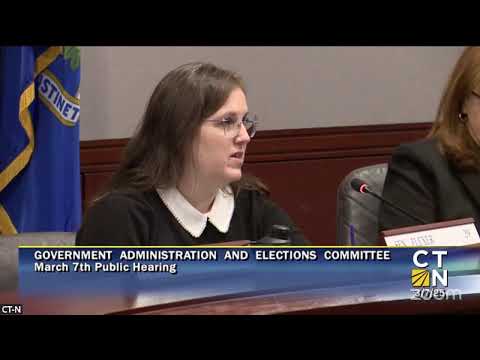
Peter Lewandowski, Executive Director of the Office of State Ethics, testified in favor of Senate Bill 1430, which would revise Connecticut’s code of ethics to extend certain conflict‑of‑interest provisions when a public official’s outside employer — or a non‑state employer of an official’s spouse — stands to receive a direct or substantial financial benefit from official action.
Lewandowski said the proposal would close an existing loophole that allows public officials and some employees to take official action that provides a direct financial benefit to their private‑sector employers. The draft would affect Conn. Gen. Stat. §§1‑85 and 1‑86 (substantial direct conflicts and potential conflicts), he said, and is narrowly drawn to accommodate Connecticut’s part‑time legislature by distinguishing full‑time officials and employees from part‑time elected members. An official need only have actual knowledge that a bill or action confers a benefit distinct from that accruing to others in the same industry for the conflict to arise.
Lewandowski said even when a conflict exists the statute permits the official to abstain or to file a written disclosure explaining the nature of the conflict and why the official may nonetheless act in the public interest, increasing transparency.
Committee members asked whether the change would often affect members of the General Assembly; Lewandowski said it would rarely do so, typically only when the action benefits a member’s individual employer rather than an entire industry.
Ending: The Office of State Ethics asked the committee to advance SB 1430 to close the statutory gap and increase transparency around outside employment and conflicts.