Get Full Government Meeting Transcripts, Videos, & Alerts Forever!
Get email alerts on the Zoning Ordinance Implementation Hb443 topic
No spam. Unsubscribe anytime.
Planning commission reviews House Bill 443-driven zoning changes; commission debate centers on development-plan process and public input
Summary
Staff outlined proposed zoning text changes to implement Kentucky House Bill 443, including objective standards (Article 16) and revised development-plan procedures (Article 21). Commissioners and staff debated waivers, community notice, technical-review roles, and potential unintended consequences for neighbor input.
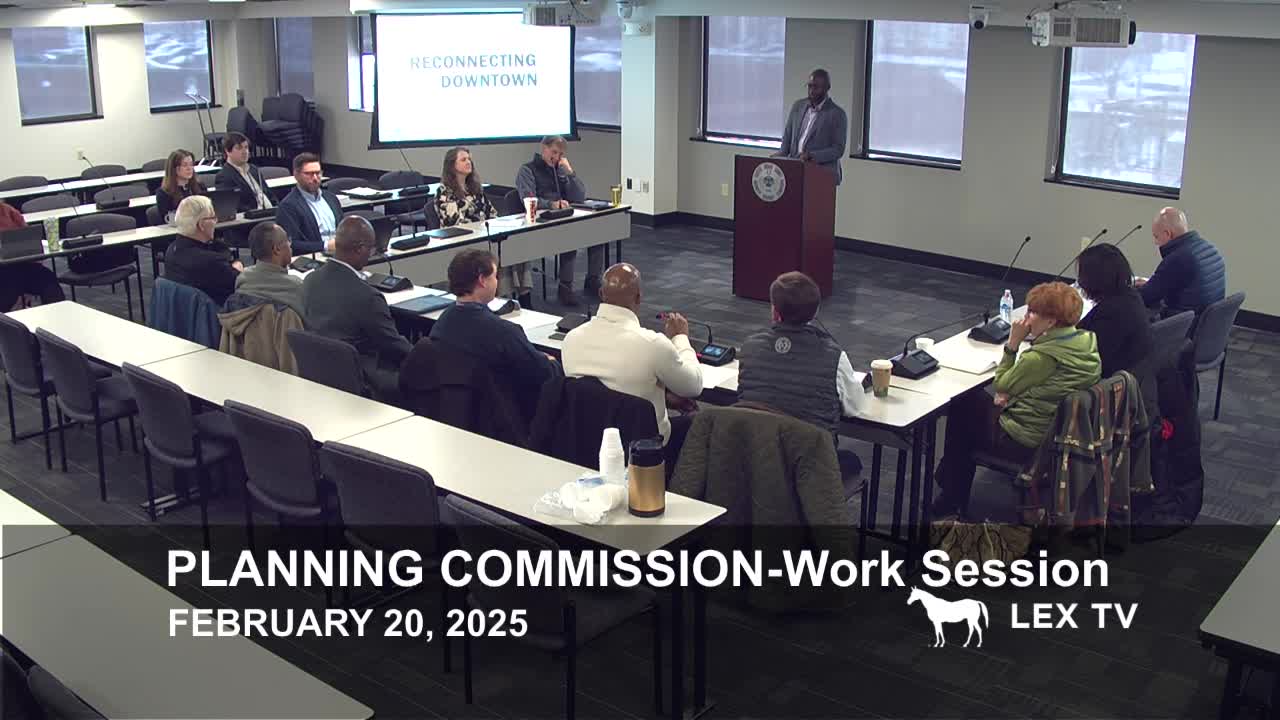
Tracy Wade, planning staff, briefed the Lexington-Fayette Urban County Planning Commission on Feb. 20 about a package of zoning text amendments intended to implement Kentucky House Bill 443 and to formalize review procedures for development plans.
"House Bill 443 went into effect this July," Wade said, summarizing why the update is required and noting the text touches roughly a third of the zoning ordinance. She told the commission the package seeks to replace discretionary criteria with objective standards, update filing processes, and add standards requested by signature divisions such as traffic engineering, bike and pedestrian, and environmental services.
Major substantive changes presented: staff highlighted proposed Article 16 revisions covering vehicular-use areas (parking, bike parking and storage, drive-thru stacking, raised pedestrian crossings when building-to-parking distances exceed 24 feet, and access-point width limits). Wade said the text establishes numeric stacking distances (using a per-vehicle allowance of 22 feet) and clarifies screening and spacing requirements for drive-up windows and drive-thrus.
Article 21 revisions would tighten and codify development-plan procedures: staff proposed more detailed submission contents, a required pre-application meeting for major development plans, a strengthened technical-review committee role to identify checklist compliance, and clearer criteria for when plans must go to the planning commission (for example, when a waiver is requested, when another ordinance requires commission review, or when a plan is filed with a zone change). Wade said the intent is to make standards and process predictable while preserving a path to request waivers.
Commission debate focused on public input and unintended consequences. Several commissioners warned that the changes could reduce opportunities for neighbors to be heard on final development plans that meet objective standards, moving some decisions to staff or the technical committee rather than a public commission hearing. Commissioners asked whether affected neighborhood groups or boards (for example, Paris Pike Corridor Commission, Rural Land Management Board, and floodplain review bodies) would retain standing and at which stage their reviews would occur. Wade and commissioners discussed options to maintain coordination so applicants do not incur unnecessary cost or delay by sequencing reviews poorly.
Waivers and notice: Staff proposed a new waiver process where applicants can ask the planning commission for relief from objective standards; waivers would carry a fee and require notice to adjoining property owners and a public hearing. Wade said the waiver language is intended to allow flexibility where an applicant can "incorporate other design measures that exceed minimums or compensate for noncompliance." Commissioners asked for clearer criteria to determine when an amendment to an approved development plan should trigger commission review rather than technical approval.
Timing and outreach: Wade said the text amendment paperwork would be mailed to neighborhood associations the week of Feb. 20; the zoning committee review would follow in March and a public hearing before the planning commission was scheduled for March 27. She also described meetings already scheduled with developers' groups and trade associations.
What was not decided: The commission did not adopt final language or vote on the amendments at the Feb. 20 meeting. Commissioners requested additional clarifications—particularly on when technical-review referrals should move to commission review, how to preserve meaningful public engagement, and whether limits should be placed on repeated postponements—and staff said they would return with revised language and definitions.
Ending: Staff emphasized the need to comply with state law while keeping public engagement where legally required. The commission and staff agreed to monitor early implementation and revisit the text if unintended consequences appear.